I never had a sister. I suppose if I did, I'd have wanted her to be a bubbly fun-loving neat-appearing soul much like Progressive Insurance's fictional sales girl named Flo, who offers insurance coverage by the box. For a number of years in the 1960s, I handled a lot of Progressive auto claims. Back then, we still reported to their headquarters in Cleveland, Ohio—my hometown—and the company's first building on Euclid had been on my route to classes when commuting to both high school and college. I don't pay much attention to those television ads, but I remember a few where Flo talked about how something called a "snapshot" would cut auto insurance costs.
From the little I was able to infer from the ads, it seems that Progressive will reduce costs by using a little "tattle-tale" device that informs the company of your driving habits—whether you have been naughty or nice while behind the wheel. But it is optional, and that being the case, apparently many policyholders have declined the offer to "fess up" to bad habits in order to save a few bucks.
Is There An "Off" Switch?
Well, this is nothing new. I reported in this column years ago that there was a black box—also known as an event data recorder (EDR)—in new cars that recorded things like speed or brake application for a period of a few seconds at a time. EDRs began showing up in cars in 1990 when General Motors introduced them for quality control purposes. The information gathered by the devices has since assisted crash scene investigators in determining the cause of a given accident and, by extension, insurers in accurately assessing liability. The New York Times reports that 96 percent of cars now carry some sort of black box under the dashboard. Moreover, the National Highway Traffic Administration (NHTA) has requested the technology should be standard in all vehicles sold in the United States by September 2014, according to Khaliah Barnes of the Electronic Privacy Information Center.
In response to the lingering question— "how private is the data stored on these recorders?"—Barnes says 14 states have passed laws allowing law enforcement officials and those involved in civil litigation to gain access to the black boxes "only with a court order." However, that same New York Times article includes a warning that, "without protections, it can lead to all kinds of abuse." Exactly how many kinds of abuse are there? Apparently more than we suspect.
Red Light Cameras
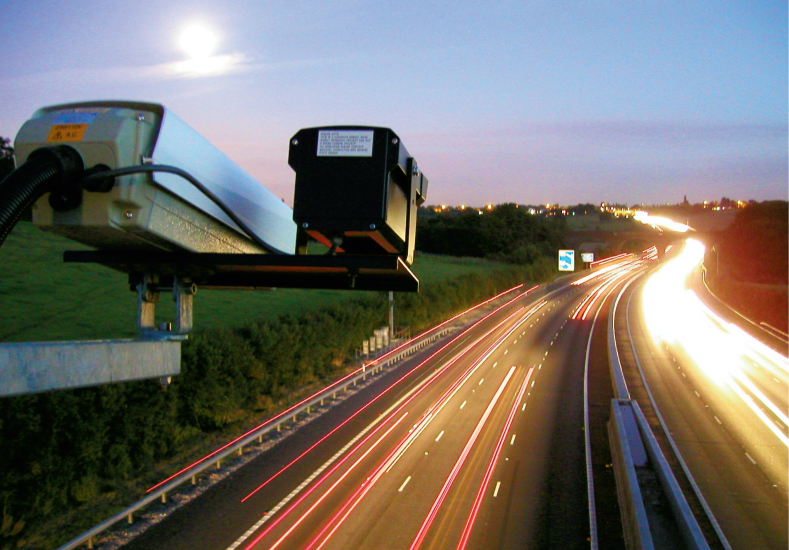
Many cities, tired of the multitude of accidents resulting from people running red lights, installed cameras that capture pictures of the license plates of cars speeding through intersections. In some places it caused such a hullabaloo that the city took them down, even though they were actually reducing the number of light-runners and thus the number of serious accidents. Hardly a day goes by that I don't observe someone coming up from behind my car to zoom through a traffic light after it has already turned red. Generally they're sitting at the next intersection as I arrive, not having gained one little bit in the effort to "beat the light." (It was the same with those who tried to "beat the train," only the loser there got a funeral rather than a ticket.)
London apparently has the U.S. beat in the number of video cameras scanning the scene. They, of course, are looking for terrorists, but those same cameras also show traffic violators. There's also a new police camera system that automatically scans the license plates of approaching or passing autos, searches its data bank, and alerts the cop to any stolen car or other vehicle that is being sought. Forwards and backwards radar has been available for years, so this is just an enhancement. But there is no doubt that as the number of video cameras mounted on buildings and at intersections increase, traffic offenders and the accidents they cause will be recorded, and it will no longer matter what tale they spin to their insurance adjuster, the video will tell the truth.
Robotics and the Workforce
In a recent CBS 60 Minutes interview two professors of robotics were discussing the future and showing to the audience all the wonderful things robots are doing in U.S. factories. The cost to build and run a computer, which doesn't need a lunch break, vacation or sick leave, or the health insurance to pay for being sick, is about $3.20 an hour. That makes a robot cheaper than Asian labor, and that means that American manufacturers are bringing the jobs back to the U.S., but not to U.S. workers. Robotics are employed in warehouses, kitchens, hospitals, even the surgery wards, and especially in the factories that manufacture robots. The newer models are sophisticated and programmable, doing one job one day, and a different job the next. It was at that point 60 Minutes asked, "What about employees?"
Yes, what about the human workers among us? Where does he or she stand when a robot takes over his or her job? I imagine exactly where a lot of Americans have been standing for the past 10 years—in the unemployment line, looking for work that no longer exists. Oh, but production is up, and corporations are making a fortune. No robotic unions, strikes, high insurance costs, workers' compensation premiums, or unemployment insurance taxes to pay. Robots don't retire; they get recycled for their parts. There is no social security or pension available for robots.
One year for Christmas, I bought my wife a Robo sweeper. I think its rechargeable battery died because it won't hold a charge any more. It did a pretty good job of sweeping the carpet. There was an electronic eye to keep it from falling down the stairs—otherwise it went from room to room, back and forth for hours, all by itself. Occasionally it would get stuck under the stereo, but otherwise it could reach spots under the bed that couldn't be reached with a hand-held vacuum cleaner. Push its on button, and it would go "bing-bong" and take off in a circle, a little wider each time until it bumped into something and changed directions until it had covered the entire room.
The Robotic Adjuster
Back in February, 1981, my Iconoclast column in Insurance Adjuster (the predecessor of Claims) was entitled "The 21st Century Adjuster." (32 years? Good gosh, was it that long ago?) Anyway, the column described "I. M. Fair, CPU," a mainframe computer that did it all. Everything was computerized, including the taking of statements, verification of coverages, a robotic machine that assessed damages to the auto, and a payment system that transferred the settlement from the insurer directly to the bank of the repair shop. Court disputes were handled by computer—after all, every type of dispute had already been resolved somewhere, so the data bank knew how the case would resolve—and negotiations were also by computer.
Some of it came true. There was a computerized negotiation system about a decade ago. Apparently it didn't work well, as we don't hear about it anymore. Adjusters are still taking recorded statements and negotiating directly with insureds, claimants and their attorneys, but coverage is now pretty much a matter of computerized verification. Who bothers to read the policy? Adjusters still inspect the damage and issue settlement checks, but many of the big bulky mainframe computers are now just desktops or laptops. Lawsuits are still heard by juries, and one of the 1981 predictions, that by the 21st century modern medicine would have eliminated pain and suffering, unfortunately did not happen. Aches and agony are still general damages in an injury claim.
There are still jobs for claims adjusters, but, as Best's Reports showed in June, the numbers of adjusters continues to dwindle, down .097%, though the number of claim administrators (whatever that means) had increased by 4.19% from the previous year. It's hard to conceive of a robotic adjuster, and I hope to never have to deal with one.
What are my predictions for the next 30 years? Will there still be an adjusting vocation? There will still be an insurance industry—that has been around for millenniums. It will be fairly similar to what is true of the industry today: it will be international. There will still be liability claims and property claims. It's hard to guess what will happen with health insurance—probably the government will be involved somehow or another, much more so than under the Affordable Care Act—and there will be as many geriatric specialists as there are obstetricians today. Undertaking will be a very lucrative profession. Instead of playing "cops and robbers," your kids will be preparing to be funeral directors. (Undoubtedly none of you will remember "Digger O'Dell, the friendly undertaker" from the radio show The Life of Riley: "I've got to be shoveling off!")
Safety devices on autos will make accidents less frequent. Today the car beeps if something is behind it while one is in reverse. In less than 10 years, such devices will become even more sophisticated, ultimately preventing even more accidents. Perhaps texting as a bad habit will have gone the direction of the CB radio and the 78-speed record. There are already cars where phones connect to the audio system wirelessly, thereby reducing distractions. The self-driving vehicle will not yet be perfected, but it will be on its way.
As to claims adjusting, the need for catastrophe adjusters will remain, and that will become a full-time occupation. With a big flood here and a forest fire there, here a drought, there a windstorm, everywhere a cat claim, adjusters will be kept busy. Claim offices will be mobile, maybe even operating over railroads like the old circus trains: just roll into a disaster zone and open the cars. Settlement checks will disappear. The money will be put into the proper account by direct deposit; bank tellers will have disappeared.
But Barry Zalma will still be busy warning us about claims fraud. With robots taking all the jobs, the unemployed will have little to do but sit around and dream up ways to defraud somebody, and insurers will be likely targets. There may be fewer "who ran the red light" or "what is my pain worth" type lawsuits, but coverage language will be much more complex, and there will be an increasing number of declaratory relief actions. As law schools pump out an increasing number of lawyers each semester, many will become adjusters, so count on a more litigious future.
Well, I'll be gone by then, thank goodness. So if you are just starting in this wonderful field of claims adjusting, you will see as many changes as there have been in the last 30 years. You will be among those making the changes, so make good ones.

Red Hot Controversy
Just as Chicago geared up to start issuing tickets up to $100 for drivers caught by the first of Mayor Rahm Emanuel's automated speed cameras, his office announced on Oct. 1 that the controversial red light cameras will be removed from 18 intersections. The city said it will take down 36 red light cameras from those intersections by Jan. 31, 2014. The reason is because in 2012 they had either no right-angle crashes or one "T-bone" crash, with a total crash rate of less than 1 percent. The "total crash rate" is calculated from Illinois State Transportation Department data by dividing the total number of crashes in a year by the average daily traffic counts at the intersection, according to a news release from Emanuel's office.
 The Need for Speed
Speed and red light cameras are a type of automated enforcement technology used to detect and deter speeders and red light runners. Some jurisdictions use similar technology for other traffic violations, such as illegal rail crossings or toll violations. Many states have enacted legislation either permitting, limiting or prohibiting the use of speed or red light cameras at the state or local level. Enforcement can be limited to a particular area or community. Penalties usually are more lenient than those used with traditional enforcement. For example, the fine may be lower, points may not be assessed, or the citation may not go on the driver's record.
Some localities operate speed and/or red light cameras even if the state does not specific permit or prohibit it. The Insurance Institute of Highway Safety (IIHS) maintains a list of all communities operating automated enforcement.
Speed Cameras
12 states have passed laws that prohibit (with narrow exceptions) the use of speed cameras. 29 states have no law addressing speed cameras. All other states either permit the use of speed cameras (two plus the District of Columbia) or limit their use by location or other criteria (seven states and the U.S. Virgin Islands).
Red Light Cameras
21 states, the District of Columbia and the U.S. Virgin Islands have enacted laws permitting some form of red light camera use. 9 states prohibit their use, and 20 states have no state law concerning red light camera enforcement.
24 states, the District of Columbia and the U.S. Virgin Islands have red light cameras currently operating at least one location.
© Arc, All Rights Reserved. Request academic re-use from www.copyright.com. All other uses, submit a request to TMSalesOperations@arc-network.com. For more information visit Asset & Logo Licensing.