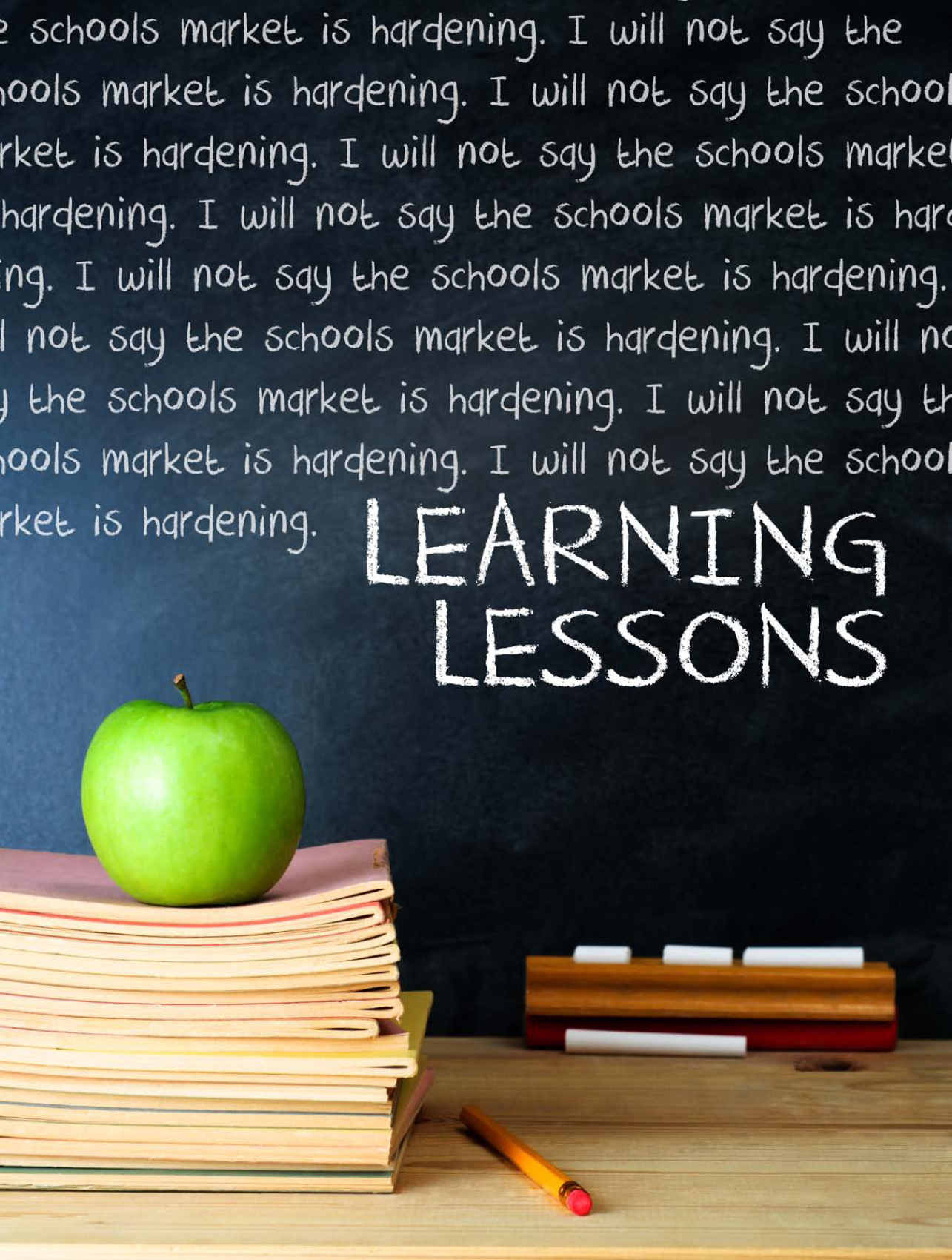
 Here's your first lesson: For the most part, the market for insurance cover for educational institutions is not wholly hardening. Rather, according to those who operate in it, the word that best describes the state of this market is "stabilizing."
"We've been hearing for some time that the school insurance market is hardening, but what we're really seeing is simply a stabilization after years of an unsustainably soft market," says Ric Valentino, director of the education practice at Baltimore-based agency RCM&D."We've seen 19 months of single-digit premium increases on average, but there are still carriers who will take the time to truly underwrite an account and be competitive."
Indeed, brokers and carriers report that the pricing environment is similar in both the public and private school sectors and across property and general liability coverage.
Rates have been ticking upward for public schools, particularly in property—but that increase is keeping up with neither the loss costs nor the increased exposures faced by schools today, says Robin Leal, underwriting director in Travelers' public services division.
"None of the emerging risk faced by the private sector has slowed things down at all," adds Deb Denker, industry manager in the education sector at Travelers.
Capacity remains strong in property and GL. Reid Sandner, executive vice president at Willis of Pennsylvania, reports no problems with finding cover for school clients, with up to $700 million in blanket property values. However, the situation is different in educators professional liability.
"The trends we're seeing with claims around failure to educate or improperly developing an IEP [individualized education plan] is really pushing some carriers to take a harder look at educators liability. We've had some significant hardening in deductibles, pricing, and capacity" in that coverage area, Sandner says. Over the past year, Willis has seen anywhere from 50 to 100 percent increases in pricing on that professional line, along with deductibles jumping from the $10,000-$15,000 range to $25,000 or even $50,000.
Buying a Bundle
Cash-strapped schools are looking for bundled coverages, along with the ability of brokers and carriers to provide access to specialized coverage for faculty, staff and students, such as accident and sickness, travel insurance and cover for clubs and sports programs.
"While insureds are still looking for competitive pricing, there is a definite interest in additional or broader coverages along with access to specialized risk management," says Kendra Bostick, school program leader at THOMCO, a division of Markel Service Inc.
RCM&D has had success in the school market— increasing its book from 15 to 70 education clients over the past nine years—by putting together a specialty program that aims to provide private schools the market advantage of larger institutions.
"We took a different approach to how we manage and transfer risk," Valentino says. Some institutions have created captive insurance groups, he explains, but trying to create a captive for anything but a mega-university is not feasible. "Therefore, we put together programs where schools can still retain their individuality in terms of the insurance policy structure, but where we go to the market as a group for leverage."
The program produces a savings of 10-15 percent across property and liability, according to Valentino, but he says the biggest benefit is in the area of risk management. "By working together as a group we can identify what works best across different institutions for controlling loss and create best practices, and develop additional services around those," he says.
One such development was creating a smartphone app designed for schools with international travel exposure. The app provides users 24/7 tap-to-call emergency assistance, pre-trip information, travel alerts and embassy-locator functions. "When students travel, it's important that they and their families can access information about the destination beforehand and that students can gain access to medical and other services when they are in foreign countries," Valentino says.
Choice, Competition Drive School Innovation
 At the same time that all schools are keeping an eye on the expense side of risk management, private schools are working to increase the revenue side of the business. "They are competing for students—developing lots of unique offerings in terms of extracurricular activities, online education and so on," says Melissa Zaparanick, education practice lead for The Hartford.
Circus camps, scuba training, whitewater rafting trips—all are exposures that have crossed the desks of Hartford underwriters in recent months. "Schools are trying to differentiate themselves to students, even at the youngest level, and we're looking at those needs from a coverage and risk management perspective," says Zaparanick. "We're also seeing a rise in online learning, which corresponds to increases in coverage for electronic equipment both within and outside the classroom."
While both brick-and-mortar public and private schools are using technology to enhance the learning environment, the number of online educational opportunities continues to grow. At the college level, more than 6.7 million students take at least one online course, according to the Sloan Consortium's most recent Survey of Online Learning. At the K-12 levels, the number of e-schools has also increased. While national figures are difficult to come by, many states report significant growth: Ohio has reported a 12-fold increase since 2000; Florida saw a 25,000-student increase in one year, and Wisconsin's virtual schools report anywhere from a 15-30 percent increase in enrollment.
Because virtual schools are still a relatively new phenomenon, coverage in the standard market can be difficult to come by. The Hartford will write schools with online exposures, but is still in the early stages of researching whether and how to insure completely virtual schools. Philadelphia Insurance Cos., for example, will not underwrite them.
"From our perspective, the potential for educators legal liability increases with a fully online school," says Robert Groff, assistant vice president/product manager at Philadelphia Insurance Cos. "And, the jury is still out as to how effective online schools are compared to a regular public or private school."
"Most [virtual schools] would be relatively new with little track record," says Sandner at Willis, adding that not many carriers are in a hurry to underwrite these ventures.
Brokers and carriers also report seeing a rise in partnerships and outsourcing of services, particularly at public schools, which has impacted the coverages being sought. These include everything from transportation to janitorial and food services.
"Because of decreases in funding, public schools are reaching out for any resources they can access to maintain the services they offer," says Leal. "We are fielding more requests to add additional insured endorsements for the entities they partner with."
 Risk Management Front-and-Center
Cost-conscious institutions are also looking to brokers and carriers to help them shape risk-management and loss-prevention plans.
"Schools are becoming more aware of fleet safety, not just for bussing at the grade school levels, but at the college level when there are students and employees using both school and personal vehicles to go to events," says Valentino at RCM&D.
"The problem is that private colleges and universities, for the most part, don't have a dedicated risk manager," he notes. "That role falls to the controller, business officer, human resources staff or someone else at the institution. Our clients are looking to us for solutions."
And those solutions had better be practical. "If we go to a school with a 100-page manual, all we will do is scare them," Valentino says. "Everything we provide to educate staff from boards of trustees to individual faculty members needs to be realistic and balanced."
Finally, in the wake of Penn State, Sandy Hook and other shocking headline events centering around children being shot, schools are all feeling the pressure to create safe environments with risk-mitigation solutions in place to counter any potential threat.
"All schools are at a place right now where they are assessing their risk management policy in terms of every area of security," adds Zaparanick. "We're at a place where everyone is taking a pause and figuring out what to do next."
© Arc, All Rights Reserved. Request academic re-use from www.copyright.com. All other uses, submit a request to TMSalesOperations@arc-network.com. For more information visit Asset & Logo Licensing.