A report by the Special Inspector General for the Troubled Asset Relief Program (SIGTARP) sharply criticized the Treasury Department for "failing to rein excessive pay" for top executives of companies that received government bailouts through the Troubled Asset Relief Program.
 "SIGTARP found that once again, in 2012, Treasury failed to rein in excessive pay," the report says.
Christy Romero, special inspector general for TARP, says in the report, "We expect Treasury to look out for taxpayers who funded the bailout of these companies by holding the line on excessive pay."
Romero adds, "Treasury cannot look out for taxpayers' interests if it continues to rely to a great extent on the pay proposed by companies that have historically pushed back on pay limits."
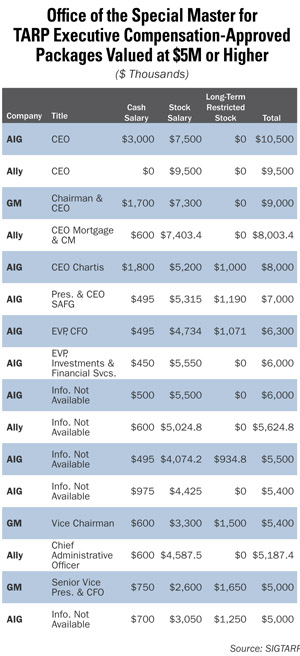
According to the report, American International Group president and CEO Robert Benmosche earned $10.5 million in total compensation in 2012—$3 million of it in cash.
Peter C. Hancock, the CEO of Chartis (back to using the AIG brand as of November 2012), earned $8 million in 2012. The report says the Treasury Department, which had veto power over AIG salaries, approved a $1 million salary hike for Hancock.
The report, however, indicates that most of the salaries of AIG top executives in 2012 were in stock, with $7.5 million of Benmosche's compensation provided in that manner. Hancock, according to the report, was paid $1.8 million in cash, $5.2 million in stock and $1 million in long-term restricted stock.
Additionally, the report notes that AIG exited the TARP program last year, and responsibility for keeping track of executive-pay policies has shifted to the Federal Reserve Board.
According to the report, the Office of the Special Master for TARP approved pay packages of $3 million or more for 54 percent of the 69 Top 25 employees at AIG, General Motors and Ally Financial Inc.
The report was especially critical of Patricia Geoghegan, Treasury's acting special master for compensation. The report accuses her of sidestepping protocol that kept pay packages at the midpoint of comparable firms.
Geoghegan, however, defended herself in the strongest terms. For example, she said, AIG's average total compensation for its top 25 employees was at the 48th percentile of similar positions at similar companies.
She also said that the report "mischaracterizes" the information her office, known as "OSM," provided SIGTARP. She said the report criticizes OSM for having "no criteria" for allowing pay packages without any long-term restricted stock, calling this "misleading."
She also noted that AIG is the "most recent exceptional assistance recipient to repay its investments. Treasury sold all of its remaining stake in AIG last November. "Not only did it exit TARP," Geoghegan said, "but it also repaid the Federal Reserve Bank of New York," noting that Treasury and the FedNY had made a $22 billion profit on the deal.
In response to the report, Jim Ankner, an AIG spokesman, says that the company has "dramatically revamped its compensation practices to ensure that all employees are held directly accountable for "clearly defined goals that reflect our commitment to properly balancing growth, profit, and risk."
He says that when AIG was subject to TARP restrictions, the company worked closely with the Special Master "to make sure we paid our employees market-based compensation, including appropriate amounts of incentive pay, under a rigorous review process that will continue into the future.
"This principle to pay market-based rates for well-defined performance is shared across the entire company and is continually reviewed by our board," Ankner says.
He adds, "AIG is evaluating certain pay structures to ensure the appropriate allocation of incentive compensation as a portion of total pay to employees that reflects our absolute commitment to pay for performance in a post-TARP environment."
© Arc, All Rights Reserved. Request academic re-use from www.copyright.com. All other uses, submit a request to TMSalesOperations@arc-network.com. For more information visit Asset & Logo Licensing.