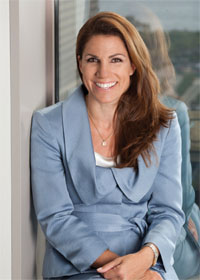
 As CEO of XL Group's North American P&C Insurance operations, Seraina Maag directs seven lines of business in America, Bermuda and Canada and has also assumed responsibility for global Excess Casualty and Surety. A mother of three and former master of voltige (gymnastics on horseback), Maag was elected a Young Global Leader by the World Economic Forum (WEF) in 2009 and has been honored by several publications as a woman to watch in business.
Here, Maag discusses her work with XL, her Global Leadership Award from the WEF, and how the insurance industry must rise to meet the changing demands of the world and attract a younger workforce.
How does XL approach the E&S market, and what's going on right now with pricing and terms and conditions?
We consider E&S as new [at XL] because the market has shifted focus from just General Liability to containing Excess Auto, Railroad and Excess Casualty. When you have a soft market, all the business starts flowing into the standard market. Then when the standard market starts shedding business due to losses, it starts coming back to E&S. Particularly in General Liability, we're really starting to see business moving back. It's not a definite hard market, but we are seeing signs of hardening.
How does Surety underwriting differ from other types of P&C underwriting?
Surety is much more like a banking product. In the P&C world, you underwrite a product expecting a loss. However, in the Surety world you look at a contractor's financials, what they are building and who is running the construction. It's much like going to a bank to take out a loan: Surety underwriters assess your financial strengths and the integrity of your work record. In Surety, your mindset is to write to a zero loss ratio.
Surety teams also mostly employ legal and financial analysts who better understand the work of a contractor, whereas in the P&C world you see people from many diverse backgrounds.
How does your work with the World Economic Forum inform your broader view of insurance?
It has been a great journey—and I've been exposed to things [XL] wouldn't have pursued otherwise, like micro-insurance. Being exposed to people of different backgrounds and ways of thinking, and the relationships you build with them, help you see how insurance works in a global context. Zurich, Marsh and Swiss Re are other insurance companies partnered with the WEF as well. Insurance touches every aspect of human endeavor, from the most complex to the fundamental.
In September at the Spencer Educational Foundation Awards gala in New York, you said that the insurance industry needs to attract talent in new ways—in the ways Apple and Google do. How can the insurance industry benefit from a younger perspective and avoid the "brain drain"?
This industry usually attracts talent by accident, while the companies you mentioned are very talent-focused. We need to think about being more innovative in attracting and retaining the interest of talent—but with the past few years of cost-cutting, training and investments in people have suffered. We also need to think about how we embrace technology, because we're dinosaurs in that regard. The kids graduating today are very tech-savvy. They are used to collaborating in teams, but the industry doesn't do a lot of that.
At XL we try to have many roundtables and group discussions. While there is a lot of benefit to that, including extra training and bringing consistency to the business' departments, the benefit is mainly to the young people. Hierarchy and bureaucracy don't work for them anymore—and we could start by showing them our own interesting and diverse backgrounds.
—Interviewed By Anya Khalamayzer
© Arc, All Rights Reserved. Request academic re-use from www.copyright.com. All other uses, submit a request to TMSalesOperations@arc-network.com. For more information visit Asset & Logo Licensing.