By A.V. Riswadkar, liability line of business director, Zurich Services Corporation
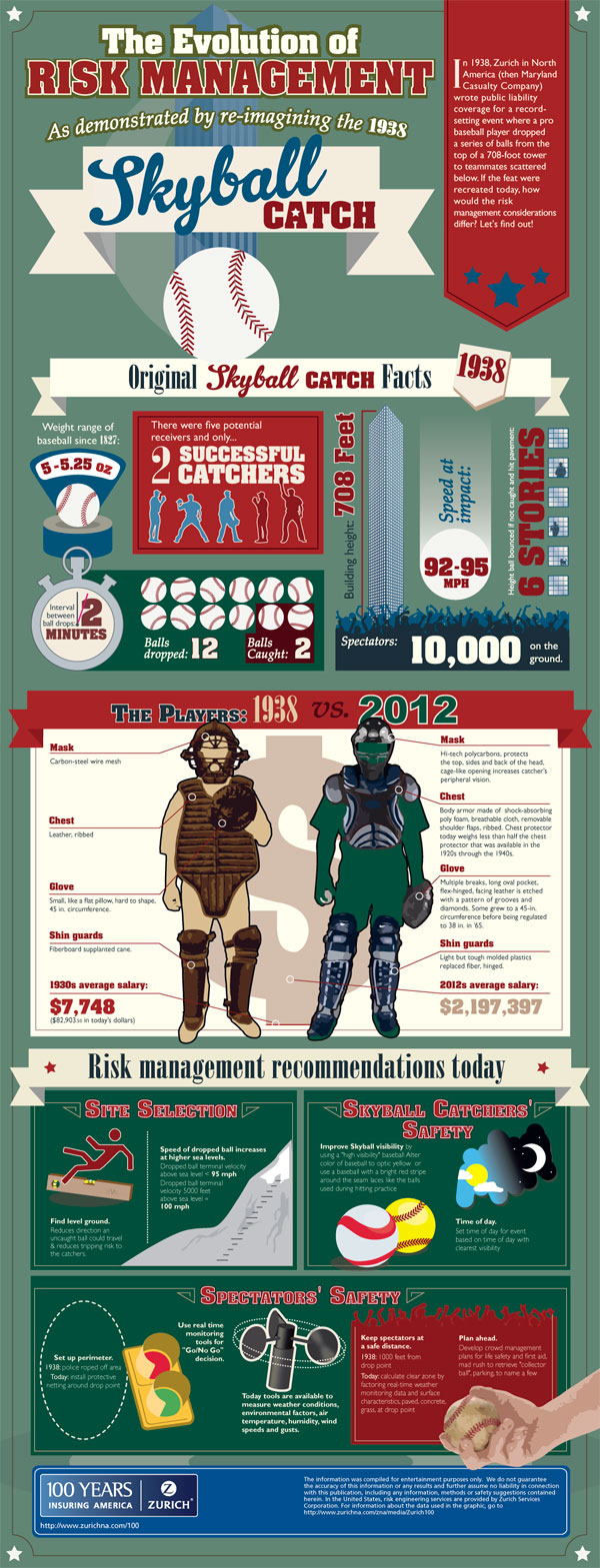
In 1938, Zurich North America (then Maryland Casualty Co.) wrote public liability coverage for a record-setting event where a professional baseball player dropped a series of balls from the top of a 708-foot tower to teammates scattered below.
In the intervening years, risk management—like baseball itself—has evolved into a much more sophisticated game.
Today's organizations face a very different risk landscape that ranges from more defined first-party property losses and business interruption to less transparent liability from law suits and brand reputation damage. If such an event were organized today, many more risk factors would be considered in assessing the risk and in planning for it.
Risk assessment has evolved into a systematic process. For example, Zurich's proprietary Zurich Hazard Analysis (ZHA) is a team-based, systematic methodology helping identify hazard scenarios with their respective severity and likelihood to determine and graphically display the level of risk. This risk profile helps organizations prioritize their risk management actions and strategy to minimize risk transfer and plan for the remaining acceptable level of risk.
For an organization, the risk of first-party property damage and business interruption losses is likely to be low, but the risk of liability from litigation and reputation loss from any adverse development at an event may be very significant. Planning for the event should consider various actions before, during and after.
See next page for an infographic on the 1938 Skyball event.
Pre-event risk planning should consider various aspects of site selection and preparation, such as the type of ground surface, its rebound characteristics for a baseball not caught by a catcher, potential tripping hazards for the catcher on the ground, and clearance zone for spectator safety. Traffic flow, contracts and permits may also have to be considered.
At the time of the event, real-time weather conditions monitoring for wind speeds, precipitation, overcast conditions and temperature will be important for the safety aspect of go/no go decision for the event.
The visibility and ability to track the ball during its descent path will help increase the chance of a successful catch with “high visibility” balls such as optic yellow or baseballs with a bright red stripe around the seam laces—similar to what is used during batting practice. Appropriate protective gear for the catcher also will be important.
Often neglected, but the one of the most important aspect of an effective risk management strategy, is the crisis management and communication planning in an unlikely event of any unexpected developments.
Much like the evolution of professional baseball players from part-time athletes to multi-millionaire icons, risk management has evolved into a much more sophisticated, systematic process over the last century. This lens on the vast risk landscape may be the primary reason why we don't see Major League Baseball players lining up to recreate the “Skyball” catch of 1938 each year. We'll simply have to marvel at the feat from a wiser perch decades removed.
© Arc, All Rights Reserved. Request academic re-use from www.copyright.com. All other uses, submit a request to TMSalesOperations@arc-network.com. For more information visit Asset & Logo Licensing.