 Legislation imposing sweeping reforms on California's Workers' Compensation system was passed by the state legislature Aug. 31 and sent to Gov. Jerry Brown for his signature.
The bill, S.B. 863, aims to reduce costs within California's Workers' Comp system by attacking cost-drivers in order to finance an increase in payments to those on the WC permanent disability rolls.
The new bill seeks to increase benefits to workers, especially those on long-term disability, by 30 percent. It pays for this by imposing certain reforms, including changing how benefits are calculated for injured workers and creating a binding arbitration process to resolve coverage disputes.
Supporters have said the bill could reduce rates by as much as 7 percent by slowing the upward climb of medical and legal costs in the $16 billion system.
But officials of the American Insurance Association and the Association of California Insurance Companies have voiced concern with the legislation, saying it would increase benefit payments to those on permanent disability immediately—while relying on cost-cutting that a new analysis says might not be realized.
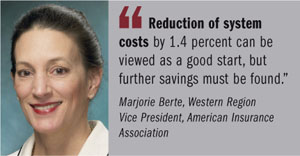
Marjorie Berte, western region vice president for the American Insurance Association, says that while the bill contains beneficial reform components that address many well-documented cost-drivers, "its projected savings are minimal."
Nicole Mahrt Ganley, a spokesperson for the Association of California Insurance Companies, also questions whether the cost savings mandated by the bill will "yield much savings."
Berte says that the Workers' Compensation Insurance Rating Bureau of California (WCIRB) has projected the bill will provide $880 million in savings but will add $610 million in 2014 benefit increases. The estimated savings of $270 million on 2014 injuries represents a decrease of just 1.4 percent in total system costs, she notes.
A late compromise in the bill requires the WCIRB, which advises the state on Workers' Comp fund costs, to rethink a 12.6 percent advisory pure premium rate increase it proposed to be effective in January 2013.
"Reduction of system costs by 1.4 percent can be seen as a good start, but further savings must be found," Berte says. "It will take the full implementation of SB 863 in 2014 before we can determine whether or not any cost savings are actually realized."
© Arc, All Rights Reserved. Request academic re-use from www.copyright.com. All other uses, submit a request to TMSalesOperations@arc-network.com. For more information visit Asset & Logo Licensing.