 Considering the record catastrophe losses experienced in 2011, one logical consequence to expect is a hardening reinsurance market, with prices rising and capacity becoming squeezed.
But that's not what's happening.
Consider the numbers: A Guy Carpenter briefing from last month on reinsurance notes that despite 2011's losses, the reinsurance sector ended the year with a dedicated capital position that was slightly up, at around $178 billion.
"It's pretty astonishing that the market overall basically was able to end the year with the same amount of capital that it started [with] and that overall earnings really weren't worse than [what was] reported," A.M. Best Co. Vice President Robert DeRose commented during a recent webinar.
In fact, ample capacity is the overriding theme in the reinsurance sector right now. And benign losses thus far in 2012 are "likely to contain any attempt at price increases throughout the year," according to the Guy Carpenter report.
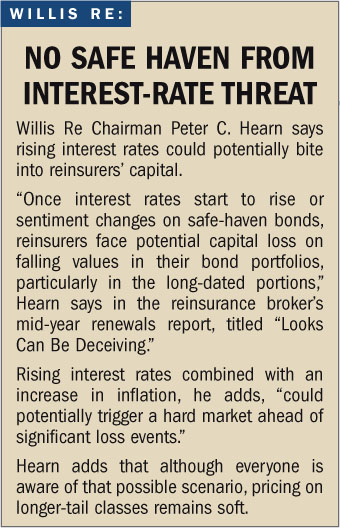
"The reinsurance market is stable and orderly…It is not hardening," Peter Hearn, chairman of reinsurance broker Willis Re, says in his firm's mid-year renewals report, appropriately titled "Looks Can Be Deceiving."
According to a June report by Standard & Poor's (S&P), losses in 2011 amounted to an earnings event, rather than a capital event—and reinsurers' enterprise-risk-management capabilities have provided the foundation for the sector's current strong footing. "Careful risk selection has enabled reinsurers to manage the soft cycle well and to contain the record catastrophe losses seen in unmodeled areas in 2011."
TOP FIRMS HAVE QUALITY FIRST QUARTER
Thanks to a decrease in catastrophe losses so far in 2012, a majority of reinsurers on NU's list of the Top 25 U.S. Reinsurers reported improvements in first-quarter earnings.
 Five reinsurers in the Top 10 returned to the black during Q1 2012, compared to net-income losses during the first three months of 2011 (see chart, page 16).
Additionally, National Indemnity's first-quarter net income shot up to $1.07 billion from $223.4 million the prior year, and Odyssey Reinsurance Co. reduced its first-quarter losses by $250 million, though it remained in the red.
A group of 19 U.S. reinsurers that comprise the Reinsurance Association of America reported a net loss of $100.6 million in 2011's first quarter but posted a combined net income of $1.5 billion for the first three months of this year. The group's combined ratio improved substantially year-over-year from 129.3 in the first three months of 2011 to 95.6 in the same period in 2012.
RISE OF NONTRADITIONAL REINSURANCE
One of the key trends to emerge of late in the reinsurance sector is the use of nontraditional reinsurance vehicles such as catastrophe bonds and sidecars.
 James Hole, managing director of Towers Watson's reinsurance-brokerage business, observes: "Central banks have been pumping liquidity into the banking system for some time, driving down interest rates to extraordinary lows. Investors seeking returns and diversification have increasingly turned to the reinsurance market as part of their portfolio-management strategy."
Some traditional reinsurers have benefitted, Hole adds, by "effectively becoming asset managers, earning fees for providing the intellectual capital and expertise to provide direction to investors as they deploy capital in this dynamic market."
Willis Re's recent report likewise notes a "marked increase in the flow of capital into nontraditional vehicles."
Hole credits the increased demand for catastrophe risk in the capital markets with suppressing some of the anticipated June 1 rate increases.
But A.M. Best analysts say that while they have noticed—since 2008—an increase each year in cat bonds and special-purpose vehicles entering the market, those forms of reinsurance aren't adding a large enough amount of capacity into the market to substantially change its pricing dynamics.
RATES UP ONLY SLIGHTLY AT JUNE RENEWALS
Brian Boornazian, CEO of Aspen Reinsurance, says renewals at June 1 were "a bit disappointing" to some in the sector who might have been looking for even more pricing gains after reinsurers saw increases of 10-15 percent in June 2011.
 Property-catastrophe reinsurance-renewal-rate increases this June crept up by about 5 percent, says Boornazian, after January 2012 renewals showed global property-catastrophe rates up by 9.5 percent, according to Guy Carpenter.
S&P says catastrophe-exposed areas that did not see losses in 2011 have seen rate increases of around 5-10 percent. Areas that were hit with losses saw higher increases.
Some primary carriers are even managing to negotiate rate reductions. Willis Re's Hearn notes that "some buyers with loss-free programs, even in areas of peak exposure, have obtained risk-adjusted rate reductions at the June 1 and July 1 renewals."
"Overall, the reinsurance market is not bad, but it's not a hard market either," observes Boornazian.
A nd while any reinsurance executive might like to see a steeper climb in pricing, Boornazian notes that the more moderate and gradual increases being seen in the market at present provide a path that "allows everyone to get back to better health."
MODELING IMPACT
Changes to models within the last year, along with regulatory pressures, have "driven a continued move toward more-customized catastrophe modeling, including the use of multiple models and client-specific applications," says Hearn in Willis Re's mid-year report.
There is an increased appetite among reinsurers for regions for which models are considered more credible, since many of the losses in 2011 were in so-called "cold spots," where catastrophe-loss potential was significantly underestimated because the industry perceived these regions—such as Thailand or New Zealand—as areas of low risk, says Hole of Towers Watson.
Reinsurers knew there was a possibility of loss in these regions but likely didn't expect such a high degree—and they certainly didn't price coverage to match the losses sustained, says A.M. Best's DeRose, adding that to some degree, "capacity in those areas has pulled back because even though there's been pricing improvement, it may not be sufficient enough to warrant taking the same level of risk."
 S&P says it expects some reinsurers to limit exposure to regions that had the largest catastrophe losses last year, especially areas where models do not adequately reflect the risk.
The Willis Re report notes a more careful examination in the U.S. of nonmodeled perils after 2011's cat losses. For regional accounts, some reinsurers have cut back on top layers getting minimum rates, Willis Re adds.
Boornazian of Aspen says some reinsurers are reducing limits and some are struggling with terms and conditions.


© Arc, All Rights Reserved. Request academic re-use from www.copyright.com. All other uses, submit a request to TMSalesOperations@arc-network.com. For more information visit Asset & Logo Licensing.