 While Workers' Comp, Product Recall and Supply Chain Management remain the greatest coverage concerns for manufacturers, Cyber Liability is also becoming a top-of-mind issue, producers say.
"For many manufacturers, Cyber risks are becoming a top area of concern," says Thomas Srail, senior vice president of Willis' FINEX North America Cyber and E&O Team.
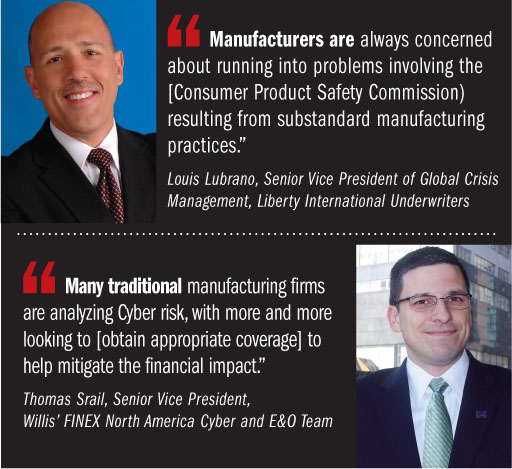
"Many traditional manufacturing firms are analyzing Cyber risk, with more and more looking to [obtain appropriate coverage] to help mitigate the financial impact," Srail says.
Cyber exposures in manufacturing include issues related to the increasing automation of factories and distribution systems—as any automated system can be disrupted due to programming or other errors.
Also a source of worry is the loss of revenue or the cost of data reconstruction due to the actions of "computer attacks, hackers, viruses, rogue employees and other evil actors," says Chris Keegan, Willis' FINEX North America's senior vice president of E&O and E-Risk.
Additionally, some manufacturing firms are collecting marketing information that can be the subject of wrongful-collection lawsuits and privacy-breach suits and expenses, if sensitive information is released.
"Names, addresses and even email addresses can be deemed to be personally identifiable confidential information in today's environment," says Keegan.
WORKERS' COMP, SUPPLY-CHAIN ISSUES STILL BIGGEST CONCERNS
While interest in Cyber Liability coverage is increasing, Workers' Compensation remains the No. 1 insurance concern for manufacturers as growing health-care costs continue to push rates higher, says Jay Little, vice president and unit manager for Kansas City-based brokerage Lockton Cos. LLC.
Managing their supply chains is his clients' second-biggest concern, Little says, which goes hand-in-hand with Contingent Business Interruption (CBI) coverage—which pays losses that occur when a member within an insured's supply chain has a loss that impedes its business (i.e., when a supplier can't get raw materials to the manufacturer).
One of Little's clients, for example, is a large plastics manufacturer that receives a majority of its raw materials—oil-based resins—from a Houston supplier.
"Hurricanes in Houston can shut down refineries and halt the supply of resin," he explains. "Our client may not receive a sufficient supply of resin or may pay a premium to go outside negotiated contracts. A CBI policy will pay for the loss of income in this scenario."
Other Top-5 concerns for Little's manufacturing clients: Trade Credit, Patent Infringement and Political Risk, for accounts with foreign operations.
FOR FOOD SUPPLIERS, PRODUCT-RECALL COVERAGE IS CRITICAL (BUT NOT ALWAYS ACQUIRED)
Product Recall coverage is also high on the consideration list for many manufacturers, says David Bresnahan, client manager for Horton Risk Management, a division of The Horton Group in Orland Park, Ill. The independent brokerage represents numerous insurance carriers in business insurance, risk management and employee benefits for clients in the construction and food industries.
Food-industry clients, Horton adds, increasingly have been inquiring about coverage since last year's passing of the U.S. Food Safety Modernization Act, which gives the federal government the power to order a food-product recall at its own discretion.
In addition to this new federal oversight providing an impetus for coverage, another reason manufacturers may need Product Recall cover is related to the quality—or lack thereof—of imported components of the manufacturing process, says Louis Lubrano, senior vice president of Global Crisis Management for Liberty International Underwriters, New York.
Quality controls in countries such as China, Hong Kong and Indonesia tend to be less stringent than U.S. quality controls, which causes importers of components to be "particularly concerned about quality," Lubrano says.
One of the key roles of the U.S. Consumer Product Safety Commission (CPSC)—the federal regulatory body that protects citizens from unreasonable risks of injuries associated with consumer products—is to enforce compliance with safety standards through activities like recalls and other corrective actions, Lubrano says. The CPSC even gets involved in litigation when necessary.
"Manufacturers are always concerned about running into problems involving the CPSC resulting from substandard manufacturing practices," says Lubrano.
And while Product Recall remains a big concern among manufacturers, most of Little's clients at Lockton Cos. don't find it important enough to actually buy it. "That doesn't mean they're not concerned about it; they're just not willing to pay for it," he says.
MARINE & CARGO COVERAGE
Patrick Ryan, vice president and senior underwriting manager for Liberty International Underwriters, says Marine & Cargo coverage ranks among the biggest concerns among his manufacturing clients.
Overseas transit presents large-scale loss potential, Ryan notes, adding that clients need to seek out an expert in international coverage.
"Quality Marine Insurance placements with companies that have global claims capabilities and expertise is of the utmost importance and could very much lessen a potential loss of business," he adds.
© Arc, All Rights Reserved. Request academic re-use from www.copyright.com. All other uses, submit a request to TMSalesOperations@arc-network.com. For more information visit Asset & Logo Licensing.