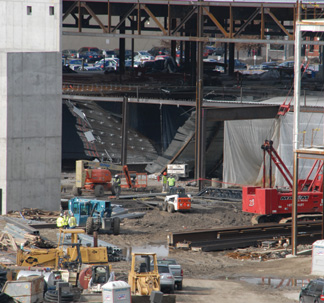
 A floor collapsed at a Cincinnati, Ohio casino construction site at the end of January, injuring 13 workers and causing project management, Occupational Safety and Health Administration (OSHA), and city safety inspectors to shut down the site to investigate. Luckily only one worker was injured seriously, with the others suffering relatively minor injuries. Work resumed on unaffected portions of the casino within a few days and the collapsed portion was later demolished.
It is worth noting that this is the second casino collapse in Ohio in recent months. The first occurred in Cleveland, where a garage deck collapsed. The projects—both run by a joint venture between Rock Gaming, LLC, and Caesars Entertainment, Inc.—have a combined value of $1 billion. They used different structural systems and different project management companies, so it is assumed they are not related. The collapse at the Cincinnati job site occurred when workers were pouring concrete onto steel decking. The Cleveland garage was made of reinforced concrete construction.
Although we cannot know for sure, it is likely that these projects are covered by wrap-up insurance programs, with all lines of coverage wrapped up into one program that encompasses all contractors and subcontractors. It is likely that the coverage is broad and complex, designed so that all contractors involved in the project have appropriate coverage. The first concern is for the workers. At the very least, they will be covered by Ohio's monopolistic workers' compensation program.
Builders Risk Coverage
Once we get past that most important aspect of such construction accidents—worker safety and injuries—we recognize that these accidents involve two of the most complicated coverage issues in P&C insurance: collapse and builders risk. Is collapse covered for a building under construction? Is loss of projected future revenue from construction delays covered on a builders risk policy? What other coverage issues might arise?
The first question is whether collapse is even covered on the typical builders risk coverage form. The Restriction of Additional Coverage–Collapse on the unendorsed ISO builders risk form precludes coverage for the collapse of a building under construction if it is caused by the "use of defective materials or methods in construction, remodeling or renovation if the abrupt collapse occurs during the course of the construction, remodeling or renovation."
Again recognizing that projects such as these casino accidents probably are covered by wrap-up programs with enhanced coverage, many projects are not. So the direct damage caused by the collapse very well may not be covered, which would void the possibility of coverage for consequential property losses arising from them. This is because of the fact that, if the direct physical damage does not trigger property coverage, consequential loss such as that caused by construction delays also would not be triggered.
Endorsement CP 11 20, Collapse During Construction, does provide coverage for collapse when it is caused not only by defective materials or construction methods, but also from faulty design, plans, specs, or workmanship. The Cincinnati collapse remains under investigation, and the bolts used to secure the decking and how they were installed reportedly is a source of interest. If the collapse ultimately is traced back to the basic design or the actual bolts, then coverage would be triggered under this endorsement as either defective materials, faulty construction methods, or workmanship.
'Soft Costs and Rents'
Once the direct property damage is assessed, the next potential problem is the loss of future income that results from construction delays. This type of coverage used to be provided by what in the past was referred to as "soft costs and rents." Soft costs included consequential items, such as the need to redo designs or revise construction methods after a covered loss. Rents is a term used to cover the loss of future projected revenue in the event that project completion was delayed because of a direct loss. (The Cincinnati casino is still slated to open in the first quarter of 2013.)
Projected income from casino operations could be pushed back for months if the project were shut down for a long period of time, or if sections had to be reconstructed because of the January collapse. In addition, changes in the timing of future income could cause project owners to incur more interest on their construction loans, more wages for the additional work, and other related expenses. Such costs were contemplated in the coverage for "rents."
The Ohio casinos already were behind their original schedules because of delays in various governmental approvals. As one newspaper stated, further delays at the Cleveland project could cost millions in lost revenue affecting the owners, local governments, supplies, and prospective employees.
The unendorsed ISO builders risk form no longer offers soft costs and rents as a part of the form. This coverage must be arranged through a Business Income form, either CP 00 30 or CP 00 32, which would be attached to the builders risk form. The declarations of the business income provision would state that the building is under construction and would be underwritten to provide the types of consequential income that previously was contemplated by soft costs and rents.
Another potential coverage issue may arise if the project featured "green" construction methods. Unendorsed property policies typically provide the "lesser of" the cost to rebuild or replace or the value of the structure. Green construction—even certain methods of debris removal—typically is more expensive than the unadorned cost to rebuild or replace an existing building. This probably would not affect the actual direct damage insurance, as any green construction methods would have been included to develop the builders risk insurance values. However, it could affect the business income recovery, especially if such construction methods increased the period needed to reconstruct the damaged property.
While these two incidents turned out to be much less serious than originally thought, they point out the importance of understanding how complicated coverage issues can be. A serious construction loss without the appropriate policy provisions could leave an owner without the financial support needed to move forward on the projects.
© Arc, All Rights Reserved. Request academic re-use from www.copyright.com. All other uses, submit a request to TMSalesOperations@arc-network.com. For more information visit Asset & Logo Licensing.