Showing rate increases/decreases were flat for the month, MarketScout's October barometer provides further evidence of the soft market making a turnaround. One insurance-broker executive says he believes the industry is actually primed for an increase in demand— although likely in areas outside the traditional property and casualty arena.
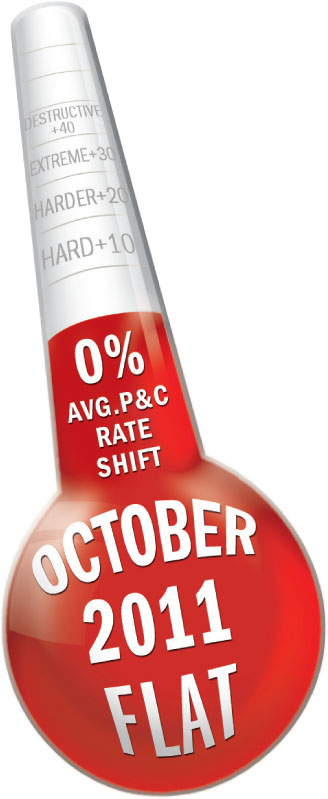 "With two consecutive months of a flat market, we are on the cusp of a composite rate increase," says Richard Kerr, CEO of Dallas-based MarketScout.
Kerr notes that according to October's numbers, umbrella liability and public entities recorded rate decreases of 1 percent. Meanwhile, business interruption, inland marine, general liability, commercial auto, professional liability, fiduciary and crime were flat.
Business-owner's policy, directors' and officers' liability, employers' professional liability insurance and surety were all up 1 percent, while workers' compensation was up 2 percent.
By account size, small accounts were up 2 percent, and medium accounts ($25,011-$250,000 in premium) were up 1 percent. Large accounts and jumbo accounts (over $1 million in premium) were both flat.
Reviewing the seven industry classes listed in the survey, transportation was up the most at 3 percent, followed by energy at 2 percent, and habitational and contracting at 1 percent. Manufacturing and service were both flat, while public entity was down 1 percent.
The report follows the Council of Insurance Agents & Brokers' quarterly market survey, which says average rate increases during the third quarter were just shy of 1 percent or about flat.
Commenting on the MarketScout findings, Meyer Shields, a financial analyst for Stifel Nicolaus, says insurers' deteriorating calendar-year results are the primary catalyst for the pricing change. He adds that the current trend should accelerate as favorable reserve-development tailwinds subside.
Shields gives high marks to personal-lines insurers who are keeping rates at or above "loss-cost inflation rates," he says, supporting "steady or improving underwriting profits (dependent on the weather)."
He also gives insurance brokers a vote of confidence, saying that obstacles to organic growth, recessionary pressures and soft-market declines are diminishing—which should lead to improvements in the bottom line.
Recent comments on 2011 third-quarter conference calls support the idea that companies are beginning to get rate increases on certain lines of business.
David H. Long, president and CEO of Liberty Mutual Group, says the company is getting rate increases for both personal and commercial lines, although he notes that competition remains intense as the premium size of the account increases.
At The Hartford, Executive Vice President/Chief Financial Officer Christopher Swift says the company is experiencing growth in all lines of business, and rate increases are beginning to outweigh liabilities.
Chartis CEO Peter Hancock says the unit is seeing price-hardening in the property and casualty space. Overall, he says rates in the U.S. are up 4 percent, which continues a trend that started in the first quarter. "We feel good about the trends on the U.S. side," he adds.
Meanwhile, in its just-released "Marketplace Realities 2010" report, Willis' Chairman and CEO Joe Plumeri says the demand for insurance services is rising. This rise is seen in emerging markets and in increased demand to transfer risk beyond the traditional property and casualty market. Plumeri cites cyber, environmental, trade-credit and supply-chain risks as a few examples.
"The nature of business in the developed world is evolving," says Plumeri. "The assets of 21st-century companies are increasingly intangibles, such as brand, data and intellectual property." The shift away from the tangibles that the insurance industry has always dealt with to these intangible risks "should increase the demand for sophisticated risk-management expertise," he adds.
While brokers continue to focus on the nuts and bolts of policies and what they protect at what cost, the industry must also "respond to the larger trends at work that may be shaping our industry for years to come," says Plumeri.
The Willis report also touches on pricing, stating that rates going into 2012 will likely be flat to modestly up or down for most lines of business.
Additional reporting by Chad Hemenway
© Arc, All Rights Reserved. Request academic re-use from www.copyright.com. All other uses, submit a request to TMSalesOperations@arc-network.com. For more information visit Asset & Logo Licensing.