Insurers are unlikely to be subject to federal oversight through the Dodd-Frank act, a Congressional staffer says, but it is unclear whether the act will lead to heightened state regulation.
Baird Webel, a specialist in financial economics at the Congressional Research Service, says the overall expectation is that few insurers will be deemed systemically important by the Financial Stability Oversight Council.
But he says the act mandates that states impose additional oversight of insurers because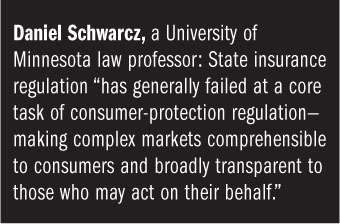 of the financial crisis, namely problems at the non-insurance subsidiaries at American International Group.
Webel notes that this process may take longer because National Association of Insurance Commissioners (NAIC) model laws must first be adopted by individual state legislatures in order to take effect. "This process can take a substantial amount of time and, in addition, state legislatures are not required to pass the NAIC models, as suggested by the NAIC," Webel says. "This may alter the effectiveness of the models or introduce variation in regulation among different states."
Meanwhile, at a Senate Subcommittee on Securities, Insurance and Investment hearing on "Emerging Issues in Insurance Regulation," Daniel Schwarcz, a University of Minnesota law professor, says state insurance regulation "has generally failed at a core task of consumer-protection regulation—making complex markets comprehensible to consumers and broadly transparent to those who may act on their behalf."
He says this type of transparency is fundamental to "fostering competitive and efficient markets."
Schwarcz says states do a poor job of promoting transparency in consumer-oriented P&C and life-insurance markets. "This failing occurs at two levels," Schwarcz says. First, most states do not empower consumers to make informed decisions among competing carriers, and second, there is a lack of publicly available market information about carriers.
For example, in personal-lines markets—home, auto and renters' insurance—consumers have no capacity to identify or evaluate the substantial differences in carriers' insurance policies, according to Schwarcz. "Consumers cannot acquire policies before, or even during, purchase," he says. "Instead, they receive them only weeks after the fact."
He adds, "No disclosures warn consumers to consider differences in coverage, much less enable them to evaluate these differences. Similar deficiencies prevent consumers from comparing carriers' claims-paying practices," and consumers neither receive nor can access reliable measures of how often or how quickly carriers pay claims, he continues.
Furthermore, consumers are not told about agents' financial incentives to steer them to a particular carrier, Schwarcz adds.
"Given this collective lack of transparency, it is hardly surprising that several large, national companies have started to hollow out their coverage and embrace aggressive claims-handling strategies," he says.
© Arc, All Rights Reserved. Request academic re-use from www.copyright.com. All other uses, submit a request to TMSalesOperations@arc-network.com. For more information visit Asset & Logo Licensing.