The insurance industry was hard hit by the Sept. 11, 2001 terrorist attack.
 Not only were a number of people highly respected in the industry killed when the airplanes hit the World Trade Center, but some in the domestic industry, especially American International Group, along with foreign insurers and the reinsurance industry, were particularly affected.
Moreover, the period between October 2001 and November 2002 was an absolute nightmare for the industry.
It took a full-court press for the industry and such allies as the real estate industry to persuade Congress and the Bush administration that a federal backup was needed in order to provide affordable terrorism-risk insurance to the commercial real estate market, especially in high-risk markets.
The resulting Terrorism Risk Insurance Act (TRIA), enacted in November 2002 and followed up on with passage of a seven-year extension enacted in 2007, has brought certainty and affordable terrorism-risk insurance to America.
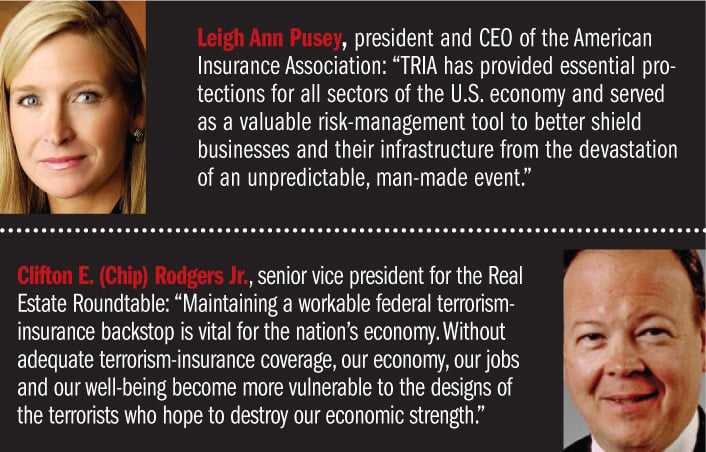
Leigh Ann Pusey, president and CEO of the American Insurance Association, says, "TRIA has provided essential protections for all sectors of the U.S. economy and served as a valuable risk-management tool to better shield businesses and their infrastructure from the devastation of an unpredictable, man-made event."
"It's not a natural inclination of our industry to seek government reinsurance, but, unquestionably, TRIA stabilized the commercial-insurance marketplace in the post-9/11 chaos," adds Joel Wood, senior vice president, government affairs, for the Council of Insurance Agents & Brokers.
"As much as we'd like to see otherwise, we don't sense a great deal of emerging global appetite for private terrorism coverage for a catastrophic event," Wood continues. "There will be an ongoing debate, no doubt, for years to come about the appropriate federal role.
"Both the Bush and Obama administrations are to be credited for the fact that no event has occurred that would trigger TRIA payments. But if such an awful event were to occur, we think the right program is in place," Wood concludes.
Frank Nutter, president of the Reinsurance Association of America, notes that, "TRIA was an essential part of the immediate recovery after 9/11 as it provided a stabilizing role in the commercial market."
But Nutter adds that, given the experience gained over the intervening years evaluating the threat, "the program's parameters should be re-evaluated to determine what level of government intervention, if any, is necessary to maintain market stability. Reinsurance markets have been supportive of terrorism risk in many ways and prefer not to have government intervention where it is not needed."
Paul Mattera, chief public affairs officer at Liberty Mutual Insurance Co., says that, "TRIA made it possible for carriers to provide property-and-casualty cover for terrorism risk at a time when economic recovery post 9/11 depended on it."
Without TRIA, Mattera said, "and with limited data upon which to underwrite terrorism risk, carriers would be severely restricted in their ability to write property or workers' compensation insurance. The economy would suffer as a result."
Clifton E. (Chip) Rodgers Jr., senior vice president for the Real Estate Roundtable, which represents large commercial property owners, further defends the program, for which his group lobbied fiercely.
"Maintaining a workable federal terrorism-insurance backstop is vital for the nation's economy," he says. "Without adequate terrorism-insurance coverage, our economy, our jobs and our well-being become more vulnerable to the designs of the terrorists who hope to destroy our economic strength."
"The bottom line: Terrorism risk is a national problem that requires a federal solution," Rodgers says. "Private markets alone cannot be expected to provide adequate capacity—and there has been no expert Congressional testimony to the contrary."
© Arc, All Rights Reserved. Request academic re-use from www.copyright.com. All other uses, submit a request to TMSalesOperations@arc-network.com. For more information visit Asset & Logo Licensing.