Employers and their insurers will have a new tool available to assess an organization's vulnerability to employment practices liability lawsuits later this year when Montage Analytics officially rolls out its EPL Risk Index, which is now in beta-testing mode.
A feature of the index that sets it apart from traditional insurance underwriting tools is a foundation in behavioral science, the field of specialization of Kathleen Long, CEO and Co-Founder of Mountain View, Calif.-based Montage Analytics.
 "People sue their bosses because of their emotions and feelings, not because they are keeping track of rules and regulations," Long tells NU, explaining why the application of behavioral science is critical to the understanding of management liability risk.
Put another way, Montage believes that "human behavior lies at the core of operational risk but is virtually ignored with current risk assessment."
While government agencies and legal systems look to put rules and regulations in place with the goals of protecting companies by making sure there is fairness, it is "at the level of the supervisor/employee interaction where the problem is. And it's emotional. That's the big secret—that emotion drives business," Long says.
Instead of having a check-mark assessment that might involve a consultant or insurance underwriting asking "do you do this" in compliance with this rule or "do you do that" to follow that regulation, the question-asking process used by the EPL Risk Index is aimed to get employers and insurers closer to understanding those critical human interactions, she explains.
Long, a Ph.D. in a field of behavioral science known as socio-cybernetics, identifies other characteristics that distinguish the index from standard EPL insurance underwriting procedures.
She says Montage's risk index, unlike conventional insurer risk assessment tools, does not rely on inductive processes, which "look backward to see what happened before statistically, assuming it will happen again."
"We've seen in the last few years with the mortgage crisis and Bernie Madoff that history doesn't always repeat itself." At the core of events like Mr. Madoff's Ponzi scheme, "there was a person. What happened [involved] the way people exercised their judgments," she says, also expanding the conclusion to the collapse of the mortgage banking system.
"Historical statistics paint an incomplete picture of risk. We look beneath the surface to plot early complex patterns of emerging risk"—examining and "diagnosing preconditions associated with risk."
She explains that the interview process of the free online test is conducted in a flexible non-linear way to imitate the workings of the human mind as it weaves together a web of clues in order to predict future outcomes based on current conditions. She likens the "intelligent risk analytics" that drive the engine of Montage's Risk Index to the process that Colombo used to solve murder mysteries in the 1970s television crime drama.
"He didn't ask each of his questions in a vacuum," she says, noting that a detective or diagnostician using the type of abductive reasoning built into the risk models reexamines each answer he or she receives in comparison to all previous information.
That means by the time the risk model has processed answers to 10 questions, it has accumulated an exponential amount of information—"because every answer is compared in turn with every other answer against the whole, which is how the mind works," she says, explaining the Montage's initial prototype and the first application in the CPA professional liability arena were built in this fashion.
INTERPRETING THE SCORE
Visitors to the Montage Analytics website will notice that the EPL Risk Index is actually the second tool being launched by the firm. The CPA Risk Index, available since December 2009, allows certified public accounting firms to take a free 75-question test that results in a three-digit score between 001 and 999, with high scores indicating increased vulnerability to professional liability risk.
The EPL Risk index "does not predict the likelihood of a management liability situation occurring," but instead "assesses vulnerability should a business find itself in a management liability situation," the Montage Analytics website says.
Long draws an analogy to damage assessments for a particular location when a hurricane strikes, noting, for example, that while some homeowners had devastating losses from Hurricane Katrina, others escaped with minor damage.
"The event was the same for everyone. What made the difference was vulnerability," she says, giving a second example of differing patient outcomes to disease epidemics.
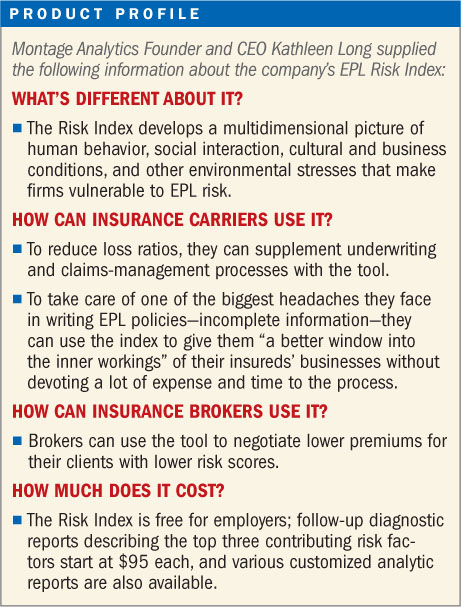
Once test takers finish their free tests to arrive at scores, they can purchase diagnostic reports describing the Top 3 contributing risk factors (the costs start at $95) and various customized analytic reports.
During the NU interview, Long shared information she has already learned from the test of the tool and from consulting experience about what makes one firm more vulnerable to EPL lawsuits than another. See related article, "EPL Risk Vulnerabilities Assessed."
In addition to employers taking the tests to self-assess their vulnerabilities, Long says insurers and brokers are likely users.
Insurers can use the Risk Index to supplement underwriting processes, for competitive benchmarking, and also to help policyholders reduce risk by offering it as a value-added service.
For brokers, who can use the tool to negotiate lower premiums for their clients with lower risk scores, a fully automated online application and renewal system is also in the works.
© Arc, All Rights Reserved. Request academic re-use from www.copyright.com. All other uses, submit a request to TMSalesOperations@arc-network.com. For more information visit Asset & Logo Licensing.