By the end of next year, insurers and reinsurers doing business in the European Union will have to demonstrate to regulators there that they have sufficient capital to cover their obligations to policyholders.
 The requirements described in the Solvency II Standards for Data Quality define a process that should be a wake-up call for all insurance companies everywhere, including in the U.S., to implement best practices to analyze and evaluate exposures that can threaten solvency. This means embracing the use of multiple catastrophe risk models.
What if the single model you're using has a significant bias that you are not aware of? What if your model changes dramatically from one version to the next?
This can negatively impact business continuity—and even more importantly, your capital and solvency.
Having a solid catastrophe risk modeling platform in place to evaluate solvency and the risk of ruin is a standard business practice. But what many insurance professionals might not realize is that for any country/peril model, the amount of uncertainty involved in evaluating risk is so great that having only one perspective on that risk can be a risky strategy. To put it another way, for any country/peril model there is certainly more than one reasonable approach to characterizing risk.
PUT TO THE TEST
Consider two insurance companies with different approaches to modeling. They both have significant U.S. hurricane exposure and they use models for measuring and managing capital and solvency.
Company A uses just one model to analyze its hurricane risk. While the company will have a deep understanding of that model, it will become reliant on that one perspective. And to the extent that model has biases, the company's portfolio will come to reflect these biases. Put another way, the portfolio might become optimized to that particular model, and the insurer's understanding of risk might be somewhat limited to its chosen modeler's view of risk.
Company B, on the other hand, licenses and uses three models to analyze its hurricane risk. While this is a significant financial and process commitment, there is also an enormous benefit: Company B essentially owns a deep understanding of hurricane risk.
The process of using and understanding many models makes this company smarter about the peril and allows it to understand model biases—the different assumptions used in each model. The company can make its own decisions about how to use the model output.
VERSION VOLATILITY
Let's now imagine that the single model that Company A uses has a systemic bias which underestimates wind damage in certain regions and that the bias is addressed in a new version. Modeled expected loss results increase by 30 percent.
How will the company deal with that from a business-continuity perspective? Will they increase rates 30 percent? Will they have to raise capital? Buy more reinsurance?
How will they deal with this "model event?" Indeed, this is a very complicated and serious set of problems that end up in the C-suite, and even at the board level.
And how would Company B fare under these circumstances? It is likely they would have a much better shot at absorbing this "model event."
Having perhaps understood the potential biases of all the models, they could have underweighted some models and overweighted others. If so, then they would be subject to less volatility from the change of a single model. While the model change might be disruptive, it would be a manageable disruption.
A word of caution: Even with the wealth of knowledge that comes from using multiple models, it's important to avoid "delusional exactitude"—merely accepting the results at face value. Models set rational expectations about risk. They don't eliminate uncertainties.
It may seem counterintuitive that with so much brainpower, technology and money dedicated to catastrophe risk modeling that we still have significant uncertainty. But when you think about it, what you're modeling is fundamentally uncertain—how often will we have really large and intense hurricanes? Where will they make landfall? How will various buildings and occupancies respond to certain wind speeds?
The models reflect this real world of uncertainty.
COMPETITIVE EDGE, SOLVENCY IMPLICATIONS
A deep understanding of catastrophe risk is a strategic asset for any insurance company—and a distinct competitive advantage. Using multiple models can help deepen your understanding of risk. To the extent that models differ, understanding these differences promotes deeper knowledge.
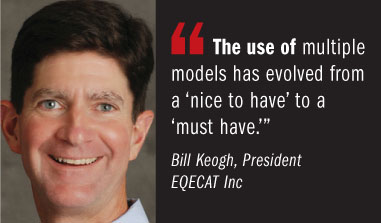
Solvency II is raising the profile of risk models and their use. Given their increased importance in solvency, the use of multiple models has evolved from a "nice to have" to a "must have."
While the old paradigm might have been questioning the costs of multiple catastrophe models, the new paradigm is what are the costs of not using multiple catastrophe models.
© Arc, All Rights Reserved. Request academic re-use from www.copyright.com. All other uses, submit a request to TMSalesOperations@arc-network.com. For more information visit Asset & Logo Licensing.