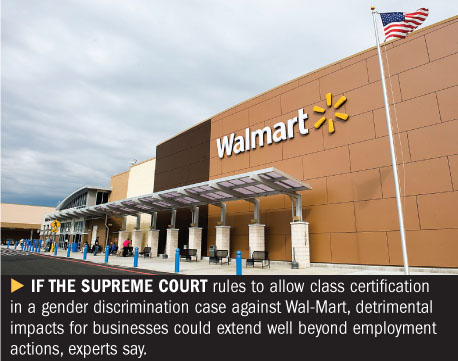
 Corporate America and trial lawyers are anxiously awaiting a decision from the U.S. Supreme Court, which has agreed to hear an appeal in a discrimination lawsuit case involving thousands of women seeking class-action status against Wal-Mart.
"This is very important to both of them," said Robert Hartwig, president of the Insurance Information Institute. "This could be a dream come true for trial lawyers."
Gerald L. Maatman Jr., a partner and co-chair of the class-action defense group at Seyfarth Shaw, said the Supreme Court's ruling "may change the workplace class-action landscape permanently."
No matter that the case is based on discrimination allegations by a large group of women seeking billions of dollars in back pay. Of paramount interest to the insurance industry is the issue of class-action status. If the group is granted the status, "it will be easier to form large classes," said Mr. Hartwig.
"It could be detrimental to any corporation subject to any case that may involve claims that can be assembled into a class," he said. "This would lower the bar on what constitutes a class."
Wal-Mart is appealing the case, Dukes, et al. v. Wal-Mart Stores, Inc. The U.S. Court of Appeals for the Ninth Circuit in San Francisco–considered the epicenter of class actions–ruled in April by a 6-5 vote that the class action could go forward. That ruling upheld a decision by the District Court for the Northern District of California to certify class-action status because the women were united by their allegations of discrimination.
Mr. Maatman said the Supreme Court decision will be "transformational" in the standards for class-action certification and will provide a road map going forward. Currently, the map given by the Ninth Circuit to plaintiffs' attorneys guides them to "file colossal employment class actions."
"This is the big one that will set the standards for all other class actions," Mr. Maatman said. Ultimately the ruling will tell employers and carriers what they will need to do to "batten down the hatches," he added.
Arguments in the case will begin in the spring, with a ruling likely by June 2011.
Wal-Mart said in a statement that "confusion in class-action law is harmful to everyone." The issues "reach far beyond this particular case," said the retailer, which has argued that the thousands of women do not have enough in common to warrant class-action status. They worked at 3,400 stores in 170 job classifications for different managers, and were paid differently, according to court records.
Kenneth Ross, of the Claims and Legal Group at Willis, said that if these plaintiffs can be considered a class, "you're going to open a Pandora's Box for plaintiffs' attorneys to find other cases–be it environmental, securities, or any other type of area–that may have not been ripe for this type of case before."
"It will be a whole different story if class status is upheld," he added.
Last week, the Supreme Court also agreed to hear American Electric Power Co., Inc. v. Connecticut, considering whether the public nuisance liability theory can be applied to global warming. The underlying case brought by a coalition of state attorneys argues that carbon emissions by various power companies are a public nuisance and seeks to have them capped and then to reduce such emissions. The Second Circuit U.S. Court of Appeals in New York ruled to allow that case to proceed in Sept. 2009.
In a briefing last week, William Stewart, a partner in the National Insurance Coverage Group of Nelson Levine de Luca & Horst in Blue Bell, Pa., predicted that affirmation of Second Circuit's ruling is highly unlikely "for the simple reason that this outcome could be crippling to the national economy."
"From the insurance industry's perspective, the appeal will also be worth watching because it will offer the Supreme Court an opportunity to restrict the scope of federal nuisance law," he wrote. "While nuisance was once a small catch-all tort used to guarantee individuals the right of 'quiet enjoyment' of their property, it has evolved into a vehicle for bringing all sorts of pollution and toxic tort claims," he said.
© Arc, All Rights Reserved. Request academic re-use from www.copyright.com. All other uses, submit a request to TMSalesOperations@arc-network.com. For more information visit Asset & Logo Licensing.