Ever heard of the Fujiwara effect? It's when two tropical cyclones come in such close proximity that they actually begin to orbit one another. In the end, the smaller of the two storms is either drained of its strength or entirely swallowed up by the larger tropical storm.
It's amazing to watch. And we came close to doing so during the 2010 hurricane season, when storms spawned off the west coast of Africa seemed to travel in pairs, very close to one another, yet not close enough to achieve the rare Fujiwara effect.
We can correlate the vortex-blending of the Fujiwara effect with what's going on today between the large storm of social networks and Web 2.0 applications swimming around the Internet, and an insurance industry that's dancing around the social networking world but, in many instances, is not yet quite orbiting it. 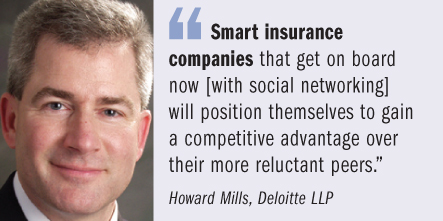
We saw this reluctance by the insurance industry to subscribe to new-fangled media around 2000, when the issue then was controlling instant messaging and e-mail traffic. With no other way to control the interchanges, some firms went so far as to ban their use, thus placing their businesses at a competitive disadvantage against forward-thinking insurers that began early in building networks that not only attracted consumers but made the administrative end of the business more efficient and effective.
Today, with Web 2.0 applications such as LinkedIn, Facebook, Twitter and YouTube leading the way, we find ourselves in a similar spot.
As social media is much more fluid and open than other trackable means of electronic communications (such as e-mail and text messaging), the fear is that current laws around records retention, advertising and safekeeping of trade secrets and intellectual property can be applied to insurers' social media use.
From a regulatory perspective, the challenge becomes how to circumvent issues ranging from the lack of managerial support for monitoring to the lack of training and resources for insurance department staff. However, this is changing.
While lack of control continues to be an issue, we are starting to see new regulatory guidance issued and emerging, respectively, at the Financial Industry Regulatory Authority and the National Association of Insurance Commissioners.
In January, FINRA issued new guidance regarding the use of networking websites by member companies, brokers and representatives. The notice states that firms must supervise use of social networking by their "associated persons" for public communications to ensure that recommendations are suitable and customers are not misled. The notice also covers recordkeeping and other responsibilities.
The NAIC, meanwhile, is beginning to take note of the trend by placing the item on the organization's Market Conduct Committee radar screen and by getting the word out to the industry–such as when it hosted an educational session on the subject earlier this year.
While they wait for more regulatory guidance to emerge, many leading firms are taking it upon themselves to develop safety nets. These include internal frameworks, including those that serve to protect firms from risks associated with the use of social media.
Insurers are also taking advantage of the wide array of external software packages and services that have become available and allow for greater control and capture of social networking traffic.
Aside from regulatory and control issues, also at issue are questions pertaining to return on investment. What are the costs versus benefits?
Legal, technical and other risk avoidance costs are baked into everything an insurance company touches, and this would include the set-up and maintenance of social media programs within individual insurance companies. However, the actual cost of subscribing to social media applications is free. It costs nothing to join and set up accounts on social networking sites.
Another area insurers should consider when it comes to incorporating social media into their business plans is the risk of not subscribing to the Web 2.0 world.
The top time-sensitive risks to ignoring social media include:
o Branding risk: Employees and customers will continue to use social media whether insurers recognize it or not. Ignoring customer conversations on social media can represent significant branding risk.
o Compliance risk: Regulations have not evolved as fast as social media, and insurers are likely at risk without knowing it.
o Risk of falling behind the competition: Action is needed now to capitalize on the opportunity to attract the top agent talent and the next generation of customers. Doing nothing may result in customer loss and talent drain.
But there's hope. Recognizing the forest for the trees, innovative insurance companies are getting out in front by acknowledging the power, opportunity and efficiency of social media while finding ways to navigate around the apparent risks.
Top areas where insurance companies are seeing value added include:
o Generating long-term revenue growth: All customer segments (including Baby Boomers) are rapidly adopting social media–a trend that was initially led by Gen X and Gen Y. Industries such as telecom and retail have embraced these capabilities, and customer expectations are quickly growing into all sectors of financial services.
o Attracting and retaining top talent: Top agent talent in the industry recognizes the need to engage with clients using these new tools and is rapidly adopting them. Insurers that provide access, guidelines and compliance clearance for social media tools will rapidly attract the top agent talent and make their agents more efficient.
o Optimizing marketing spending and effectiveness: Insurers can use social media as another tool to gather information about their customers and effectively conduct targeted marketing campaigns to the right customer segments.
The Fujiwara effect is named after Sakuhai Fujiwara, a brilliant Japanese meteorologist who, in a 1921 paper, first noted the phenomena of vortices in water. The very definition of a vortex is a spiraling mass of water or air that sucks everything near it into its center.
To be sure, social networking is a force to be reckoned with. Smart insurance companies that get on board now will position themselves to gain competitive advantage over their more reluctant peers.
Indeed, entrenchment in the Web 2.0 world now can only bring greater perspective, insight and control over social media on the road ahead–with nary a cyclone in sight.
Howard Mills, formerly Superintendent of the New York Insurance Department, is Director and Chief Advisor at the Insurance Industry Group for Deloitte LLP. He may be reached at 212-436-6752, or via e-mail at howmills@deloitte.com.
© Arc, All Rights Reserved. Request academic re-use from www.copyright.com. All other uses, submit a request to TMSalesOperations@arc-network.com. For more information visit Asset & Logo Licensing.