Every company wants to grow, but in a well-established industry finding ways to do that can sometimes be a difficult task.
Identifying customers with special interests and needs–needs that require unique insurance products and innovations–is one sure-fire way to unearth underserved market niches, create opportunities to take on more profitable risks and strengthen the relationship with clients.
The process of selecting a niche market to attract with a targeted marketing program begins with an analysis of what your company has to offer.
Understand that not all market needs demand major innovations to solve the issues at hand. Sometimes just a smaller and easier-to-implement tweak to your product lineup is all that's needed.
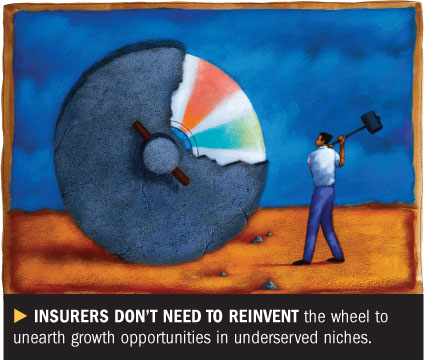 However, be open to the fact that sometimes big issues require big solutions. Both large and small changes can produce significant growth.
Here are some steps to consider:
o Modify an existing product
Repackaging existing products or services to better resonate with consumer demand is an excellent example of a relatively small change that can pay huge dividends. For example, Allstate packaged accident forgiveness, disappearing deductibles, new car replacement and safe driver discounts into Your Choice Auto. All of these were existing features in one or more variations, but the package messaging was unique and appealed to a group of risk-averse consumers.
o Add to an existing product
Many consumers bought auto insurance and many bought roadside assistance over the past several years. When insurers started offering roadside assistance instead of the then-standard limited towing service, they hit a chord with consumers.
Roadside assistance has now become an industry standard.
More recently, professional liability insurers have been expanding their offerings to include coverage for privacy breaches.
Like other modern enterprises, law firms, accounting firms and health care facilities all increasingly rely on information technology applications and client databases to conduct their business. As a result, there is a growing need for coverage to respond to first-party response costs and liability exposures arising from a failure to protect personally identifiable information from misuse or theft, as well as violations of an increasing number of federal, state or local privacy statutes.
Another innovative expansion of coverage developed by professional liability program managers over the past decade provides coverage to physicians and health care facilities for defense costs and fines and penalties resulting from various types of regulatory investigations, including investigations of Medicare and Medicaid billing errors and fraud allegations.
o Use new technology
Many insurers are recognizing that telematics devices placed in vehicles can revolutionize the information available for auto insurance rating–both for private passenger and commercial vehicles.
Emerging technology is taking self-reported annual mileage from a modest idea to an entirely new pricing scheme. Data about the actual operation of the vehicle takes the place of reliance on traditional rating variables.
 Instead of using data loosely correlated with loss costs, insurers now have access to actual, causative behavioral data. The additional services that can be offered through the telematics technology only increase the opportunities for consumer appeal. The technology is quickly evolving to the point that–in the not too distant future–the traditional paradigm of roadside assistance will be turned on its ear and the car will tell the consumer something along the lines of, “I know you just ran out of gas and I can send someone from the gas station one mile away from where I already know you are.”
Additionally, telematics helps insurers reach an audience of better-than-average drivers who sign up for the chance to earn discounts. Thanks to the data provided by the innovation, auto insurance programs literally self-select a population of safe drivers, more profitable risks.
Just last month, Hartford-based Travelers announced a program of commercial auto liability premium discounts for qualifying insureds that effectively use telematics technology to monitor commercial fleets and driver behavior. This follows at least a half dozen other companies that have launched usage-based insurance programs to differentiate themselves in both the personal and commercial auto markets.
o Exploit special expertise
Many opportunities have created ideas that have blossomed into entire new companies. Two great examples of this are USAA, which was created to offer insurance specifically to armed forces personnel, or GEICO, originally established to provide insurance exclusively for government employees.
But every opportunity doesn't always need to be a home run. Evaluate any expertise your company holds or special relationships you personally have with your customer base. These relationships hold special value if the expertise is hard to replicate and provides a sustainable competitive advantage.
The high-risk markets are often fertile ground for the insurer who has the expertise to partner with their customers and supply the full range of required safety and insurance services. Many insurers shy away from transportation of hazardous chemicals, but the insurer who understands the risks can gain significant market share.
Dallas-based Nobel Insurance, a division of Lancer Insurance Company, is an example of an entire company with a focus on a high-risk industry sector–the commercial explosives marketplace. The company provides casualty insurance products and services for manufacturers, distributors and transporters, as well as drilling and blasting contractors with a primary business focus within that marketplace.
In the area of environmental liability, there are many examples of programs that tailor basic environmental coverages to specific classes of insureds, such as elder care facilities or schools and other educational institutions.
o Create demand
You don't always have to create a new product or service offering to reach a target audience. Sometimes you can create demand for an existing product by simply communicating with customers.
Allstate regularly markets offerings such as a fraud investigation department and permissive use on auto policies. Many consumers were unaware that these are common services, and since Allstate was the only company marketing them, consumers turned to the insurer because they wanted these features.
Savvy commercial specialty brokers that place liability coverage for small businesses often realize that their customers don't have internal resources to handle potential employment practices liability claims, such as in-house counsel and human resources professionals to establish risk-management policies and procedures or rigorously document poor employee job performance. These brokers fuel demand for EPL insurance by promoting services that are add-ons to coverage, such as loss prevention websites providing employment procedures ready to download and use, online harassment training modules, and even telephone help lines staffed by local attorneys that provide general employment guidance to business owners.
o Pricing
Don't forget to consider options on how to deliver product offerings to clients or prospects. A feature can be priced as an additional option at an extra cost, accounted for in the base price or, as in the case of Progressive's Pet Insurance, simply rolled into the product without a price change.
Progressive identified that many consumers own and have a special emotional attachment to their pets but had no idea veterinary expenses for their own pet were not actually covered when injured in an auto accident. Given a relatively modest limit and low incidence, Progressive was able to roll out the coverage nationally literally overnight through addition to the current product at no charge, thus avoiding the necessity of state rate filings.
DO YOUR HOMEWORK
Ultimately any time you expand your business, proper preparation and research are crucial. It's easy to get caught up in a fun, new idea, but there are important criteria to evaluate before moving forward. Determine what, if anything, your competitors are doing that may be similar. Make sure to use company resources for this target market that fit with your corporate strategy. You should be able to reach the targeted audience with effective, cost-efficient, focused marketing messages.
Customer research is crucial to developing niche products. Ensure that your new target market is large enough to generate sufficient revenue to justify diverting precious company resources for product development and support and that your proposed innovation will appeal to your target audience. Don't make assumptions. Evaluate any proposed plan with comprehensive customer testing before moving to implementation.
The ideas for innovative products abound, and many can probably be found by asking your employees, agents and current customers. The key is to find time to focus on the steps to identify, evaluate and develop good ideas. This is critical for sustainable growth, but simply can't happen if you don't step away from the crunch of daily deadlines and allocate time to the critically important task of innovating in an increasingly competitive marketplace.
Robin Harbage is a senior business consultant for EMB America in Chagrin Falls, Ohio. He is a Fellow of the Casualty Actuarial Society and a member of the American Academy of Actuaries. He may be reached at robin.harbage@emb.com.
© Arc, All Rights Reserved. Request academic re-use from www.copyright.com. All other uses, submit a request to TMSalesOperations@arc-network.com. For more information visit Asset & Logo Licensing.