 A little more than a century ago, The New York Times ran a brief article detailing the commotion at a horse auction held at old Madison Square Garden. It was1909, and alongside more than two dozen equines that were put up on the block was a lone automobile. As though it was a horse, the car was led out with a halter attached, and the auctioneer called out its full pedigree, including dam, sire, age, and mark.
According to the article, it was “the first time that a motor car intruded in such a manner on the premises where horse is king, and the invasion was hailed with derision,” later described as jeers, laughter, and hoots of a thousand horsemen. But we all know how things turned out for the automobile.
A Virtual Revolution
Flash forward to the present, and another technological sea change is again revamping the way things are done. This time instead of the automobile replacing the horse, it is live virtual auctions replacing physical, in-person auctions. Not only is this change revolutionizing auto auctions, it is changing how insurance companies manage the disposition of salvage vehicles acquired as part of the claim settlement process.
Salvage auto auctions were originally formed to save insurance companies the costs and hassles involved with dealing with contracted auto wreckers or salvage yards. Rather than continue with this inefficient logistical nightmare, cars were pooled together and buyers were allowed to bid on them. Salvage auto auctions were born.
The ensuing years brought various innovations, such as replacing sealed bids with live auctions, and bringing the events indoors instead of out in the cold. But nothing quite changed the face of auto auctions like the Internet. When the Internet gained widespread popularity in the mid-1990s, one of the first uses the salvage industry found for it was as a powerful marketing tool. It no longer needed to mail or fax lists of cars to potential buyers, a process that was labor-intensive and time consuming.
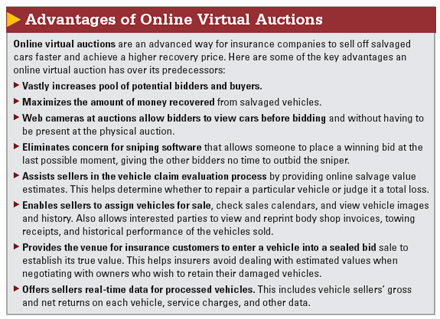
But this was only the beginning. It was not until the advent of virtual online auctions that the salvage auto industry harnessed the true power of the Internet. In addition to being a great marketing tool, virtual online auctions provide claim managers with an outlet to sell off salvaged autos fast and for a high recovery price. Insurance companies can utilize this technology to enhance operating efficiency through Internet bidding, salvage value quotes, electronic communication with buyers, vehicle imaging, and online used vehicle parts locator services.
Test Driving the Process
To illustrate, let's look at a virtual online auction technology that employs a two-step bidding process. The first step is an open “preliminary bidding” feature that allows a buyer to enter bids either at a bidding station in a vehicle storage facility in advance of the actual auction date, or over the Internet.
To improve the effectiveness of bidding, the auction allows buyers to see the current high bid on a vehicle they want to purchase. Buyers then enter the maximum price that they are willing to pay for the vehicle, letting the computer incrementally increase the bid on their behalf during all phases of the auction.
Preliminary bidding ends one hour prior to the start of the second bidding step, an Internet-only, live virtual auction. This step allows bidders the opportunity to bid against each other and the high preliminary bidder. Buyers enter bids via the Internet in real-time, while an automated program submits bids for the high preliminary bidder, up to their maximum bid. When bidding stops, a countdown is initiated. If no bids are received during the countdown, the vehicle sells to the highest bidder. Because it's all done online, it's available to buyers anywhere who have Internet access—including overseas.
Indeed, unlike the U.S., most countries are not major manufacturers of automobiles and do not have the ability to meet domestic demand, so many foreign countries import their vehicles. Online vehicle auctions have enabled foreign buyers to purchase cars online in the U.S. for shipping overseas. Today, some of the largest export markets for salvage vehicles in the U.S. are in Eastern Europe. This trend has provided an opportunity for sellers—the insurance companies—to expand their markets by connecting with customers globally, move vehicles quickly, and lower claim costs while providing other benefits for the insured.
Other Benefits
These are but a few of the benefits. For instance, a live auction that might be canceled due to inclement weather would still be held in an all-electronic model. Online virtual auctions do not have to rely on physical attendance. When a hurricane hit Tampa a few years ago, 250 cars were sold in a virtual auction that otherwise would have not been held.
Bringing auctions online has also helped eliminate the opportunities for collusion. With the Internet, buyers who want to place a bid at an auction they can't attend simply enter their bids into a computer rather than going through an onsite auction manager who may handle multiple competing bids. By eliminating the human element in the auction process, an even playing field is created for all bidders, along with improved transparency.
Virtual online auctions also allow sellers to contingently sell a vehicle through the auction process to establish its true value, allowing the insurance company to avoid dealing with estimated values when negotiating with owners who wish to retain their damaged vehicles.
The next logical step for the auto auction industry is to move to an entirely electronic title format. This will reduce the cycle time of the whole process when insurers are chasing down a title being held by a bank or title warehousing facility.
The shift to an entirely electronic format will only continue to help in expediting vehicle turnaround time in terms of speed and cycle time in and out of the auction yard. This can translate into lowered claim costs for insurers, allowing them to receive the most value for damaged vehicles in a short amount of time. A fast, efficient turnaround can increase the return on investment for the insurance company.
© Arc, All Rights Reserved. Request academic re-use from www.copyright.com. All other uses, submit a request to TMSalesOperations@arc-network.com. For more information visit Asset & Logo Licensing.