While the most comprehensive information about the Federal Motor Carrier Safety Administration's rollout of its Comprehensive Safety Analysis initiative is available on FMCSA's website, for those agents, insurance underwriters and motor carriers who don't have time to wade through all the details, here are the "basics."
WHAT IS CSA?
According to information on FMCSA's website (https://csa2010.fmcsa.dot.gov), CSA 2010 is a new operational model that seeks to give a better view of motor carrier and driver compliance with existing safety regulations. It also seeks to intervene earlier with those who are not complying.
The new model has three components:
1) Measurement
2) Evaluation
3) Intervention
HOW DOES THE MEASUREMENT SYSTEM WORK?
Contained in the CSA model is a Safety Measurement System (SMS) that uses on-road performance data. This new system actually has two systems–CSMS for motor carriers, and DSMS for drivers.
While driver evaluations will not result in the assignment of safety ratings (fitness determinations defined below) under the evaluation component of the model, they will impact carrier ratings.
SMS replaces SafeStat, the measurement system of the old operational model. SafeStat did not contain a separate driver evaluation comparable to DSMS and relied on data from out-of-service violations and selected moving violations only.
The SMS summarizes data on all safety-based v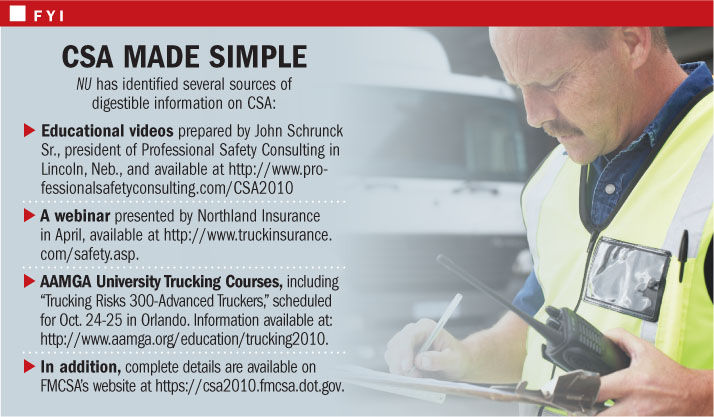 iolations indicated on roadside inspections reports and data from state-reported crashes. CSMS includes two years of data, and DSMS uses three prior years. The data is sorted into seven buckets or Behavior Analysis Safety Improvement Categories (BASICs).
WHAT ARE THE BASICs?
There are six BASICs. They are:
o Unsafe Driving BASIC, which looks at speeding, improper lane change and other violations indicating that drivers are operating commercial motor vehicles (CMVs) in a dangerous or careless manner.
o Fatigued Driving BASIC, which includes violations of regulations related to the complete and accurate recording of hours of service in logbooks and other indications that drivers are operating CMVs while ill or fatigued.
In general, a truck driver cannot drive more than 11 hours per day, or work for 14 hours without an eight-hour rest period.
o Driver Fitness BASIC, which includes violations such as the lack of a proper driver's license–violations indicating that drivers lack training, experience, or are unfit for medical reasons.
o Controlled Substances/Alcohol BASIC, which includes violations related to driver possession or use of alcohol, illegal drugs, and misuse of prescription or over-the-counter medications.
o Vehicle Maintenance BASIC, summarizing violations for blown lights, bad brakes, or other mechanical defects
o Cargo-Related BASIC, summarizing violations for issues such as those for improperly secured loads or unsafe handling of hazardous materials
HOW ARE RESULTS EVALUATED?
Details of the formula used to convert the violation and crash data into seven numerical measures–one for each BASIC and one for the crash indicator–are included in a 94-page document at http://csa2010.fmcsa.dot.gov/Documents/SMSMethodology.pdf.
The document explains that violations and crashes are weighted based on the severity, and that the time elapsed since the violation or crash is also considered–giving less weight to events occurring further back in the past.
After a measurement is determined, results are "normalized"–in other words, the motor carrier is placed in a peer group. The method for determining peer groups was recently revised, but reports from FMCSA in mid-August suggest that peer groups will be based on a combination of miles driven and the number of power units.
For motor carriers, percentiles from zero-to-100 are then determined by comparing the BASIC measurements of the carrier to the measurements of other carriers in the peer group. A score of 100 indicates the worst performance.
A sample carrier summary measurement page–the CSMS screenshot–included in FMCSA's methodology report (Fig. 5-1 on page 5.2) shows a carrier with an "unsafe driving BASIC" percentile of 98.6, indicating that the motor carrier performed worse than 98.6 percent of its peers in this category. That result is highlighted in red, while the "fatigued driving BASIC" of 90.5 is shaded in yellow. A footnote reveals that the colors mean the "intervention threshold" has been exceeded.
WHAT ARE THE INTERVENTIONS?
FMCSA and its state partners will use measurement results to identify motor carriers that need CSA interventions, ranging from recommendations for corrective action to strong penalties. There are no driver interventions under CSA.
Carrier interventions CSA are broken into three categories:
o Early Contact includes warning letters and targeted roadside inspections. Warning letters identify deficient BASICs, outline possible consequences of continued safety problems, and instruct carriers on how to access their carrier safety data and measurement scores.
o Investigations include offsite investigations, requiring carriers to submit documents to FMCSA or a state partner, related to specific problems identified through the SMS–such as drug testing records for deficient substance/alcohol BASICs. A carrier failing to submit requested documents may be subject to an onsite investigations or subpoenas.
Onsite investigations range from focused investigations (on particular issues such as vehicle maintenance) to comprehensive investigations addressing all aspects of the carrier's operation.
Comprehensive investigations, similar to multiday, labor-intensive compliance reviews conducted in the past, will be used for carriers with continually deficient BASICs, worsening multiple BASICs (three or more), or a fatal crash or complaint.
o Follow-ons include:
1) Cooperative Safety plans, which are voluntary safety improvement plans collaboratively developed with FMCSA to address the problems leading to a carrier's substandard safety performance.
2) Notice of Violation, which are formal notices of safety deficiencies that require a response from the carrier–used when regulatory violations discovered are severe enough to warrant formal action but not civil penalty.
3) Notice of Claim or civil penalty.
4) Operations Out-of-Service Order, requiring the carrier to cease all motor vehicle operations.
WHAT IS A SAFETY FITNESS DETERMINATION?
As part of the safety evaluation process, FMCSA is developing a new Safety Fitness Determination methodology, subject to ongoing rulemaking.
In the past, SFDs were only assigned after a full compliance review was performed. Under CSA, SFDs will be based on the SMS calculations, and they will also include the results of investigations when they are performed.
SFD assignments–"continue to operate," "marginal," or "unfit"–will be updated on a monthly basis for every motor carrier.
WHAT DATA IS AVAILABLE TO INSURERS?
FMCSA envisions that public users, including shippers and insurers, will have electronic access to SMS results that is very similar to the access to SafeStat they have currently. That means privacy-related information, such as driver names from individual inspections, will be removed for public viewing.
Public access is expected to begin in early December. Motor carriers have been able to preview their results since mid-August.
© Arc, All Rights Reserved. Request academic re-use from www.copyright.com. All other uses, submit a request to TMSalesOperations@arc-network.com. For more information visit Asset & Logo Licensing.