As Congress considers ways to resolve wind-versus-water damage disputes, the U.S. House of Representatives for the second time in two weeks opted not to act on a bill that would add windstorm coverage to the National Flood Insurance Program. But Congress may not have seen the last of this controversial proposal.
Indeed, Rep. Gene Taylor, D-Miss., who authored the bill, is insistent on bringing it back to the House floor in September, according to Matt Brady, a representative for the National Association of Mutual Insurance Companies. 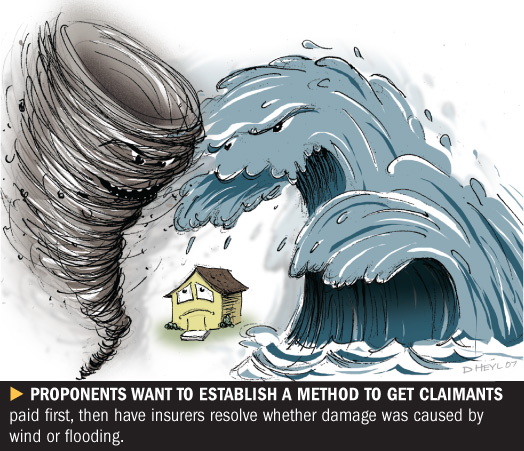
Mr. Brady said the House considered bringing the bill to the floor on July 30, but ultimately opted to hold off until after their summer recess. He said the lack of action on the bill shows that Congress is listening to the measure's opponents and realizing that H.R. 1264, the Multiple Peril Insurance Act, is not good policy.
The Property Casualty Insurers Association of America said opponents to the bill include not just the insurance industry but environmental groups, consumer advocates, taxpayer watchdogs, the business community and the White House, as well.
"The fact that the Obama administration and so many consumer, taxpayer and business groups are united in opposition to this bill speaks volumes," said Tom Litjen, PCI's vice president for federal government relations. "We are glad to see that the support was not there for the bill at this time, and we hope that remains the case after the August recess."
The latest delay marks the second time in as many weeks that the bill was not brought up for a vote, noted Mike Becker, director of federal affairs for the National Association of Professional Insurance Agents. The bill made it to the House floor on July 22 but was pulled after debate and before a vote could be held.
"We think this indicates many House members are having second thoughts, and support for this bill appears to be eroding," according to Mr. Becker. "Rep. Taylor's bill would add a peril to the program that does not belong there because coverage for wind damage is available in the private market and through state wind pools."
Mr. Becker said PIA supports H.R. 5114, the Flood Insurance Reform and Priorities Act of 2010, which extends the NFIP for five years and contains some reforms. That bill passed the House on July 19 and is awaiting action from the Senate.
A separate bill introduced in the Senate that seeks to address fights over wind-versus-water damage following hurricane-driven storm surges–by having the wind insurer and the NFIP each pay the policyholder 50 percent of a disputed claim before settling differences through arbitration–will also not be considered until at least September, according to Mr. Brady. That bill is sponsored by Sen. Roger Wicker, R-Miss.
The Wicker bill appears to be generating little support within the property and casualty insurance industry.
Moreover, Rep. Taylor doesn't appear to be accepting the Wicker plan as an alternative to his legislation to add wind coverage to the NFIP.
The warmest industry support came from PIA, as Mr. Becker said the bill "has some interesting possibilities." However, Mr. Becker said PIA has shared two areas of concern in our meetings with Sen. Wicker's staff about this bill.
First, he said, there would need to be sufficient buy-in on the part of carriers. "Second, if disputed claims are to be sent to arbitration panels, these panels should be set up by state departments of insurance, rather than by the federal government," Mr. Becker added.
Jimi Grande, senior vice president of federal and political affairs at NAMIC, rejected the Wicker proposal, saying it "serves only as a distraction from the fundamental problems facing the NFIP."
"Instead of bringing actuarially sound rates or reducing subsidies, this bill would only shift the expense of storm losses and, ultimately, raise the cost of insurance for consumers in the gulf and elsewhere," according to Mr. Grande.
"At NAMIC, we believe that any efforts to reform the program should be focused on moving it toward financial sustainability and easing the exposure of taxpayers," he said.
He noted it has been nearly five years since Hurricane Katrina, "and we are still waiting for meaningful NFIP reform because of political bickering." Meanwhile, "the reliance on short-term extensions has led to an unacceptable number of lapses over the past several months," he added.
Blain Rethmeier, a representative for the American Insurance Association, said the AIA's initial concern with the bill is the way in which it is constructed.
"As currently drafted, the dispute mechanism is triggered by a loss event, and not by an actual dispute," he said. "This presumes that the claims adjuster does not know how to determine whether, or the extent to which, a loss was caused by wind versus water."
In fact, he said, claims adjusters make these determinations all the time and in the vast majority of cases, it's easy to determine which peril caused the loss.
"And when the loss is caused by a combination of wind and water, the claims adjuster makes a determination as to how much of the loss was caused by each peril. They do this based on the best science available, and they use the NFIP's claims-handling standards as well as the claims adjusting procedures developed by their own company," Mr. Rethmeier explained.
Brian Martin, policy director for Rep. Taylor, contradicted reports that his boss believes the Wicker bill is a good compromise between his legislation, which would add wind to the program, and the bill recently passed by the House that doesn't add wind to NFIP.
"[Sen.] Wicker's bill is not a substitute for Rep. Taylor's legislation," Mr. Martin emphasized. He noted that Rep. Taylor's amendment to the flood bill passed by the House several weeks ago limiting the use of anti-concurrent causation provisions in settling wind/water claims is "slightly similar," in that when there is private wind coverage and a dispute arises over how much damage was caused by flood versus wind, the homeowner would be paid, and then the wind and flood carriers would figure out how to allocate the loss.
That bill–H.R. 5114, the "Flood Insurance Reform and Priorities Act of 2010″–passed the House on July 15.
Mr. Martin said that in Rep. Taylor's amendment, "we have NFIP pay the homeowner, and then the insurer reimburses NFIP after they sort out who owes what," whereas Sen. Wicker's bill "would have each policy pay 50 percent and then sort it out in arbitration."
"I thought we would have some state and [National Association of Insurance Commissioners] issues if we tried to make the private insurer pay the homeowner, so that is why we propose in our amendment that the NFIP pay the homeowner and then make the insurer reimburse NFIP after the allocation was decided," Mr. Martin added.
© Arc, All Rights Reserved. Request academic re-use from www.copyright.com. All other uses, submit a request to TMSalesOperations@arc-network.com. For more information visit Asset & Logo Licensing.