Despite being trapped in a stubborn soft market and an economy with fewer insurable exposures, the country's biggest commercial insurance brokers reported some positive results for the second quarter while bracing for “fierce” and “intense” competition ahead.
“We continue to operate in one of the toughest economic environments since my grandfather navigated his agency through the Great Depression,” said J. Patrick Gallagher Jr., chair, president and chief executive officer of Arthur J. Gallagher.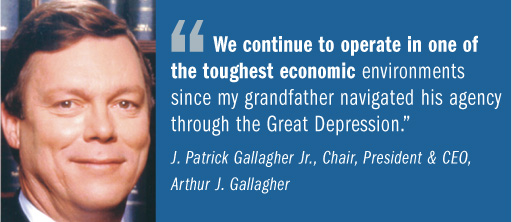
AJG saw slight improvement in the second quarter, with net income up by $200,000 to $44 million and revenues rising 1 percent, up $6 million to $460 million. Earnings per share dropped 2 cents in the quarter to 42 cents due to a charge for discontinued operations.
For the first half, net income increased 4 percent, up $3 million to $73 million, while revenues rose 10 percent, up $87 million to $942 million. Earnings per share was unchanged at 71 cents.
Second-quarter organic growth in AJG's brokerage segment stood at negative-3 percent compared to negative-1 percent for the same period last year. For the first half, organic growth for the brokerage segment was unchanged on a year-to-year basis at negative-3 percent.
Mr. Gallagher said the property and casualty business remains the toughest of all its segments. Many clients are not seeing signs of stabilization in their business and continue to buy less coverage units. The insurance business climate is further hampered by the continued soft market that shows no signs of letting up, he noted.
“It is fiercely competitive out there,” he said of the insurance placement climate, adding that the insurance cycle is at “an interesting point” because most carriers are trying to renew business at flat rates, but clients who shop their accounts will get “a reduction in their rate.”
MMC
In terms of revenue, Marsh & McLennan Companies–parent of insurance broker Marsh and reinsurance broker Guy Carpenter–reported a solid gain for the second quarter.
Net income turned around by $429 million–with last year's loss of $193 million flipping to the black, with income of $236 million. Earnings per share improved 80 cents, from a loss of 37 cents to a gain of 43 cents. Revenues increased 6 percent, up $136 million to $2.6 billion for the quarter.
For the first half, net income had a $501 million turnaround, from a loss of $17 million (a loss of 3 cents a share) last year to income of $484 million, or 88 cents a share. Revenues grew 7 percent, rising $328 million to $5.24 billion.
MMC's performance was impressive given the challenges “presented by soft market conditions in the global property and casualty insurance marketplace–which shows no signs of abating–and the overall weak economic environment in developed markets,” Brian Duperreault, president and CEO of MMC, emphasized during a conference call with analysts.
He said commercial insurance capacity is abundant and competition among carriers “remains intense.”
MMC's risk and insurance segment, which includes Marsh and Guy Carpenter, reported organic growth of 1 percent. Revenues at Marsh rose 9 percent, up $102 million to $1.2 billion for the quarter, with 1 percent organic growth. Guy Carpenter's revenues increased 7 percent, up $16 million to $243 million over the same period last year. Organic growth stood at 2 percent.
Revenue gains at Marsh were driven by double-digit increases in its Asia Pacific and Latin America segments, which grew by 28 percent and 17 percent, respectively–including organic growth of 12- and 13 percent. However, its United States/Canada segment reported negative organic growth of 4 percent, despite a 6 percent revenue gain.
The results, MMC said, reflected strong growth in new business in the quarter. (The day after reporting its results, MMC said it had completed the $1.13 billion sale of its risk consulting firm Kroll to Altegrity.)
Mr. Duperreault indicated that the cash the firm has accumulated–in excess of $2 billion–will primarily be used for acquisition activity. “My preference is to grow the company and identify good strategic partners and grow over time,” he said.
AON
Aon Corp. second-quarter net income grew 3 percent, up $4 million to $153 million compared to the same period last year, translating into a 3 cent increase in earnings per share to 54 cents. Revenues rose 1 percent, up $16 million to $1.9 billion.
For the first half, net income compared to last year was down 23 percent, off $98 million to $331 million. Earnings per share dropped 29 cents to $1.18. Revenues rose 2 percent, up $74 million to $3.8 billion.
“We believe we delivered solid progress against our core commitment to shareholders, and while we face headwinds from the broader economy, we are driving the set of initiatives that are driving strong, core operational improvement, positioning Aon for long-term growth with greater client-serving capability and effectively allocating capital to maximize shareholder value creation,” said Greg Case, president and CEO of Aon.
Organic growth improved to negative-1 percent from the previous quarter's negative-3 percent as the firm saw improvements in both its insurance brokerage and consulting business.
Mr. Case noted that despite the soft market and economic weakness in the United States and other parts of the world, the firm managed to maintain a high retention rate, underscoring its value proposition to clients.
WILLIS
Willis Group Holdings reported net income up 2 percent for the second quarter as it achieved organic growth of 4 percent despite the soft market and continued challenges from the economic downturn.
Willis reported second-quarter net income up 2.3 percent, rising $2 million to $89 million compared to the same period last year. Earnings per share was flat at 52 cents. Revenues grew 2 percent, up $15 million to $799 million.
For the first half, net income rose 5 percent, up $13 million to $292 million, with earnings per share up 4 cents to $1.71. Revenues grew 3 percent, up $57 million to $1.77 billion.
Willis Chair and CEO Joe Plumeri credited the company's performance with capturing new business and solid retention rates. “It is an outstanding result given the headwinds,” he said, citing the soft market and poor economy.
He noted that in the United States there is no evidence yet of a sustained recovery, while the rest of the world remains under economic pressure as well, resulting in a reduced number of exposures written.
When combined with the soft insurance market, he said it has been a tough environment to conduct business. Mr. Plumeri said there is little expectation the soft market will change “significantly” for the rest of the year.
Yet despite these challenges, he called the second-quarter organic growth performance in North America “stunning” at negative-1 percent, while Willis reported organic growth in its Global segment at 7 percent and International at 8 percent.
The controversy over contingent commissions came up during analyst conference calls with Aon and Willis.
Mr. Case said Aon's recent decision to accept contingent commissions where appropriate received a “very muted” reaction from clients. He underscored the need for transparency, but added that contingents were historically not a significant part of the firm's earnings.
Mr. Plumeri said Willis' stance–to take upfront commissions in lieu of contingents–has put it “in good stead with our clients and prospects,” but added he still expects to get paid for the work brokers do. “I don't expect to be paid any less because we do not take contingents,” he said.
© Arc, All Rights Reserved. Request academic re-use from www.copyright.com. All other uses, submit a request to TMSalesOperations@arc-network.com. For more information visit Asset & Logo Licensing.