Mutual insurers have a highly successful history in the United States and enjoy a loyal following among their clients, who like the personal service and value they are able to provide. But the competitive landscape is fierce–and mutuals now face tremendous pressures to secure a sustainable future.
Unlike shareholder-owned companies, the mutual financing model restricts access to capital. So it is reasonable to question how these organizations can stay fit for the future in a fast-changing world.
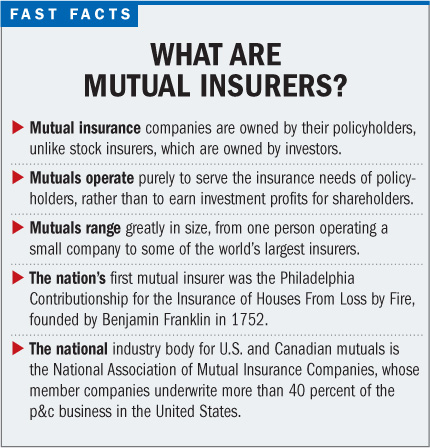 There are hundreds of mutuals operating across the United States, with a high concentration in the Northeast and Midwest regions. They account for around half of the homeowners market and almost three-quarters of the farmowners market, supplying traditional property and casualty insurance products.
Mutuals are well embedded in local communities, where they can build deep knowledge and understanding of specific policyholder risks and needs. This personal connection means mutuals lay claim to providing a high level of individualized service and value when compared to big national carriers, and indeed regional mutuals can outperform larger stock companies in certain lines of business by being more nimble.
They offer vital service and choice, including underwriting risks that national carriers may overlook. Policyholders repay them with strong loyalty. Our experience has shown that mutuals can enjoy client retention rates up to 90 percent.
However, mutuals face growing threats.
Large non-mutual companies are moving in–keen to diversify away from their coastal exposures–to compete for clients. These organizations benefit from enormous financial resources and scale, which enable them to fine-tune premiums to specific exposures, to add new coverage features and leverage multiple routes to market.
Better funding also allows competitors to invest in state-of-the-art technology to segment clients, evaluate risk, provide loss control services and use interactive Web-based technology to promote and sell products, settle claims and massively reduce their costs to serve.
STAYING RELEVANT: KEY STEPS
So how can mutuals stay relevant and competitive?
Among the key steps toward a sustainable future, and probably one of the most important, is mastering technology.
Mutuals need to ensure they continue to invest in technology and have access to the same tools as stock companies for key functions such as risk evaluation, marketing, sales and claims-handling. They need to get a firm grip on data-mining and other analytics used by their competitors to segment their customers and decide what business they really want.
Those that fail to take those steps face the daunting prospect of adverse selection–picking up the risks that others may already have rejected based on superior analytical capabilities.
The comparatively smaller mutual companies are embracing new technology such as using automated underwriting and multivariate rating engines to select and evaluate risk. But keeping pace with the big nationals is undoubtedly a struggle not just because technology is expensive, but also because it has fundamentally changed the way the market works. This approach can commoditize insurance and threaten the personal service model that has served mutuals so well.
Mutuals also need to ensure their Web presence is fully interactive and responds to customer demand for electronic application uploads, real-time quotes, funds transfer and billing. The key is to make doing business with the company easy and efficient. If it isn't easy and efficient, customers simply utilize those that are.
Along this path, and taking on an ever increasing importance, the emergence of social media channels (Facebook, Twitter and You Tube, for example) will further evolve the way customers research and purchase insurance coverage.
Accelerating this process is the emergence of smart phones and tablet computers. Large companies such as Progressive and GEICO are already at the cutting edge of these new technologies, increasing the pressure on all players to adapt.

Mutuals should also evaluate broker and reinsurance partners to remain competitive. It is vital that mutuals select partners who understand their business and are able to offer a wide range of resources that give them the best opportunity to successfully negotiate the market.
The right reinsurance broker and risk partner can add value in many ways, such as sharing information on risk modeling, helping to fine-tune underwriting guidelines, coverages and rates, and assisting with financial rating agency reviews. The insights these partners offer can help primary mutual companies perform better, make informed decisions and play to their strengths.
For example, a mutual may be interested in entering a new state or a new line of business. However, it may not have the internal resources to properly evaluate whether the exposure, coverage and legal challenges can be successfully overcome.
Strong reinsurance partners can assist by bringing their broader industry knowledge, underwriting/rating resources, actuarial modeling and risk capacity to bear so the mutual can make an effective business decision.
Last but not least, mutuals need to focus on succession planning–seeking to attract talented professionals to lead the business forward and meet the growing demand for risk management skills. This is a tough challenge since they are competing with other financial and consulting industries for the best people.
Companies that promote education, such as support of the Chartered Property Casualty Underwriter designation, appear to have the upper hand in putting the talent they gain to best use.
Mutual insurers continue to have a successful business model and contribute invaluable choice to the market. Although competition is intensifying and we expect some consolidation among smaller mutuals, there is still plenty of opportunity for those that can master technology change, exploit their local knowledge, and move swiftly and flexibly into new niche markets.
Eric Hubicki is a vice president and Charles Desmond is a senior vice president at BMS Intermediaries Inc. in Chicago.
© Arc, All Rights Reserved. Request academic re-use from www.copyright.com. All other uses, submit a request to TMSalesOperations@arc-network.com. For more information visit Asset & Logo Licensing.