Who do you really work for? That's a question all insurance buyers should ask of their agents or brokers. It's a fair question. You can't hide the truth.
Whether you're a big global broker like Willis, or a local insurance agency like in Eatontown, N.J., you can only serve one master. It's either the carrier or the client. You can't work for both.
Willis, unlike most retail brokers and agents, has planted its flag firmly on the side of its clients. That means not taking bonuses from insurance companies that would put us at odds with our clients' best interests.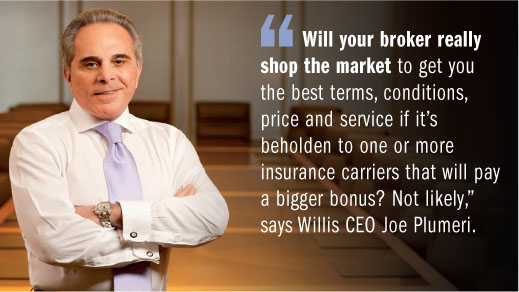
Writing in this spot on June 28, Kenneth Auerbach, immediate past president of the National Association of Professional Insurance Agents and a managing director and general counsel of E&K, suggested Main Street agents have no conflicts of interest simply because their customers are "fully aware they don't pay us (the insurance company does)." (See "Don't Penalize Agents for Mega-Brokers' Sins" at http://bit.ly/cY8u5x.)
Insurance buyers, however, should make no mistake: When doing business with an agent, they are dealing with a sales representative of the insurance company. There is nothing "independent" about an independent agent. They work for the carrier, not the customer.
Agents are paid by the insurers they represent–compensation with many ingredients that's ultimately baked into every premium.
That pay includes contingent commissions which are, essentially, sales incentives that are contingent on reaching volume and profitability targets. You bring us more business, and help us keep claim costs low to increase profits, and we'll pay you extra at year-end. Some agents count on these payments for, maybe, 100 percent of their annual profits.
Contingent commissions, by their very nature, work against the buyer's best interests. Those who buy coverage through an agent should know those agents aren't obligated to get them the best price, terms and conditions, or fight for them when they have a claim. No amount of compensation disclosure will change that fact.
Brokers, on the other hand, are supposed to be independent from insurance companies and represent the best interests of their clients, the insurance buyers. Brokers come in all sizes, from large multinationals like Willis, to small brokers who serve the insurance needs of a particular community. There are more than 30,000 licensed insurance brokers in the United States alone.
The trouble is you'll be hard pressed to find a broker who is less conflicted in their business as the independent agent across the street. Like agents, brokers also accept sales incentives from insurance companies that put them at odds with what they're supposed to do for their clients–get them the best coverage at the best price and advocate for them when they have a claim. That isn't right. How'd it happen?
At one time, insurance was predominantly a local business. Insurance companies sold policies from the home office through local salaried employees–the first insurance agents.
Over time, a new business model emerged in which agents took appointments from multiple insurers–the so-called independent agents. It worked great for insurance companies because it let them trim their salaried sales force and shutter local offices. But it also led to a new problem–how to incentivize these independents to sell policies with equal gusto as their captive, or salaried, agents.
That led to the rise of new forms of incentive compensation, including contingent commissions.
As carriers relied increasingly on independent distribution, they widened the incentive programs to include producers of all kinds–including brokers who were supposed to be working for the insurance buyer. Enter the conflict: How to faithfully represent the buyer on one hand, and take sales incentives from carriers on the other. Who did they work for, indeed?
The conflicts persist. Insurance buyers must consider this: Will your broker really shop the market to get you the best terms, conditions, price and service if it's beholden to one or more insurance carriers that will pay a bigger bonus? Not likely.
And when calamity strikes–the very reason you buy coverage–will your broker really fight for you, advocating on your behalf to get you the best payout in the fastest time? They may not, if a sweetened bonus–contingent on higher profitability and keeping claim costs low–is at stake.
These conflicts of interest were widely exposed in 2004 when several state attorneys general and state insurance regulators launched investigations into broker compensation that resulted in a ban on contingents for the four largest brokers in 2005. The ban affected only the tip of the iceberg. Tens of thousands of brokers remained free to take contingents, to the detriment of insurance buyers.
The ban also created an unlevel playing field, giving an unfair advantage to the rest of the pack. Brokers who accept contingents can low-ball their upfront commissions, knowing they can make it up on the back end with bonus payments from the carriers.
Even before the ban, Willis put a stake in the ground by voluntarily refusing to accept contingent commissions in its retail brokerage business–the only broker to do so. While a 2010 rule change allows the big brokers to once again accept contingents, our position will not change. We put clients before contingents every time.
Our stance has made us a better company–one that's more innovative and focused on delivering real value to clients, compared with those that simply manage their business to maximize their next contingent check. It's helped us retain clients and win new ones who share our view and want their broker to operate in a contingent-free zone.
Mr. Auerbach, along with many other agents and brokers, argue that contingents are legal, and simply being transparent about taking them eliminates the conflict. Some say clients can "opt out" if they don't want their broker to accept these bonus payments.
The fact is contingent commissions are paid annually on a broker's entire book of business, so the cost to the individual buyer can't be known until months after the insurance is purchased. Even then, the accounting is so opaque that the true cost can't be determined without a forensic examination of the books.
Whether you're a risk manager of a multibillion dollar corporation, or the owner of one of the millions of small businesses that are the backbone of our economy, you deserve to know how, and how much, your insurance broker or agent gets paid.
Not only can it affect the cost of your premiums, it can determine the quality of your coverage, and your ability to recover a claim when something goes wrong.
These back-door bonuses are a hard habit to break. They won't fade away by themselves, and a regulatory fix is unlikely. That's why we've launched an industry education effort called "Clients Before Contingents" (www.clientsbeforecontingents.com).
It's our hope that by continuing to provide information about the conflicts that contingents create, we'll get buyers to vote with their wallets and ask their brokers to refuse these payments.
As a broker that operates in more than 130 cities across America, we know the value of local service and personal relationships. Working with a broker or agent who knows you and your business should bring an added measure of comfort and sense of security.
But make sure it's not a false sense of security. It's important to know where the loyalties of your broker or agent really lie. Ask the question: Who do you work for? Knowing how your agent or broker gets paid can make all the difference in the world when insurance matters most.
Joe Plumeri is Chairman and Chief Executive Officer of Willis Group Holdings, the global insurance broker.
© Arc, All Rights Reserved. Request academic re-use from www.copyright.com. All other uses, submit a request to TMSalesOperations@arc-network.com. For more information visit Asset & Logo Licensing.