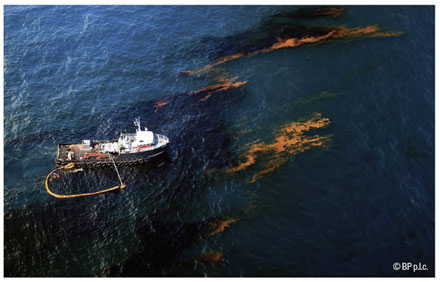
 As the nation and world are mesmerized by the sight of oil gushing from a well on the Gulf of Mexico's floor, a new fear is arising about the course the oil will take and which areas will be most affected long-term. With hurricane season just a month old, we have to wonder what impact hurricanes in the region will have on the expanse and damage from the gushing oil.
Five years after the fact, we continue to watch as courts wrestle with the question of whether water damage that occurred during Hurricanes Katrina and Rita should be covered through residential and commercial property policies. Other tricky questions arose when policyholders who carried flood insurance first made a claim on that line and then tried to recover additional damages by claiming the damage was caused by wind and thus should be covered on their property policies. How complicated will these issues become when a third element — pollution — is added to the equation?
Mixing Oil and Water
The National Oceanic and Atmospheric Administration (NOAA) has begun speculating as to the potential effect of the oil slick on hurricanes that are likely to run through it. NOAA, in a recent fact sheet, explains that the oil should have little impact on a storm. This is because most hurricanes span enormous areas, likely much broader than the current size of the oily residue. If the slick remains small in comparison to the size of a hurricane that moves through it, "the anticipated impact on the hurricane would be minimal."
A hurricane may, however, affect the spread of oil. NOAA predicts that hurricane-generated storm surges may carry oil inland as far as the surges reach. In addition, hurricane-carried debris may be contaminated by not only oil from the BP deep water accident but also other oil releases that may occur in the normal course of such storms. A hurricane probably will mix Gulf waters and disperse the oil that now is primarily below the surface.
From an insurance perspective, it is likely that any coastal damage that is exacerbated by the discharge will further complicate the coverage issues that arise.
Litigation that continues to play out from Katrina and Rita has analyzed the flood exclusion, as well as the anti-concurrent causation (ACC) language that precedes many water damage exclusions. Most of the major cases have been determined in favor of insurance companies, as courts upheld both the flood exclusion and the ACC language.
In 2007, however, the Louisiana Fourth Circuit Court of Appeals in Sher v. Lafayette ruled that the homeowners' policies in question failed to exclude all forms of flooding because the policy language was ambiguous. In differing from previous federal court decisions, the Sher court stated that because flood was not defined on the policy, the exclusion was ambiguous because natural and man-made floods were not mentioned. Since the case involved water damage that had coursed through man-made levees that were meant to stop such waters, the state court would not enforce the exclusion.
On appeal, the Supreme Court of Louisiana dismissed the distinction between natural and man-made flooding, stating that the flood was not caused by man but, rather, by Hurricane Katrina. The levees did not cause the flood but, rather, failed to prevent it. So the exclusion was upheld.
How complicated would the Katrina claims have been, however, if pollution damage were added to the mix? If the coast experiences not only wind and water damage this season, then will policy language that attempts to address pollution issues lead to even more complicated claim issues?
The Pollution Exclusion
It is understood that BP Oil and its subcontractors carry various levels of pollution liability coverage, although it is difficult to envision this coverage being expansive enough to satisfy potential coast dwellers' injuries and damage. But will residents and business owners be able to turn to their property insurance policies for relief?
Typical homeowners' policies exclude damage arising from the discharge or dispersal of pollutants, unless the release of pollutants is caused by a peril specified under Coverage C, Personal Property. There are 16 Coverage C perils on a standard homeowner's policy. Although windstorm is included, the environmental damage would not be caused by the windstorm, but rather by the rupture of the underwater well. The pollution damage would be a consequential result and not direct damage. Therefore, it is expected that coastal residents will not be able to turn to their homeowners' insurance to foot the bill for cleaning up oily water that may be brought ashore by a hurricane.
In similar fashion, the typical commercial property policy excludes damage arising from pollution unless it arises directly from a specified cause of loss. The standard policy does, however, offer additional coverage for pollutant cleanup and removal from land and water that is triggered only if the discharge or dispersal is caused by, again, a covered cause of loss. A case may be made for this additional coverage to be triggered for clean-up funds. Policyholders and adjusters will have to keep in mind that the additional coverage for clean-up is only applicable to polluted land or water — not clean-up of pollution from real or personal property.
Oddly enough, those insureds who carry flood insurance through the National Flood Insurance Program (NFIP) may be in better position to have pollution clean-up costs included in a flood recovery (see sidebar, "FEMA Says NFIP Will Pay"). Neither the NFIP commercial nor residential forms specifically exclude pollution. Only the residential form states that it will not pay for the "testing for or monitoring of pollutants unless required by law or ordinance."
Ironically, these flood policies may end up as the primary source of clean-up funds for those property owners who carry flood insurance and can make the case that the pollution was caused by flood and not wind—the reverse of the argument that was used primarily in the wind-versus-water litigation following Hurricanes Katrina and Rita.

© Arc, All Rights Reserved. Request academic re-use from www.copyright.com. All other uses, submit a request to TMSalesOperations@arc-network.com. For more information visit Asset & Logo Licensing.