Scottsdale, Ariz.
As the economy goes, so goes the insurance market, excess and surplus lines experts agreed at a meeting here.
While there were some differences in opinions about whether the economy is starting to rebound, representatives from wholesale brokerages and an E&S insurer said that an economic recovery would help to turn around soft market conditions that have led to increased encroachment by standard carriers into traditional E&S lines.
The comments were made to National Underwriter during the 2010 Mid-Year Leadership Forum of the Kansas City, Mo.-based National Association of Professional Surplus Lines Office Ltd.
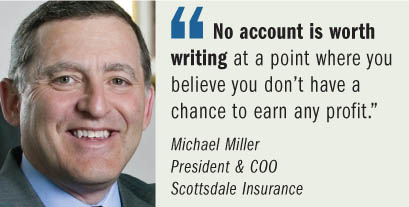 Michael Miller, president and chief operating officer of Scottsdale Insurance Company, said he believes the economy “is a big contributor to the soft market.” He noted that there are just as many players in the market, but they are competing for risks in a shrinking economy, which is helping to drive competition.
“Everyone's reacting to what the economy is doing,” he added.
Jim Roe, president of Indianapolis-based wholesaler and managing general agency Arlington/Roe & Co., agreed. “Obviously any market is a measure of supply and demand. So right now, we've had, for the last number of years, a lot of supply, and with the economy being down, there's less demand for insurance,” Mr. Roe said. Participants in the specialty and surplus lines area “just try to be that relief valve for agents and customers that have a specialty need or a surplus lines need,” he said.
Standard carriers, Mr. Miller noted, started dipping into E&S lines about three-to-four yeas ago. Typically, he explained, standard carriers will write E&S lines in soft markets, and then back out again as combined ratios rise and they re-examine their books.
But so far, Mr. Miller said, the standard companies are continuing to see manageable combined ratios and rates of return in the traditional E&S lines.
Mr. Roe said insurers' loss ratios are up, but they're writing more premiums to fuel top-line growth. He added that, for many insurers, it is about “premium, not profit.”
A lack of hardening in reinsurance rates is compounding the problem, he said.
While there may be unique aspects to this soft market because of the economy, Mr. Roe and Mr. Miller both noted that soft market conditions are nothing new for the insurance industry.
 Mr. Roe said that in the Midwest, where his firm is based, there are so many regional and mutual companies that take care of most agents' needs that there are never as many E&S opportunities there as compared to coastal areas. He said capacity seems to come to the Midwest “anytime the wind blows or the earth shakes” on the coast.
“We have a perpetual soft market there,” Mr. Roe said, adding that the market never gets hard, just less soft.
Mr. Miller said this soft market has actually been relatively short compared to other soft markets, and he added that the industry spends the majority of its time in soft markets anyway.
Alan Jay Kaufman, chairman, president and CEO of Burns & Wilcox in Farmington Hills, Mich., also said this soft market has been about on par with previous ones. He added, though, that the current market has been a “perfect storm” of no major hurricanes, a lot of available capital, and a struggling economy. He predicted more hard times ahead.
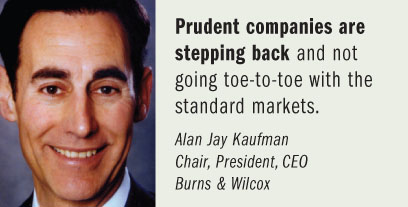
For E&S insurers in this market, they have a choice whether to try and compete with standards, or to back off and move to other areas, according to Mr. Kaufman. The prudent companies, he noted, are stepping back and not going toe-to-toe with the standard markets.
As for strategies employed to cope with the market and economy, views were mixed.
Mr. Miller said: “I don't think we change our strategy during a soft market. We're always working hard to deliver products and services to meet the needs of our insureds and agents.”
He added, “One thing we're making sure we do is we're out visiting our agents, and talking to them about what they do to meet [customers'] needs.”
 He said he is also paying attention to the economy to see if there is a need to change or modify programs. With the economy down, he said, some accounts in certain areas, such as construction, have lost volume. That, Mr. Miller said, will affect pricing, as general liability premiums are based on payroll or sales.
Another difference between hard and soft markets, he said, is in a hard market, an insurer can put out a quote and move on to the next opportunity. In a soft market, “once you put a quote out, you have to keep working at it.”
It is important, he said, for companies competing in a soft market to be able to draw a line in the sand and have a walk-away price.
Mr. Miller acknowledged the dilemma companies face when fighting to retain risks they like, but he said in the end, discipline must prevail. “If it's an account you really like, obviously you're going to work to retain it,” he said. “And you understand that account better than many other accounts because you've had it for a while… But I still think at the end of the day, if someone else is going to price it in what we would consider to be a ridiculously low price, no account is worth writing at a point where you believe you don't have a chance to earn any profit.”
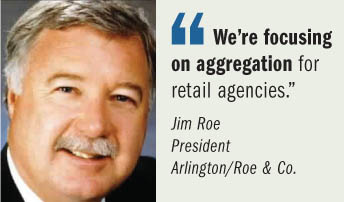
Outlining his strategy in this soft market, Mr. Roe said, “We're focusing on aggregation for retail agencies.” He said retail agencies are looking for more revenue in an environment where prices are dropping and competition is high.
“What we do,” he said, “is go in there and say, 'Why don't you take a look at all the wholesale intermediaries–MGAs, program managers–all the intermediary business you do? And what we can do with all the specialties and markets that we have, is help you aggregate that business with fewer MGAs and wholesalers.'”
Mr. Roe said, “We've been fairly successful with that.”
For Mr. Kaufman, the strategy is to stay ahead of the market and get involved in growing areas. He said Burns & Wilcox is focusing on recreational products, where there are still insurance needs to be filled. The wholesaler is also expanding offerings in medical niches such as spas, clinics and plastic surgery, he said.
Identifying and growing in these areas, he said, is important rather than focusing on an area such as manufacturing “which is dying.”
To identify growing areas, Mr. Kaufman said Burns & Wilcox draws upon its presence around the country.
He said Burns & Wilcox is also focusing on bringing more expertise in certain areas, noting as an example that the wholesaler has hired people with more expertise in certain professional liability niches.
Ultimately, Mr. Kaufman said the strategy is to remain active–making acquisitions, investing in technology and hiring new people–rather than pulling back and waiting for the market and economy to change.
When will the economy recover? Experts had differing views.
Mr. Kaufman and Mr. Roe both said they have seen no change in the economy. Businesses are still struggling, they said, and Mr. Roe–speaking for the Midwest–said Michigan in particular remains in trouble.
Mr. Miller, though, said he has seen some signs of recovery–pointing to more visitors in the Scottsdale area, and more people in general in restaurants and airports.
“Attitudes are improving,” he said, and added that the economy is driven by attitudes.
© Arc, All Rights Reserved. Request academic re-use from www.copyright.com. All other uses, submit a request to TMSalesOperations@arc-network.com. For more information visit Asset & Logo Licensing.