The tough economic realities of the past year have led insurers to fundamentally re-evaluate how they interact with IT vendors. However, the response has been anything but uniform.
Some carriers have transitioned to a tactical focus, dealing with individual, isolated challenges. It's easy to see why. When push comes to shove, pressing issues still need to be handled. Priorities rule. Overreaching in a tough climate can open the organization to undue risk.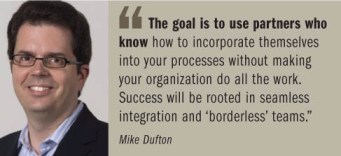
On the other hand, there are carriers that have maintained a strategic plan for vendor partnerships in spite of the temptation to do otherwise. They have used the increasing sense of urgency caused by stalled growth rates to revise how the basic carrier/vendor partnership functions in a modern, information-driven economy.
These organizations have recognized the value of a shared risk-reward model, with greater integration of vendors and consultants than in years past. Today, strong partnerships are seen as the basis for sustainable success with lower risk.
So, what is the new strategic model for information technology at insurance companies?
Tactical thinking may have helped budgets in the short term, but it left unleveraged opportunities on the table.
Today's CIO is increasingly concerned with tying initiatives directly to business issues. They want to be proactive and keep their company competitive, but they would rather do it in an agile manner, keeping their home team lean and letting their workforce expand and contract based on project need.
Here is where strategic long-term relationships prove themselves.
In a shared risk-reward relationship, there is a second entity that shares the desire to succeed in a timely manner. They have an equal stake in success and they often have more experience than the carrier at bringing the project to a successful completion.
Your organization may, for example, have completed two or three major underwriting projects in the last decade. A good vendor may have completed dozens of underwriting projects. They have seen the obstacles and surmounted many of them.
Meanwhile, their depth of domain expertise may be able to save you thousands of unnecessary hours. Their solutions may have more functionality than your team ever knew existed.
From a risk-reward perspective, outside IT staff are often less expensive, with either a fixed cost or variable cost model that can help organizations scale up and scale back to meet their needs. They are commonly good at estimating and helping to develop an accurate business case.
The new model of IT uses the vendor relationship to fill gaps in expert development, architecture design and even project management. A fringe benefit to integrated teams is that when two firms are involved, teams feel the weight of increased accountability.
A concurrence of economic pressure, available technologies and consumer tastes has also created opportunity to revamp core processes.
New business underwriting, policy administration and business intelligence are all experiencing rapid innovation and change, with new technologies presenting expanded functionality.
Billing is another area where investment in new technologies can pay off and speed otherwise slower processes.
The advancements come at a good time if carriers make the decision to capitalize on them. Consumers are looking for better, faster service–more in line with what they have come to expect from retailers and banks.
New channels can be used to cultivate business, maximizing producer productivity and underwriter availability. Consumer desire to shift to the Internet is changing the roles of producers. The net effect is that the whole process can be streamlined.
The hurdle is that all of that change can carry a heavy cost, at a time when most carriers aren't in a position to make tremendous investments.
Here is where business process outsourcing–BPO–with a trusted partner can provide real value.
Some vendors offer hosted solutions or BPO environments that can release insurers from the weight of technology investment.
In a BPO arrangement, an organization typically loses a little control over application development while gaining deep functionality and regular technology upgrades. Insurer chief information officers have to worry less about keeping up with new technology and can focus more on the real issues of business.
Traditionally this is one of the most difficult decisions to sell internally, yet when management views the business case and sees the results, it can be one of the most successful.
Both ideas–using partners for IT development and the concept of outsourcing–have to be approached carefully. Their success will be rooted in seamless integration and borderless teams.
The goal is to use partners who know how to incorporate themselves into your processes without making your organization do all the work. Clear communication and clear expectations make a good foundation.
But it is the day-to-day interactions that fuel a great partnership. When your integrated teams begin to see themselves as an integrated unit or when your users forget the system is run out-of-house, you'll see the real value in a strong IT partnership.
Mike Dufton is president and senior vice president of the North American Business Unit at MajescoMastek, a global provider of technology solutions for insurers headquartered in New York. For more information, go to www.majescomastek.com.
© Arc, All Rights Reserved. Request academic re-use from www.copyright.com. All other uses, submit a request to TMSalesOperations@arc-network.com. For more information visit Asset & Logo Licensing.