The regulator leading the National Association of Insurance Commissioners' controversial effort to collect insurer climate risk data said companies will be given lots of leeway in responding. But carrier groups–already leery about the possible exposures they'll face by participating–are also alarmed about how the survey might be implemented should a particular state not fully cooperate.
Pennsylvania Insurance Commissioner Joel Ario, who chairs the NAIC's Climate Change and Global Warming Task Force, addressed the issue last week during a Climate Risk Summit here.
At an earlier NAIC Task Force session, in remarks that had surprised insurance trade group representatives, he had said that, in pursuing data for NAIC's Climate Change Disclosure Survey, if an individual state chooses not to administer the survey to a domiciled insurance group, regulators will seek the information from one of their subsidiary companies in another state.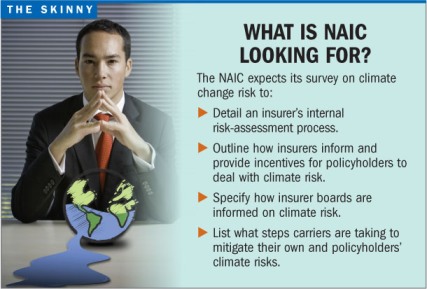
In response, David Kodama, director of policy analysis for the Property Casualty Insurers Association of America, said the situation seems to be one of regulators in one state not respecting the decisions of colleagues in another.
Mr. Kodama compared it to a parent deciding whether their children will participate in an activity, and then someone else trumps that decision and makes them participate anyway. He said regulators should respect the decision if one regulator decides the survey is not appropriate for the insurers in their state.
Robert Detlefsen, vice president of public policy at the National Association of Mutual Insurance Companies, echoed those sentiments, stating that a regulator might not be making the decision to not administer the survey simply because of lack of resources at the insurance department. The regulator, he noted, might be philosophically opposed to the climate risk disclosure survey, adding that should be a decision respected by other regulators in other states.
Mr. Detlefsen wondered if the NAIC would take it one step further and administer the survey to the second company in a group if it does not like how the regulator in the lead state administered the survey.
In his later remarks that seemed designed to mollify such concerns, Mr. Ario said the aim is simply to get all of the required companies to answer the questions, then see what responses companies give and what comments are received in response.
He said he is not expecting insurers to answer the questions in any specific way, and commissioners want to give companies a lot of flexibility in how they respond.
"I'm sure we're going to get some people giving extremely detailed answers trying to show everything they're doing," he said. Others, he added, may be doing more in the climate change arena than they indicate on the survey but are nervous about putting it in the public record, "and then we may get some companies that are giving a very cursory set of answers."
The NAIC will initially administer the disclosure survey to insurer groups, where only the lead company–defined as the insurer within the group that reports the largest direct written premium volume–must submit the survey to its domestic regulator.
Only groups with $500 million in direct written premium in 2009 will have to complete the survey for 2010. In 2011, the number drops to $300 million.
One industry association representative, reacting to Mr. Ario's earlier comments, said if the NAIC plans to look to the next largest insurer in the same group domiciled in a separate state if the regulator of a state containing a lead insurer chooses not to administer the survey, he wondered whether the NAIC would use a similar tactic to obtain the sort of answers the NAIC wants.
But Commissioner Ario said later that the NAIC is only looking to make sure it gets responses–be they detailed or vague–from every insurer.
He added, though, that regulators could follow up if they have an interest in a company that answers the survey from a different state–particularly if there is a regulatory concern, such as solvency, with a survey answer. "All that kind of second-level follow up, that's part of the idea," Commissioner Ario said. "There's a public record now and people can look at it."
He added that "once it's all out in the public arena, we will welcome all of that kind of comment, but beyond simply trying to make sure every company answers [the survey], we are not trying to create a threshold beyond, 'you are required to answer, and we hope you'll answer as best you can.'"
Regarding whether there will be more detailed requirements going forward in the second year of the survey, Commissioner Ario said "there could be–that depends on what happens."
He said individuals or groups will read the survey answers, which will be made public, and commissioners will listen to their recommendations. "This is an area where we're not going to be short of people advising us of what we should do," he said, "so we'll listen to all of that carefully."
The NAIC is looking at climate risk in insurer internal risk-assessment process, how they inform and provide incentives for policyholders to deal with climate risk, how insurer boards are informed on climate risk, and what steps carriers are taking to mitigate their own and policyholders' climate risks.
NAIC's effort has drawn objections from industry representatives worried that answers could reveal proprietary information and provoke policyholder lawsuits if insurers disclosed they were not writing or were canceling coverage based on climate change exposures.
© Arc, All Rights Reserved. Request academic re-use from www.copyright.com. All other uses, submit a request to TMSalesOperations@arc-network.com. For more information visit Asset & Logo Licensing.