Review and Outlook 2009-2010: Insurance company executives
How has the recession changed the way your company conducts business? 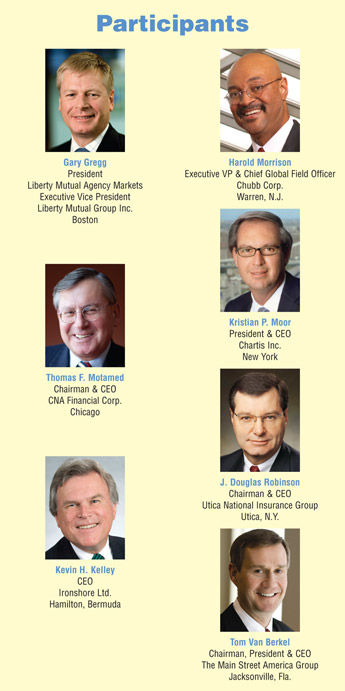
Kristian P. Moor: In many important respects, the challenges of the past year have made our businesses stronger.
In that time, we have spoken with thousands of our clients and brokers and as result we now are more attuned to their needs than ever before.
We've taken many steps–including rebranding as Chartis and announcing one global management team–that have helped unify our businesses globally, which will benefit all of our stakeholders.
The past year also has made us more informed as marketers of our company and even more motivated to grow the business. Chartis businesses were stable, profitable and debt free before the recession began, and they still are due to the extraordinary efforts of everyone who works here.
Harold Morrison: The recession really has changed the way we conduct business, because it is very influential on our clients. On the commercial side, the reason our sales are down is the level of layoffs of employees among our clients. That's a big rating base for us. We've resolved to work with our clients on their deductibles and limits to make sure they take care of their risk and get through this crisis with minimal impact on their business.
Kevin H. Kelley: The slowdown in economic activity affecting other companies is very different for us. We'll be 3 years old this December, so in contrast to them, we're in a building mode.
The economic slowdown is affecting us less than companies with a more mature market position. We're hiring people, leasing space in many cities. The benefits of reduced rents are advantageous for us.
So we look at economic conditions very differently than might someone from a Travelers or a Chubb.
Thomas F. Motamed: I think the short answer is that we're working harder; we're becoming a little more aggressive.
We've expanded our lines of business. They now include business services, construction, healthcare, financial services, manufacturing, professional services, retail, real estate, technology and wholesale distribution.
With our services, if you look at risk control, we're always looking to expand our capability. And we have a good facility, whether it's for construction, IT, etc. Ultimately, we'll be able to hold down costs for the insurance buyer. We're a fairly large writer of workers' compensation, which is about safety and getting people back to work. We do that as well as anybody out there.
Gary Gregg: I wouldn't say that the way we conduct business has changed, but our mindset has changed. It has heightened attention in some areas: the retention of good business–that's critical; paying attention to the balance sheet and growing our capital base; and ensuring that we're managing expenses in accordance with the downward pressure on premiums and revenues. This is a time when lack of solid execution can be costly. We have to maintain enterprise risk management and an adequate balance sheet.
Companywide, we've reduced our dependence on any one line of business, on any one distribution system and on any one geographic area. It's positioned us well to deal with shifts in consumers' buying behavior.
We weren't into subprime securities or hedge funds–we don't get involved in what we can't understand. We were getting uncomfortable with the stock market in late 2007, so we reduced our exposure to equities pretty early in this cycle.
Tom Van Berkel: The recession has not changed any of The Main Street America Group's core values–ownership, relationships, service–or our overall market strategy. It has led to a deeply prolonged soft market, which has caused our ability to grow premium to be quite difficult.
Our independent agent customers tell us repeatedly that they value our consistency. A large part of this comes from our being a company that adheres to very disciplined underwriting strategies and pricing methods, making sure we match risk with rate. We refuse to engage in irresponsible underwriting and pricing practices. As a result, it is making our growth more difficult than normal. But we would rather appropriately price business today than have to react to an underpriced book tomorrow.
To respond to the need for top line growth, we have placed greater emphasis on assumed reinsurance and program business and have been actively seeking mergers, acquisitions and affiliations with companies that share our Main Street niche and values.
J. Douglas Robinson: The biggest impact it's had is its impact on revenue. Our top line revenue is lower. As a result, we have to watch our expenses–we have to look at every expense and adopt our operations accordingly.
Many firms also are cancelling capital investments, so there's less to insure. We have to accept that and maintain our underwriting integrity.
There's still too much capital pursuing too few exposures, but in my opinion, in 2009, the industry will show some solid underwriting profit by harvesting reserves that were previously recorded, but won't be needed.
Our expenses fall into three general categories: taxes–there's not much you can do about that; commissions–there's not much you can do about that, either; and people and related expenses, such as phones, lights, heat, etc. There have been no major layoffs, and we don't intend any. But we continue to redeploy people to where we need them. For example, we're expanding in underwriting but we're reducing our back office. We have fewer people, mostly through attrition. Some positions have been eliminated, though that's done fairly rarely.
Operational expenses are being reduced to essential minimums for us to operate. This includes travel, entertainment, agents' conferences, country club memberships–everything down to the number of printers we need in a building.
Has the soft market and recession caused you to change your distribution strategy? If so, how?
Gregg: I would say that strategically, we've been well along our path for 10 years.
Our overriding strategic thrust is that we can't dictate to our customers how they purchase insurance from us, and that's true in every sector of the personal and commercial lines marketplace–whether it's on the direct side, in affinity business or on the Internet.
In January, we announced we no longer would sell direct to middle market companies–those that purchase from $150,000 to $1 million in property-casualty insurance premiums annually. The middle market was among our direct business clients since 1912. But in 1999, we acquired Wausau Insurance Co., which distributes through brokers and agents. We merged into our Liberty Mutual Middle Market unit that middle market business that would use exclusively brokers and agents. Liberty Mutual sold its renewal rights to its direct middle market business to several brokers.
I wouldn't say this is related to the recession. It's related to the increasing middle market layer. As the complexity of their needs have changed, they have relied more on agents and brokers, and it's more difficult for direct sales to meet those needs.
Meanwhile, our Safeco acquisition has brought us a very strong competitor in the personal lines market. It, too, uses the independent agent and broker distribution system.
And companywide, we have multiple distribution channels on the commercial side.
We've been working very hard on our distribution strategy. It's positioned us well for the changes caused by the recession.
Van Berkel: The soft market has not changed The Main Street America Group's distribution strategy. We are still 100 percent committed to independent agents, and we also are committed to geographic diversification, which we have been very successful at.
In our 2010 plan–which is part of a 5-year strategic plan Main Street America implemented in 2006–we said we wanted to be in 5 additional states, and we have entered 6 additional states in just the past year.
Our new states are Michigan, with the fourth-quarter 2008 acquisition of Great Lakes Casualty Insurance Co.; Oklahoma and Texas, via affiliations in homeowners program business; and Arizona, Nevada and Utah, through our affiliation with The Leavitt Group, which will exclusively represent us for commercial lines.
By year-end 2009, our new affiliation with Indianapolis-based Grain Dealers Mutual Insurance Co., a transaction scheduled to close around Dec. 1, will add additional new states to the mix, notably Indiana and Mississippi.
Altogether, that makes 24 total states for Main Street America, including eight since the start of 2008. This has enabled us to generate, on a net basis, positive premium growth. Our goal for 2009 was to write $40 million from our new states, and we are right on target for that.
We will continue to seek more spread of risk, more geographic diversification and more distribution points.
Robinson: It hasn't materially.
Our distribution strategy changed slightly to give consumers more for their dollar, with an emphasis on information. We tried not to expand coverage. A problem with the soft market is giving away coverage you shouldn't. The exception was identity theft coverage.
With our distribution of coverage through independent agents, our strategy is to give customers more of what they want so they won't feel compelled to move to a company that can give them 24/7 information on bill payments, etc. We had to provide that. The recession has put pressure on our customers' discretionary income, and so they're looking for this.
We are committed to our independent agent distribution system.
Kelley: No, we're building our distribution strategy, and I think our operations are causing us to look at it very differently than others might.
In the United States, we're building a multi-dimensional approach. We've retained wholesale producers and program administrators. The economy has very little impact on that.
With our operations in Bermuda and London, the distribution system is very different in those two venues. In Bermuda, you can rely only on Bermuda brokers. In London, you can rely only on a London broker. Those are the only choices you really have.
Morrison: It's not that the soft market is changing our distribution strategy. At Chubb, we've pretty much targeted our agent group, as we work with 4,500 out of the 37,000 that exist. They're really our sole source to access customers.
They're focusing on lines where prices have held up, focusing on the differentiation they can bring and we can bring to attract new customers and retain customers, because of their expertise and services.
Motamed: CNA is pretty set there. We do business with about 3,000 independent agents and brokers in the United States. That pales in comparison to the number at the typical property-casualty insurer, which works with 8,000, 10,000, 12,000 agents.
So, we really haven't changed much on the retail side, other than getting closer to them. We're opening up 5 new offices–in downtown Chicago; in downtown Los Angeles; in downtown Washington, D.C.; in Westchester County, N.Y.; and in Birmingham, Ala.–to produce new business and service accounts.
We've also created a wholesale division that focuses on wholesale brokers. We have a facility that will work with wholesalers of excess and surplus non-admitted business.
And we've broken up our branches into zones. The top officer is responsible not only for profit and growth of that zone, but also for how we move resources around based on the opportunity in the marketplace, regardless of whether it's a standard lines or specialty risk. Those resources are underwriters.
And we're hiring 100 specialty underwriters for our D&O business and health care as well. With healthcare, that used to be centralized. But now we're decentralizing that business by putting more people in the branches, at the point of sale.
Our objective with this is to be much more customer centric. We want to be able to appeal to the agent to write specialty business as well as standard business, and you really have to do that at the point of sale.
What are your company's 2010 goals, and how will you achieve them?
Robinson: The main difference in our 2010 goal is to recognize that renewal premiums are subject to recessionary pressures and continue to be depressed and that we have to increase new business to offset that.
To do that, we have to expand our agency plan and bring in new and innovative products to the market. We have to expand our technology to be more user-friendly. And we have to invest in our people to make everyone better in the marketplace. We have to be better without giving up our underwriting integrity.
Do we have walk-away pricing? Absolutely. We have very, very strict guidelines. Analytics modelling gives us a very good idea of what our walkaway price will be on any risk. We'll work hard to keep renewals but will absolutely walk away and give up business. That's the reason we haven't shown any top line growth the last few years. It's easier to recover from that; it's tougher to fix a book of business when losses start to show up.
Motamed: There are five generic objectives on our mind for 2010 and beyond:
- We're trying to create sound business to grow our top and bottom lines.
- We intend to build stronger producer relationships. That's why we're out filling branches with more underwriters. We're putting them at the point of sale.
- We want to deliver superior service internally and externally. From the producers' standpoint, we want to satisfy their needs, and internally, we want to operate as efficiently as possible.
- We want to build our human capital. We're pretty successful at bringing new people on board who are considered top in the industry.
- We want to build a culture of collaboration through communication. We need to talk to each other so we get better solutions for producers and customers.
Kelley: The prospects of 2010 don't look good from an economic standpoint. We see some very, very slow growth in 2010, and many lines will be limited because of the effect of unemployment.
Our growth will be driven by getting into new business and the business within those businesses. In 2009, we doubled the number of businesses we were in, not because of the economy but because of the strategic approach for our company. I don't see that occurring in 2010, but I'm seeing us having more people, leasing more space and growing the top line.
Morrison: We're at the stage now from a goals or financial standpoint that we believe 2010 will continue to be a little like 2009. Regarding the economy, there will be the impact of financial markets coming back, but there's always a lag between when employees start to do better and when sales increase for
our customers.
So, first and foremost, we're working with our partner producers to provide products and services that our customers need.
We also are making sure our financials, our balance sheet stays pristine and that we maintain our underwriting discipline so we're profitable and we can be there to meet our customers' needs. Also, managing expenses is important.
And we have to use automation technology to make it easier for agents to do business with us and in a way that meets the needs of customers.
Moor: Our plans for the New Year include the elements that have made us successful over the past 90 years–a global leadership position in property-casualty and general insurance with the largest geographic footprint, a breadth of product that is unrivalled, a broad risk appetite, experienced underwriting and claims service professionals and industry-leading financial strength.
We also see many specific opportunities domestically and overseas that we can capitalize on in 2010 and beyond.
In North America, we are particularly focused on our multinational segment and offering the very best service in the industry for brokers and customers.
Internationally, the growth opportunities before us include the expansion of multinationals on a regional basis–that is, single-country businesses in Brazil or Europe, for example, that are branching out into other countries. We also think we can capitalize on the opportunities that will materialize in the marketplace as affluence and the concept of insurance expand globally.
Brazil is a great example in this regard. It's scheduled to host the World Cup in 2014 and the Olympics in 2016, and there are hundreds of billions of dollars that already have already been committed beyond those two events to infrastructure and other projects. Brazil has always been important, but particularly now.
Van Berkel: In 2010, The Main Street America Group will continue to support our customer, the independent agent. We will also continue to seek new market opportunities through either acquisitions of small to mid-sized insurance companies or affiliations with other mutual insurance companies.
We expect to see some industry price firming. We already are starting to see that in personal lines in most of our states. We are also getting a few anecdotal stories in commercial lines. We believe that as the economy continues to improve, exposure bases will increase, and we expect that to trigger more rational competitor pricing.
Our company will be looking for positive top-line growth through our existing customers/ agents in existing states, and we will try to leverage new opportunities in our new states. We will be looking to appoint approximately 100 new agents as we methodically increase our
distribution points.
One of our biggest initiatives will be to continue implementing our new Main Street Station policy-processing platforms for commercial lines and personal lines. We expect to have this rollout completed in all of our states in 2010. This is in addition to the rollout of our Main Line BOP, our significantly expanded business owners product, which features four additional programs–restaurants, garages, condo associations and light manufacturing–and 106 new classes, for a total of nearly 500 classes.
Gregg: We continue to be conservative in our view of 2010. We don't expect a strong recovery in the economy.
Our goal is a continuation of where we are in 2009. If we end 2010 saying we were disciplined and didn't chase growth and priced accurately and grew our capital base, we'd be proud of that. Regarding our capital base, we want to manage our balance sheet and grow capital through prudent investing, solid underwriting and managing our expenses.
2010 is a year we need to be careful and cautious. We need to tighten our belts, get the machine running well, keep expenses down and prepare for better times in late 2010 and 2011. Growth will be tough to come by and expensive for those who pursue it in a soft market and this economy.
What specialties or lines of business have the best potential for growth in 2010 and beyond?
Kelley: As I said, we are a specialty company. I think D&O and professional liability coverage demand probably will exceed supply, and it continues to be an area we're interested in.
And as the economy begins stabilizing and recovering, demand will increase in several areas, including high capacity excess casualty.
We think 2010 will be a good year for us. We'll continue to outpace the market on top line growth. We will still face some very challenging issues, but ours are different than more mature companies.
Robinson: We see three general categories. Personal lines, because it's not as dependent on market cycles as commercial lines.
The E&S lines business has great potential. It's a business that a company like ours has typically ignored. But we're not just chasing premium dollars. Predictive analytics tells us a lot about our conventional wisdom and our biases that have kept us out of certain markets.
Rural exposures–unprotected buildings such as barns–are tied to predictive analytics. Mainstream insurance companies–like us–don't like barns, because they're 10 miles from volunteer fire protection stations, and usually if there is a fire, you don't save the barn. The difference is if you look at it similar to underwriting a life insurance exposure. There are always losses with life insurance, and so you price accordingly. There's no good reason not to underwrite rural exposures.
Morrison: One piece we looked at in 2009 was the stimulus dollars that were supposed to be coming into various sectors of the economy. It didn't happen at the pace we thought.
Also, with the debate on healthcare, we looked at whether healthcare and various related lines create some opportunity in our life sciences side. I'm not sure it's going to, but in 2010, we'll see.
There's also the area of clean technology and the need for alternative fuel. That has some potential.
Gregg: I would say we don't expect a significant growth rate in the industry for any line of business in 2010. It's going to be a slow recovery with intense competition.
In this environment, we like small commercial business. We think it's more stable from the standpoint of pricing–less volatile than large commercial business. Also, personal lines, especially auto.
Internationally, we like Asia and certain South American countries where the economy is picking up. We're very interested in China, Brazil and Columbia. That's another area that provides us strategic diversification on both the commercial and personal lines side. On the commercial side, we're interested in indigenous operations, small commercial operations. On the personal lines side, we'd be distributing through indigenous agents.
Motamed: I would say specialty business, although that's also becoming more crowded with new market entrants. We see healthcare, professional liability and corporate governance. I think all of those areas are pretty solid in the specialty area.
And financial institutions, although they've gone through a bit of a catharsis, their rates are still good; technology; professional services; and education–colleges and universities.
Now, retail, manufacturing, commercial real estate and construction are
all challenges.
So, of our areas, at least half seem to have good prospects in 2010 and beyond.
Van Berkel: In personal lines, we are starting to see companies impose rate increases, which will provide the industry with needed profit improvement and top line growth. We also have our Main Street Station platform and our Personal Auto MVP, or multivariate, product going into all of our states. And we will be starting to roll out our new Homeowners MVP product in 2010. As a result, we expect to grow profitably in personal lines.
In commercial lines, our fastest growing product will be main line BOP. We also will be continuing to experience solid growth in our commercial surety and miscellaneous surety business. This largely is due to our Main Street Station for Bonds processing system, which further promotes ease of doing business by enabling our customers to simply process a bond right at their desktops within a few minutes.
We also will remain active with assumed reinsurance and program business within our niche. This area has provided us increased spread of risk and geographic diversification that support the long-term stability our company and agents have enjoyed.
Has Web 2.0 changed the way your company markets its products and services?
Van Berkel: Our differentiation revolves around our passion to take care of our customers, and our customers' customers, better than anyone else. This is, after all, still a people business, so we always assess technology in terms of its ability to be an enabler of our strategy and values.
The Main Street America Group has been engaging social media vehicles to complement our traditional channels of communication with our customers. This includes utilization of YouTube to broadcast quarterly video messages to our customer base, as well as Twitter to announce our product and technology rollouts and our community relations efforts. We also use interactive vehicles such as WebEx to provide interactive training support for our customers as we roll out our new Main Street Station platforms and new products.
While we are seeing some of our customers starting to utilize social media sites like Facebook and MySpace to enhance their sales and servicing strategies, it's not clear to us whether this specific application is a viable business tool for insurance, which the consumer tends to view as a commodity, or if the value lies more in personal networking applications. We do know that the market impact of social media is evolving, so we are following those developments to assure we respond appropriately. Clearly, all agencies and carriers should be paying close attention to this emerging medium.
Morrison: Not to this point. We look at what the whole social networking area as a new frontier. Our customer base is not relying on the Internet but on our agents and brokers as their trusted advisers.
We're starting to do more research before getting too engaged. With Facebook, we're looking at trying to get some feedback through that. With Facebook and Twitter, we're looking at them for our producers and customers. Our producers would be our first path. We want to get information in their hands so they can get it to the customers.
We're also trying to get real time feedback on things we can do to improve. We do feel it's going to have a big impact down the road.
Robinson: There are a lot of different elements to technology we're looking at.
With policy processing–we're investing heavily to make it user-friendly.
We're using predictive analytics to understand risk characteristics that you don't usually think about and might be better predictors of loss.
With Web 2.0, we've come a long way, but we don't have everything finalized yet. It's based on what agents feel is necessary–paying bills online, calling up your policy history and other information. That's a big change for us. You have to treat them not as nice things to have, but threshold items. It's a big change. You have to be concerned about security.
We're also moving to various social networking venues, using videos, looking at setting up a blog internally and externally where policyholders can post policy issues.
Gregg: We're definitely in the arenas of Facebook, Twitter and YouTube. Web 2.0 is in its early days, but we've done a number of interesting things already that are providing value to us and our audience.
We've created a Facebook page to provide information on our company's programs, products, and community initiatives, which includes The Responsibility Project, an outgrowth of our "Responsibility. What's your policy?" ad campaign. On the project's own Web site, we feature short films and a blog about the role of responsibility in people's day-to-day lives, what it means and why it's important.
Also on Facebook, we've created the Liberty Mutual Responsible Sports page, where we recognize volunteers–coaches and parents–who are helping kids both on and off the field.
We also sponsor the Liberty Mutual Coach of the Year contest. College football fans can watch videos, see this year's nominees and review previous winners on YouTube and then vote at www.coachoftheyear.com for the college football coach whom they believe best exemplifies sportsmanship, responsibility, integrity and excellence.
We also sponsor a Responsible Scholars program that gives grants to students who engage in extraordinary community service projects.
I think we're playing at the right pace–not too aggressively, but we're not a follower, either.
With social media, if it's truly about starting a conversation with a customer, then that's one thing. But you have to be careful not to be too intrusive with social media. You're prone to backlash if it's seen as too much of a hard sell.
Motamed: I may be a bit old school but I believe in face-to-face conversations. At the end of the day, that's how you build relationships; it's how you resolve issues.
A lot of agents and brokers are technologically challenged like myself. They want to call someone in the office and get a problem solved and get a policy. If they call and a CNA underwriter shows up, then there's a greater feeling of security both ways: For the underwriter, there's greater comfort about the risk. For the buyer, they get to see who's standing behind that piece of paper.
Kelley: Technology, from the standpoint of process and style of communication has changed, but the substance of the communication hasn't. When we're doing a deal, we use face-to-face communication or e-mail. Our business–the vast majority of it–is not the kind you would do over the Internet.
Regarding marketing, we see it done on Facebook and with more personal podcasts. But I question the effectiveness of that, to be honest.
Our product focus is probably on 20 percent of the commercial market. That may evolve, but our market segmentation is focused now on the upper-middle to the Fortune 2000 market, and I'm not sure that market is going to be using a lot of social media as possible communication channels. Time will tell.
Are you concerned about the possibility of federal oversight of the insurance industry? Why, or why not?
Gregg: We're very involved with the insurance trade organizations. We do favor a federal option for life insurers and insurers of large multistate accounts. We think that makes a lot of sense.
But we still support effective state regulation. We don't want market regulation–of rates and forms–separated from solvency regulation. If those are separated, it could be a very difficult and problematic system to operate under. We as an industry don't do the best job of demonstrating that there's no systemic financial risk in the insurance industry. We don't think insurance is prone to the systemic risk found in other financial institutions.
There's a proposed federal insurance office that would not be a market regulatory agency but would be responsible for negotiating international regulatory agreements. We think that would be a good idea.
Few senators and representatives have an in-depth understanding of our industry. Because of state regulation, they have limited exposure to our issues. So a federal insurance office might be part of creating a better understanding in Washington of what our issues are.
Morrison: We have been a supporter of an optional federal charter. We've long thought that state-by-state regulation of insurance creates a challenge in bringing new products to market in terms of creating added cost and complexity. We've long felt a need for a different approach.
We write not only in all states but also globally, so current regulation doesn't benefit a customer as much as it could. It causes delays and creates added costs to get a product to a customer that needs it. Some states act pretty quickly, but in some states, it could take years to get a product to market. And then there can be differences in the same product in different states because of their regulations.
Motamed: CNA has taken the position that it is opposed to federal regulation. We believe that the state model works pretty well. It can be pretty onerous at times, but it's a pretty good model.
If you look at systemic risk issues, though some financial institutions may have had insurance operations, that doesn't apply to us. The federal government has to recognize the players out there. Clearly, I think, you can't throw everything into the same pot. I hope the people in Washington understand that not every business is the same, although we're all thrown into financial services.
The Office of National Insurance, which was proposed to be an area under the U.S. Treasury Dept., probably has some merit, since it would be designed to deal with insurance on an international level. But I wouldn't see that as an oversight agency, as opposed to it trying to build global cooperation.
Van Berkel: We are more concerned with the role that federal oversight of the insurance industry will likely play.
For example, if the McCarran-Ferguson Act is repealed, smaller carriers would be impaired in their ability to aggregate data necessary to develop sound rates. This would prove bad for consumers and agents, as the number of property/casualty insurance companies competing in the United States–approximately 2,000 today–would decrease. We believe regional carriers play a vital role in the stability of our industry, particularly in underserved areas or lines of business. Because of this, we oppose efforts to move regulation to the federal level.
We believe that state regulation has done an extremely good job of ensuring solvency of insurance carriers and protecting policyholders. If you look at the companies that were affected in the 2008-09 financial fallout, the property/casualty industry came through this crisis unscathed. That's a result of close state regulation of insurance companies. We agree there needs to be some reform of state regulations so, for example, carriers can get new products out to market faster, but we need to keep the core state regulatory framework in place.
Kelley: We are not in favour of a new layer of regulation. We continue to be a proponent of state regulation, because it works.
If you need any proof, look at the way the property/casualty insurance industry stood up n 2008. The P/C business did pretty well in not being as affected by the credit crisis as other businesses were. I attest to that the way the industry is regulated by the states. Companies are properly capitalized to assume the risks they do.
If regulation is not broken, why fix it?
Robinson: We think there's plenty of oversight already. The insurance industry didn't cause the meltdown. It's well-capitalized. We don't securitize our risks–we keep them.
With a federal office, very broad subpoena power has been proposed. We have nothing to hide, but a data call from a federal bureaucracy could be catastrophically expensive.
Also, the feds could move into dictating coverage–all homeowners get flood insurance, or all businesses get wear-and-tear or things commonly excluded.
There's also discussion about repealing the McCarran-Ferguson Act for health insurers. It's not too much of a leap to extend that to property/casualty insurers' limited anti-competition protection. That's a big concern of ours. It would hurt a lot of mall companies–smaller than ours.
© Arc, All Rights Reserved. Request academic re-use from www.copyright.com. All other uses, submit a request to TMSalesOperations@arc-network.com. For more information visit Asset & Logo Licensing.