If an underwriter stopped by the office a few years ago and proposed that drywall leads to significant pollution liabilities, you probably would have laughed. Yet it turns out that drywall–pulverized limestone sandwiched between paper–isn't as innocuous as one would assume.
While all limestone contains sulphur, for reasons unknown, the sulphur levels in the now infamous Chinese drywall are significantly higher–so much so that, when moisture hits the sulfur-rich drywall, sulphuric gases are emitted.
The results are claims of failing electrical and plumbing systems, the foul odor of hydrogen sulphide, and emerging concerns over adverse health effects.
Dozens of lawsuits have been filed in various jurisdictions around the country against those who handled defective drywall, and the number is likely to grow.
In a July 8 report, the U.S. Consumer Product Safety Commission noted that defective Chinese drywall has so far been reported in 21 states and Washington, D.C., with most reports coming from Florida, Louisiana and Virginia. (For a recent report about the effects Chinese drywall from the CPSC, see related article, page 14.)
What many believe will follow is some of the most complicated and expensive litigation involving products pollution in the past decade. Factors complicating this litigation include the difficulty of suing foreign manufacturers and the reoccurring question of whether sulphuric gases are "pollutants" as defined in typical commercial general liability insurance policies. These gases are indeed likely to be treated as "pollutants" and, in many cases, subject to the pollution exclusion common in most CGL policies today.
Environmental liability isn't new.
MTBE (methyl tertiary butyl ether), a gasoline additive, enables cleaner combustion and lower emissions. Widespread usage began in 1980. But by 2000, many concerns arose over adverse effects on the nation's water supplies.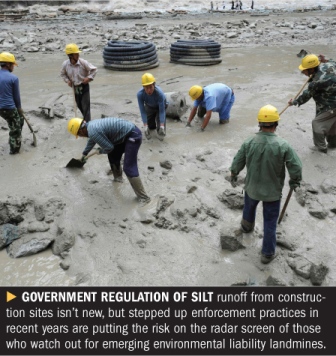
Just as the use of MTBE was phasing out, toxic mold exploded onto the scene in 2003. A jury in the case of Ballard v. Fire Insurance Exchange (part of the Farmers Insurance Group) initially awarded the Ballard family $32 million, including punitive damages, mental anguish and lawyers' fees. Thousands of lawsuits alleging various damages and ailments from toxic mold have followed.
So what are the next potential environmental landmines?
While it's impossible to predict, several issues have been smoldering over the past few years, including silt runoff from construction sites, green construction and evolving environmental regulations.
SILT REGULATION
Environmental regulators recently have focused on silt runoff from construction sites. When rain washes exposed soil at construction sites downstream, sedimentation, or silt, may pollute the receiving waters.
Silt runoff has been regulated under the Clean Water Act since 1987, and subject to National Pollutant Discharge Elimination System (NPDES) permissions since 1991. Until recently, enforcement of these regulations was lacking. In 2008, however, U.S. EPA announced a $4.3 million settlement against four home builders for the discharge of silt at construction sites.
Many states have followed the EPA's lead. In Minnesota, nearly 100 enforcement actions and $700,000 in penalties related to stormwater controls at construction sites were levied between 2007 and 2009.
Regulatory scrutiny hasn't been limited to contractors. Home Depot was fined in excess of $1 million for silt runoff from sites where new stores were being constructed. And while these penalties are no small potatoes, defining sedimentation as a "pollutant" creates perhaps the most drastic ramifications from an insurance coverage standpoint. Claims concerning pollutants are likely to fit squarely in crosshairs of the pollution exclusion in most CGL policies.
GOING GREEN
Like MTBE, green construction techniques were designed with environmental stewardship in mind. With promises of reducing impacts to the environment, creating healthier spaces for building occupants and lowering building energy costs, green construction is rapidly building steam around the county.
But while green construction may be admirable, it doesn't necessarily equate to lower liability for those engaged in the process. New construction techniques carry a higher risk of unforeseen liabilities. For example, the placement of gardens on rooftops may lead to water penetration into the building envelope, causing toxic mold.
Many industry observers also believe that some of the green building techniques begin to blur the line between traditional professional activities and purely contracting operations. Such was the case in Shaw Development v. Southern Builders, where an owner alleged hundreds of thousands of dollars in lost tax credits as damages against the contractors resulting from not achieving green certification on time.
Shaw since has been dubbed the "first green building litigation." However, neither professional services nor economic damages are typically covered under many contractors' CGL policies.
MORE TO COME
Other emerging issues deserving mention include potential new regulations surrounding "e-waste" (discarded electronic equipment), nanotechnology and global warming.
(For a full discussion of nanotechnology risks, see NU, April 13, page 16.)
Environmental law and policy are likely to evolve rapidly in the near future in these areas. And while it's impossible to predict what the next potential environmental liability landmine will be, the most prudent course of action is to include robust environmental decision-making in corporate risk management practices now, before the next environmental issue explodes.
Just ask those who manufacture, distribute and install drywall.
Adrien T. Robinson, J.D., P.E., is the environmental practice leader for The Navigators Group Inc., an international specialty insurance company headquartered in New York. Mr. Robinson has more than 14 years of experience in the environmental industry, is licensed in Illinois as a professional engineer and is admitted to the Illinois Bar. He may be reached at ARobinson@navg.com.
This article was originally published on Oct. 2, 2009 by American Agent & Broker magazine, a member of Summit Business Media's P&C Magazine Group, which includes National Underwriter. The original publication was a Web exclusive on American Agent & Brokers' Web site, www.agentandbroker.com.
© Arc, All Rights Reserved. Request academic re-use from www.copyright.com. All other uses, submit a request to TMSalesOperations@arc-network.com. For more information visit Asset & Logo Licensing.