Credit insurance, a once-arcane risk management tool, is becoming increasingly popular in the United States. Why? The answer is simple. Defaults and bankruptcies are at an all-time high.
Accounts receivable typically represent a company's largest single asset. Just one large customer defaulting on a payment could spell disaster–a lesson too many companies have already learned the hard way.
 According to the American Bankruptcy Institute, business bankruptcy filings reached 30,033 in the first half of 2009 alone. That's a 64 percent increase over the same period in 2008.
In fact, a recent survey of chief executives found that payment default–not the cost of capital or poor sales–represents the greatest risk to their balance sheets.
Commercial trade credit insurance is a way for companies to protect themselves. It can be purchased to cover a single transaction, transactions with certain customers, certain industries, or all of a company's transactions with all of its customers. At its most basic, credit insurance provides two kinds of protection.
o It can cover counter-party insolvency. (If a customer goes bankrupt, your outstanding accounts receivable will be paid.)
o Or, it can cover bad debts. (If a customer defaults on a payment, the outstanding accounts receivable will be paid.)
The global market for credit insurance is $6.7 billion. Of that, about $4 billion is written in Europe. U.S. premium written is only about $800 million. However, that is changing.
Credit insurance is very common in Europe. An estimated 40 percent of companies–large medium and small–use credit insurance. There are two reasons:
o Much trade takes place between countries in Europe. If a customer defaults in another country, navigating the local court system is difficult, expensive and time-consuming.
o Terms in Europe tend to be more liberal, with 90 days and 120 days not uncommon. This longer duration represents a greater risk.
Though credit insurance was invented in the United States back in the 1890s, less than 10 percent of American companies use it today. The reasons are the converse of the European experience. Most U.S. companies sell to domestic customers and terms in the United States tend to be shorter.
As the U.S. economy drags itself out of the recession, however, American companies need to protect their assets more than ever. As a result, all of the major credit insurers report that inquiries are significantly up. More and more American companies are finding credit insurance to be an effective risk management and operational tool.
In addition to protecting against counterparty risk, credit insurance provides powerful advantages beyond the core benefit of protecting against bankruptcy or payment default.
Perhaps the most important benefit is the fact that credit insurance improves a company's financial profile. Lenders are more likely to extend credit to companies whose accounts receivables are insured. And when credit is extended, interest rates tend to be lower.
Credit insurance also gives companies a competitive advantage, enabling them to offer potential new customers extended or more open terms, while sharing that risk with a third party.
It can also help businesses find the right customers and/or markets. Credit insurers maintain payment and credit information on millions of companies worldwide.
This coverage can lower the cost of collections. In fact, many European companies use credit insurance as a way to outsource their credit departments.
And finally, credit insurers can provide valuable information about expansion into emerging markets and industrial sectors, while offering protection against political turmoil, import disruptions or trade restrictions.
Because of its direct effect on balance sheets, purchase of credit insurance used to be the exclusive domain of chief financial officers. But lately, as counterparty risks become more systemic, risk managers are also playing a larger role in its purchase. The coverage is sold either directly or through brokers.
As with any type of insurance, premiums are based on risk. When it comes to credit insurance, there are a large number of factors–size of the debt, duration, industry, location. But the most important factor is the credit history of the customer.
Credit insurers have come under criticism during the current economic crisis. Premiums have increased sharply and coverage has been reduced. Most criticism, however, has come not from customers, but from customers' customers–that is, their debtors, who have seen their terms shortened or withdrawn.
The primary role of the underwriter is to measure and price risk. Bankruptcies and defaults are at an all-time high. That is not the fault of insurers. If anything, credit insurers, by paying their claims, have played an important role by slowing and/or preventing bankruptcy chain reactions.
Moreover, several of the larger credit insurers have transparency policies that enable creditors to review the criteria used to assess their risks. Challenges on the merits are very rare.
While use of credit insurance in the United States may never approach European levels, writers do expect continued growth–even after the credit crunch–for several reasons:
o First, many businesses that have been using credit insurance have come to appreciate the many extra benefits.
In their experience, the very reasonable premium–which can be passed along to customers–is a small price to pay for the extra security, stronger balance sheet and accounts receivable optimization.
o Second, as the global economy becomes more “value based,” American companies will be forced to develop new markets, both domestically and overseas.
These new markets carry inherently greater risk, while new customers will demand more liberal terms.
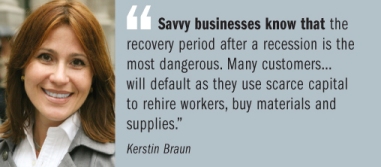
But it is the economic recovery itself that poses the most imminent risk. Savvy businesses know that the recovery period after a recession is the most dangerous. Many customers who have survived until now will default as they use scarce capital to rehire workers, buy materials and supplies.
Good times or bad, commercial trade credit insurance will be there to protect balance sheets and smooth volatility.
Kerstin Braun, Ph.D., is executive vice president of Coface North America Insurance Company in New York City.
© Arc, All Rights Reserved. Request academic re-use from www.copyright.com. All other uses, submit a request to TMSalesOperations@arc-network.com. For more information visit Asset & Logo Licensing.