Placing a client's risk with a carrier that you trust will be there when a claim must be paid should be the paramount concern of every agent and broker. Yet some producers seem to forget this when it comes to buying their own errors and omissions coverage.
For some members of the Professional Insurance Agents of Florida, failing to do their homework proved to be a major error in judgment and underscored what they tell clients–let a professional do the work.
“We are telling agents, make sure you do your due diligence. Investigate the carriers just like you would do for your customers,” said Jeanie Hardy, E&O agent for the PIA of Florida.
The lesson came home with the loss of two E&O coverage resources in the Sunshine State, with one carrier turning out not to be an insurer at all.
With cheap premiums, a number of agents placed their E&O risk with E&O of America, reported Ms. Hardy. The only problem was that this wasn't an insurance company. The outfit turned out to be a risk retention group based in Colorado that stopped answering the phones. Its closing produced a scurry of activity for those agents to find substitute E&O coverage.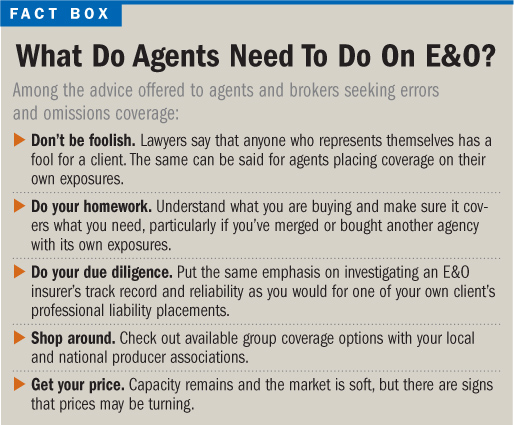
The second carrier–First Commercial Insurance Group–went into receivership on Aug. 24. The regulator, the Florida Department of Financial Services, canceled the agent E&O policies, forcing agencies to scramble for coverage to stay in business.
The department warned agents with First Commercial, but agents with E&O of America never got notices.
“They [agents] had no clue until they tried to contact the company–it was scary for them,” said Ms. Hardy. “You don't expect to see that in the insurance industry, but it happens.”
The agents caught in this bind were primarily young agents new to the business, according to Ms. Hardy. They also suddenly discovered the difference between claims-made and claims-reported E&O coverage.
A claims-made policy provides coverage for claims filed during the life of the policy–even if those claims were prior to the date of coverage, unless otherwise excluded. A claims-reported policy covers only E&O claims events that occur during the policy period.
The lesson, she said, is that “it might seem like a great idea to place your own [E&O coverage], but it is better to go to someone who does it for a living.”
Luckily, finding coverage in Florida, she said, should not pose a serious problem. The admitted markets have pulled back primarily because of the E&O exposures agents face on coastal risks. This situation is not confined to Florida, she said, but the “surplus lines are active and aggressive” in this market.
Advice to place coverage through a professional was no less true at PIA Connecticut, New Hampshire, New Jersey and New York, where Shawn Buicko, director of member services for the four state associations, said markets are amply available and competition is on the upswing.
The soft market and recession are keeping premiums low, she said. Premiums tied to revenues have declined because agencies have lost clients in the bad economy. It helps that competition remains among carriers, she added.
Ms. Buicko advised that agents seeking to cut their premiums further should consider taking loss prevention seminars to receive credits that will help lower rates.
Ms. Buicko insisted that it is vital for agents to read and understand their policies and know the extent of coverage–including defense coverage, limits and deductibles.
Some policies may not have sufficient tail coverage, she warned–a vital point when an agency makes an acquisition and needs to cover events extending beyond a one-year period.
The market for agent E&O is surprising because pricing remains below what is historically indicated, according to Sabrena Sally, senior vice president for Swiss Re Insurance Corp. The loss of investment returns for insurers would indicate the need for higher prices to bolster underwriting profitability. Instead, competition is keeping prices lower than what would be expected under the circumstances, she explained.
“It is surprising to see that activity, especially among those [insurers] that want to remain long term,” Ms. Sally said.
Mark Wolf, program leader for the Independent Insurance Agents and Brokers of America professional liability program–which is underwritten by Swiss Re's Westport Insurance Corp. that Ms. Sally heads–said some of the pricing in the market is clearly unsustainable, and current rates cannot pay future claims.
“There is no rhyme or reason to this,” he said. “It's almost like some companies are lowering their prices to grab market share in anticipation that they will raise rates fairly quickly. That is what we have all come to the conclusion about.”
Ms. Sally called that a risky strategy–one which Swiss Re is not following. “Our approach is to price soundly for what we expect the exposure to be,” she said.
The partnership between IIABA and Swiss Re goes back 23 years, the executives noted, and Mr. Wolf said it has been sustained with remarkable loyalty by the agents and brokers.
“It is very important to understand that we have a premium product in the marketplace and we think agents value that product,” he said.
The long-term success of IIABA's E&O program is its attention to risk management, according to Mr. Wolf–something he said the program spends a lot of time on with its members to control losses.
One growing exposure that has changed in the past eight years concerns mergers and acquisitions, noted Ms. Sally. Because agencies are expanding into other states, they need to be aware of how professional liability standards can differ from state to state. That differentiation in standards can have a bearing on the liability coverage needed, she noted.
For Liberty Mutual Group's Liberty International Underwriters, the company has kept its rates in check despite what Ross Herlands, vice president of professional liability, sees as a very soft and competitive market. Lately, he noted, there has been a subtle change in direction.
“Price is still soft, but you are seeing pockets of increase,” according to Mr. Herlands. “We have always maintained our patience to hold the line at what makes sense and not follow the market down.”
He said there has not been a dramatic change in loss trends in the past couple of years on the property and casualty side of the business. “We're starting to see more discipline,” he said of the E&O marketplace. “We want to be hopeful about that.”
© Arc, All Rights Reserved. Request academic re-use from www.copyright.com. All other uses, submit a request to TMSalesOperations@arc-network.com. For more information visit Asset & Logo Licensing.