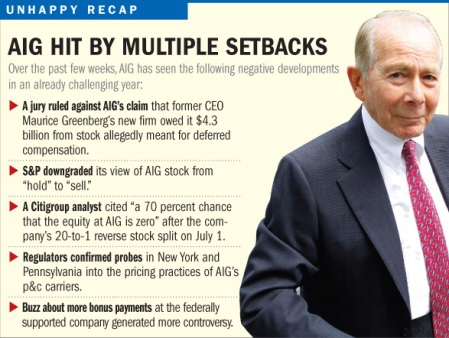
To say that American International Group is having a tough month would be an understatement, seeing its claim rejected by a jury in a dramatic legal showdown with former CEO Maurice Greenberg, its stock dismissed by an analyst as potentially worthless, and its insurance pricing practices probed by regulators.
A federal jury in Manhattan rejected a claim by AIG that Starr International Company (SICO), headed by Mr. Greenberg, was obligated to hold shares of AIG stock in trust for retiring AIG employees, and owed the company $4.3 billion in damages.
Mr. Greenberg was forced to leave as chair and chief executive officer of AIG in 2005 amid allegations that the firm has misused finite reinsurance to artificially bolster its balance sheet–eventually resulting in the convictions of one AIG and four General Reinsurance executives.
Shortly after Mr. Greenberg left AIG, SICO terminated the deferred compensation retirement program, which had been distributing a portion of the dividends SICO gained as a major shareholder of AIG stock.
AIG attorney Theodore Wells hammered away at Mr. Greenberg during his seven days of testimony, accusing him of lying while on the witness stand. AIG relied on memos that discussed the deferred compensation program and speeches made by Mr. Greenberg to participants in the SICO plan as evidence that a trust existed.
But SICO attorney David Boies argued that there was no documentation to back up AIG's claim and nothing to show that the company ever created a trust within SICO.
AIG had maintained there was a trust set through SICO to reward key executives with extra compensation that would be delayed until after retirement. However, Mr. Greenberg's attorney told the jury that the company made up its claim after SICO sued AIG over some disputed art work.
The jury, which heard evidence for three weeks, was handed the case on July 7, yet took less than a few hours to decide in favor of SICO, ruling that the company owed no liability to AIG.
Still to be decided by U.S. District Judge Jed S. Rakoff is whether there was an express breach of trust or fiduciary duty by SICO. He said in an order prior to the trial he will take the jury's decision into account but make his “own independent findings of law and of fact on the equitable claims.”
A representative for the court said Judge Rakoff would issue his decision in August.
“We are disappointed by the jury's verdict and we await the court's final ruling. We continue to believe in the merits of our case,” AIG said in a statement.
A SICO representative, Liz Bowyer, said that “we are gratified by the jury's quick and complete vindication of Starr International and Mr. Greenberg, and the jurors' quick and complete rejection of the outrageous personal attacks on Mr. Greenberg's character by AIG and its counsel.”
In an interview shortly after the verdict with Maria Bartiromo of CNBC, Mr. Greenberg called the seven days he was on the witness stand “grueling,” but said he was glad he did it because it was the turning point in the case. He welcomed the jury verdict but noted that the final decision is up to Judge Rakoff.
In the interview, Mr. Greenberg revealed that at the time he left AIG in 2005, SICO's AIG stock holdings were worth $20 billion. But today, following AIG's flirtation with bankruptcy last fall and its subsequent and ongoing federal bailout, the stock's value is down to only $200 million.
Standard & Poor's downgraded its view of AIG stock after the verdict, changing its recommendation from “hold” to “sell.”
“We still view AIG's underlying fundamentals as weak and under pressure, and believe AIG's loss in its lawsuit versus former [AIG] CEO Hank Greenberg is another negative for the shares,” said Catherine Seifert, insurance analyst with S&P's equity research unit.
She said the recent 1-for-20 stock split by AIG “may ease the mechanics of shorting AIG shares,” but S&P's opinion “reflects our view of AIG's weak fundamentals and high degree of execution risk.”
AIG absorbed more negative publicity after a stock analyst predicted the company's shares could be worthless.
Citigroup analyst Joshua Shanker, in his own note to investors, cited “a 70 percent chance that the equity at AIG is zero” after the company's 20-to-1 reverse stock split on July 1. He said his assessment reflected further possible losses from credit default swaps and “management's increased openness to disposing of businesses at low valuations.”
The company may be able to pay back the investment by the U.S. government, as well as some other debt as it sells off core assets, but the remaining company may generate low return on equity and be handicapped by a high debt burden, he said.
The analyst also questioned the ability of current CEO Ed Liddy to lead the company as he transitions out of his role once a successor is found.
Citigroup said there was a 20 percent probability that AIG would continue as a property and casualty insurer, but the expectation is that the p&c business will be carved out in an initial public offering in 2010. There is also a 10 percent probability of insolvency, Citigroup said.
Andrew J. Barile, an industry consultant based in Rancho Santa Fe, Calif., said the loss of the compensation plan could cost AIG a big competitive edge to keep qualified executives from moving elsewhere–with some going to SICO.
“[Mr. Greenberg] was a genius in using the concept to build and retain AIG executives,” Mr. Barile said in an e-mail. “Now the pendulum switches to building Starr using his same expertise.”
He added that “AIG executives need to be freed up to build value, not spend their time on costly litigation.”
In an interview with National Underwriter, Mr. Barile said finding a way for AIG to replace the incentive plan would “take more work than they [AIG] ever dreamed of.”
The brilliance of the plan, he said, was that being a private company, SICO never had to report how much the executive incentive payments amounted to. The competitive advantage, he explained, was that other companies found it difficult to lure executives away from AIG because they would never know how much to pay them in incentives to make it worth their while.
He noted, too, with the federal government owning a large share of AIG now, it is doubtful such an incentive program would be allowed to continue.
Adding to the negative press, in an interview with Bloomberg Television, New York's acting insurance superintendent, Kermitt J. Brooks, said both his department and regulators in Pennsylvania were conducting examinations into the pricing practices of AIG's p&c units.
The probe follows complaints from several carriers that AIG's insurers benefit from an unfair advantage in pricing their accounts because their parent company is backed by the federal government.
Representatives of both state insurance departments confirmed to NU that they do have ongoing exams but refused to give any additional information. AIG did not return a request for comment.
In March, the U.S. General Accountability Office and Pennsylvania Insurance Commissioner Joel Ario told Congress there was no evidence of predatory pricing by AIG. Orice Williams, GAO's director of financial markets and community investment, told Congress that while pricing is aggressive, it is not out of line with the company's previous practices.
Meanwhile, Kenneth Feinberg, the Obama administration compensation czar, would not answer questions after widespread reports that AIG will pay millions more in controversial bonuses.
Mr. Feinberg said by e-mail he was sorry but would have no comment concerning articles reporting that the company had spoken to him concerning the bonuses. AIG did not respond to a request for comment.
The payments of bonuses has been a hot-button issue since March, when it was revealed AIG was paying $165 million in retention bonuses to executives at the Financial Products unit that brought it to the brink of failure.
Mr. Feinberg was appointed last month by the Treasury Department to oversee compensation to executives at seven companies now receiving federal assistance.
According to published reports, AIG is seeking government approval for $2.4 billion in performance bonus payments to 43 executives. The money is part of a larger bonus pool, most of it paid out in March.
When the storm broke in March over the bonuses, the company said that it had a contractual obligation to pay them and they were a needed tool to retain top talent.
Eventually the company reported that at least $50 million of the $165 million distributed was returned by U.S. citizens, and that foreign employees gave back money as well.
(Additional reporting by Daniel Hays.)
© Arc, All Rights Reserved. Request academic re-use from www.copyright.com. All other uses, submit a request to TMSalesOperations@arc-network.com. For more information visit Asset & Logo Licensing.