Personal lines insurance is clearly enjoying a high-profile media life lately, with a seemingly endless and ever-present cast of anthropomorphic amphibians, cartoon insurance action heroes, urbane Neanderthals and hyper-friendly cashiers who effortlessly pull your insurance needs neatly boxed and gift-wrapped off a shelf.
Meanwhile, commercial lines continue to toil in a decidedly less visible realm. But the exploits of its popular personal lines cousin have created an impact that is finding its way to into the commercial ranks.
 Beyond the obvious impact of the Internet and the comfort the general population now has with buying in that medium, the personal lines "easy" pitch is largely driven by data. Quickly type in your name, address and birth date, and off you go, almost instantaneously, to a virtually fully formed quote.
The commercial world typically involves assembling much more, and more complex data, which must be evaluated and integrated into the rating process.
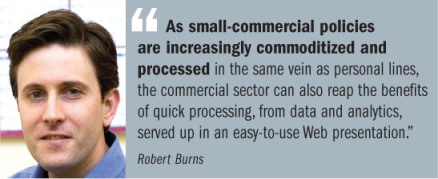
But as small-commercial policies are increasingly commoditized and processed in the same vein as personal lines, the commercial sector can also reap the benefits of quick processing, from data and analytics, served up in an easy-to-use Web presentation.
But are the challenges too much to overcome to have the same revolutionary impact that personal lines has realized? Let's look first at the available data.
The commercial market has much broader segmentation in risk size than does personal lines, so the data available varies, based on the size of the risk.
In auto lines in all segments, motor vehicle reports, Vehicle Identification Number validation and cost estimators are widely used for risk assessment, as are building cost estimators in property lines.
Vehicles associated with a risk or with small-business principals are also now available for quote "prefill," in a mirror of the personal lines online experience–in which two or three data elements, manually entered, can yield many times more prefilled fields. In the small-to-middle market, additional data options come into play.
Taking a cue from personal lines, commercial insurers are also increasingly seeing the value of using credit data. The credit of a small business or that of its owner can be a key predictor of insurance loss, particularly when combined with other risk characteristics.
Of course, when available, loss history is even more predictive. Its availability is quickly evolving as a data product to realize promise that it achieved in personal lines in the commercial space.
Access to data has obvious advantages from an ease-of-doing-business perspective.
For most companies, the commercial underwriting process is still manual, cumbersome and inefficient. Access to more data offers the promise of a thorough evaluation, uncovering all relevant information about a person, location or business beyond what might be submitted.
Quality is also a factor, as accurate data reduces the cost of corrections and compliance issues.
When analytics are added to the equation, the data becomes even more valuable. Predictive loss models appropriate for your book of business and appetite for risk can use an array of data points to more efficiently underwrite small risks specifically geared to the commercial market–including business demographics, business-owner data, vehicle data, driver data and property data.
Data and analytics alone are not new, but commercial lines have specific challenges in this area. The commercial space has experienced an unacceptably low hit rate against traditional business information sources. When located, information is often sparse and of low quality, making it difficult to verify.
Information is also supplied by many disparate providers, which can be expensive compared to policy value, and is often provided via report rather than in an electronic data format.
Fortunately, solutions are emerging. One is the concept of "smart" or "directional" ordering. Rules engines combined with access to multiple data sources can align the risk, the order and the appropriate data source. For instance, an insurer will gather financial history information on a large company from a different provider than would be used for a small business run out of someone's home.
Smart ordering can also provide considerable cost savings. Motor Vehicle Record data, for example, is fairly expensive–ranging near $20 per report in some states. Approximately 80 percent of all drivers have "clear" MVRs.
Re-using previously ordered reports and checking cheaper sources of information, such as driver activity reports, that only indicate the presence or absence of violations are now viable options. For example, an insurer could order a full set of MVRs upon first writing a business, but then only check activity reports on renewal.
Of course, all this ordering assumes that the data is easily aggregated and seamlessly delivered to the appropriate place–the submission or quoting system. A software solution that can easily coordinate services to deliver and manage the data is essential for the commercial agent and underwriter.
The data must be presented within the submission/quote flow, allow the user to choose which data to use, and have the rules and workflow available to evaluate the data and manage the decision-making.
These requirements seem daunting, but software and data solutions are available today to enable this cutting-edge vision. For instance, an agent can upload application data from their agency management system, which then:
o Flows to a policy quote/administration system.
o Automatically orders third-party commercial data.
o Runs rules to evaluate the results.
o Routes the aggregated results to an underwriter for approval.
Or, if everything looks accurate and complete, the agent can allow a full-fledged quote or complete policy to be issued.
So, while we may not see a Super Bowl ad for commercial lines anytime soon, significant process enhancements similar to personal lines should help this sector gain more fans than ever before.
Robert Burns is senior product director of LexisNexis Risk & Information Analytics Group in Hartford, Conn. He may be reached at robert.burns@lexisnexis.com.
© Arc, All Rights Reserved. Request academic re-use from www.copyright.com. All other uses, submit a request to TMSalesOperations@arc-network.com. For more information visit Asset & Logo Licensing.