Regulators around the globe are toughening up insurance requirements for companies doing business outside their domiciled countries, and the companies worldwide are demonstrating a greater willingness to focus on regulatory compliance.
Insurance industry experts said much of this focus stems from a natural trend that has been evolving for years and does not necessarily have its origins in the current worldwide recession.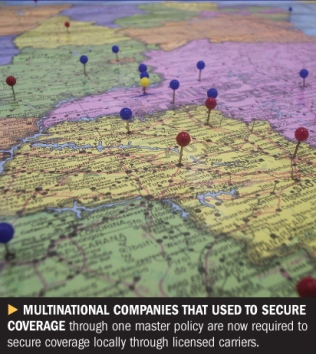
But while increased regulatory scrutiny and requirements may not have originated with the recession, the economic struggles have brought regulation into sharper focus in many countries.
Multinational companies that used to secure coverage through one master policy and rely on certificates for conforming coverage to different countries are now seeing regulators around the world enforcing insurance regulations that require these companies to secure coverage locally through licensed carriers. Regulators are also ensuring that the coverages adhere to stricter local requirements.
Mario Vitale, CEO of Zurich Global Corporate, said the regulatory tightening began before the recession and started as the world became more compliant in nature. Regulation has gained stronger momentum since the recession, he noted.
There is a revenue-generating angle for countries, according to Howard B. Whitmore, managing director of Marsh's Multinational Practice. By requiring that coverage be secured locally, he said regulators are able to generate revenue through premium taxes to offset some of the effects of the recession. With tax bases going down, Mr. Whitmore noted, going after something like premium tax is one way to help cover the shortfall.
Kathleen Ellis, senior vice president, Chubb & Son, and worldwide manager, Multinational Risk Group of Chubb Commercial Insurance, said she would not be surprised if there was a desire among countries to make sure they're getting the right amount of premium taxes, but she also noted the drive toward ensuring local coverage precedes the present crisis. And while regulators are pushing this issue, she said multinational companies have demonstrated an eagerness to comply to show that they are "good citizens."
Aside from ensuring multinational companies are buying coverage locally, compliance in general has come into sharper focus around the world. For example, Mr. Whitmore noted the Financial Services Authority in the United Kingdom said recently it intends to get much tougher with insurance companies that do not meet their standards. This, he said, means stricter enforcement and a more intrusive approach to supervision.
News reports note the FSA hired over 180 people–a 10 percent staff increase–in April to take a more aggressive regulatory approach.
The regulatory landscape change was hastened not because of the recession itself but rather the crisis among the banks that directly preceded it, said Rolf Tolle, director of Franchise Performance for Lloyd's.
Mr. Tolle said regulators and others have made the mistake of grouping insurance and other financial institutions into one group, and having failed in their regulation of the banking industry to a large extent, regulators now want to make sure they do not drop the ball in any other area.
Insurance is not helped by the fact that some within the industry made the mistake of overextending themselves in some areas, he said.
As a result, Mr. Tolle said regulators around the world will become more intrusive, "which is totally understandable." The pendulum has swung toward more intervention, he said, and that will last until some comfort has been re-established.
While the heightened global regulatory environment creates more work for insurers, the demand for their services among multinational companies remains.
Ms. Ellis said in previous economic downturns, companies may have reconsidered operations outside of their domiciled country. Today, though, she said companies still have to engage the global marketplace even in the face of a recession. Because the multinational companies still need to be out there, they still need insurance.
She said multicountry risks represent a profitable segment, and she added Chubb is continuing to grow with the segment of international clients that have exposures around the world. They are still buying local policies, she said, even if they are more cautious about where and how they are spending money in this economic environment.
She said the interest among these companies is to be compliant and transparent rather than find an easy or cheaper way to skirt the rules.
Serving these risks in a world of greater regulation requires work for insurers.
Ms. Ellis said Chubb works with clients to structure the right types of programs. Chubb, she said, has companies around the world and can work with clients to secure the appropriate coverages at the local level.
Chubb also has a master policy that sits above the local coverage to provide comprehensive coverage, Ms. Ellis said.
Mr. Vitale said Zurich was one of the first insurers to offer a solution to multinational companies to help them cope with increasing regulatory requirements. He pointed to Zurich's Multinational Insurance Proposition, which helps companies align coverages with the licensing, premium tax and other requirements in countries in which they do business. The program, he said, ensures compliance and also provides legal input and advice.
Mr. Vitale said developing the program required Zurich to build an in-depth program, and he said it was also a considerable investment for the company.
But the result, he said, has allowed Zurich to offer customers a solution to the uncertainty relating to securing coverage across borders.
Mr. Tolle noted that insurers can cope with the regulatory requirements as long as they are licensed in the territories where they do business. "In those areas where you are licensed, you can do business as usual," he said.
Lloyd's has licenses to operate in 80 countries.
In general, Mr. Tolle said that given the financial crisis and recession, regulators have to show activity and demonstrate "they're on top of things." As a result, placing worldwide coverages may become more complicated and difficult for insurers as regulators request more information.
© Arc, All Rights Reserved. Request academic re-use from www.copyright.com. All other uses, submit a request to TMSalesOperations@arc-network.com. For more information visit Asset & Logo Licensing.