The inland marine pie may be shrinking as two major target industries–trucking and construction–struggle in the current economic crisis. But at the same time more players are fighting for a slice, keeping competition fierce and the market soft, experts in the field report.
 Those queried for this article agreed that new entrants continue to look for growth opportunities, even as construction projects struggle to get funding and lack of shipping demand forces trucking companies to cut operations or go out of business.
“The marketplace in inland marine continues to be competitive,” said Joseph Tracy, president of Travelers Inland Marine. “People have seen the profits of inland marine over time, and there have been new entrants, which fuels competitiveness.”
In this regard, the marketplace is similar to what it was a year ago. A National Underwriter analysis of the market last April focused on struggles in the two major inland marine lines, while competition continued and even increased, and Mr. Tracy remarked how that analysis could still be relevant if it was published today.
But while the overall circumstances are similar, some details have changed. For example, last year, soaring fuel prices were the source of trucking company hardships. And while those companies are still struggling, fuel costs are not a factor.
Last year, diesel prices hit $5 per gallon, recalled Steve Silverman, vice president of inland marine for Bermuda-based Hiscox. This drove up expenses, which hurt trucking companies, even though revenues were high and truckers were still getting a lot of loads.
Now, Mr. Silverman noted, these companies are dealing with a problem that is essentially the opposite–expenses are lower as fuel costs have abated, but with the current recession shipping demands are down and revenues are weaker.
Mr. Tracy noted that the slowdown in shipping volume, and the resulting impact on receipts of trucking operations, leads to less premium for insurers, as receipts is a typical basis on which to develop coverage prices.
Lower revenues could also lead to risky cost-cutting measures by trucking companies, Mr. Silverman warned. He said when shipping is down, some companies looking to save money cut back on risk management and loss prevention. For example, he noted, some companies will skimp on preventative maintenance, which could increase loss experience.
Crime is an additional problem affecting truckers, according to Mr. Tracy. He said because of the weak economy, some people look to profit from illegal activity, and robbing cargo from trucking companies is one way to do that.
 In general, Mr. Tracy said factors affecting trucking could be seen as a three-legged stool consisting of fuel prices, shipping volume and crime. At the moment, he noted, two of the three factors are adversely impacting the companies.
But Mr. Silverman said while there are trucking companies going out of business, there remain many companies that are healthy financially. Overall, he said, trucking remains an attractive business for insurers–although maybe not as much as before, because loss experience has deteriorated somewhat.
Speaking to construction, experts agreed the sector continues to struggle, particularly on the residential side, which Mr. Tracy characterized as “still in decline,” without much movement on the housing front.
John Tutera, vice president of construction property for Hiscox, said he believes demand for rental houses at least will pick up sometime soon.
Over the last nine months, he said, he has seen clients trying to find ways to buy risk protection “economically.” Clients want protection, he said, but don't have much to spend, so some companies are choosing to retain more risks.
Jayne Honeck, assistant vice president of inland marine at CNA, spoke to the uncertainty in the construction market overall, noting that every month there are signs the market will turn for the better, but those signs never seem to pan out. She said there are projects still ongoing, while others are being completed, but there are fewer of them.
Some new construction projects are having a hard time getting financed, she said, while existing projects cannot secure financing to continue. This means there are fewer risks to go around, and insurers are “really hungry for desirable accounts.”
Ms. Honeck said underwriters are “burning the candle at both ends and in the middle” to attract business–lowering rates, cutting deductibles, offering better catastrophe terms and paying higher commissions to producers.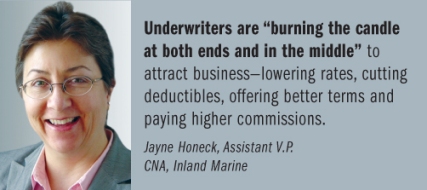
Catastrophe areas are particularly competitive with respect to pricing, according to Ms. Honeck. “It's like [insurers] forgot all about the fact that hurricane season is about to start,” she said.
Areas within construction that have not softened, Ms. Honeck said, are more complex risks that involve in-depth underwriting–projects that are not simply “four walls and a roof.” These include work on bridges and tunnels, and even risks associated with alternative energy, such as wind farm construction.
For commercial construction risks, there is hope that the recently passed federal stimulus package will get projects on track, but most experts agreed it is still too early to tell what the impact of the additional federal investment will be.
Only a small part of the stimulus is going toward construction–in particular, updating infrastructure, Mr. Tutera noted.
Ms. Honeck added that it is hard to tell if the stimulus is having any effect yet, though she said everyone is expecting it to help by injecting new lifeblood into the sector. “My impression is I'm not seeing more [infrastructure projects] than a year ago, or two years ago,” she said, but is continuing to see ongoing projects.
But Mr. Tracy said he is beginning to see infrastructure project bids and orders to bind infrastructure-type projects, adding the horizon looks like it could be brightening.
New entrants in the construction segment and throughout the inland marine market are contributing to continued competitive pricing, but experts generally agreed these newer arrivals do not represent what was once called na?ve capital, instead displaying a level of expertise and entering the market with eyes wide open.
Ms. Honeck said companies that have come into the market since last year have gotten stronger, are staffing up in more geographic areas, and are continuing to pursue inland marine risks.
Mr. Tracy said new entrants' inland marine operations are typically headed by well-respected individuals and bring sound underwriting talent to the marketplace. Speaking to their pricing strategies, Mr. Tracy said that “clearly they have goals in terms of revenue, just as we do.”
New companies have not been “flooding in” to the marketplace over the last year, the way they had been previously, according to Pat Stoik, vice president and global commercial inland marine manager at Chubb & Son, but carriers are still lured to inland marine by the market's historical profitability.
He said companies that are struggling in other lines are looking for areas where they can make money. They see the historical profitability of inland marine, he explained, and try to tap into it.
Speaking to the underwriting quality of the new entrants, Mr. Stoik said it is hard to make a general statement about all carriers that enter the inland marine market.
He said the only general statement he can make is that the new entrants are not necessarily bringing anything new to the table. Mr. Stoik said they are just additional players in the marketplace, with some acting more responsibly than others in terms of pricing and underwriting.
The effect of these new entrants, Mr. Stoik observed, has been some inconsistency in the marketplace. He said one day there will be extreme competition for a given type of risk, but the next day, a similar risk in a different geographic area will be more reasonably priced. But generally, he said, there have been more examples of extreme pricing than reasonable quotes.
Hiscox is one of the recent entrants into inland marine. Mr. Silverman said the company put together its systems and forms in November 2008, and started writing business in January of this year.
But those behind the company have years of experience in the market. Mr. Silverman, for example, joined Hiscox from AIG/Lexington, where he was responsible for inland marine and specialty property business in the U.S. and Canada.
Mr. Tutera also joined Hiscox from Lexington, and has more than 35 years of experience in the insurance and construction industries.
Mr. Silverman said Hiscox feels it has an opportunity to write a wide variety of inland marine business, adding the company brings expertise as well as a well-capitalized player to the market.
Hiscox saw an opportunity to get into inland marine, Mr. Silverman noted, because buyers have expressed some frustration with the lack of experience among insurers–particularly smaller markets that have been overly aggressive. Additionally, he said some existing players are struggling from a financial standpoint due to the strains in the capital markets.
Hiscox's strategy, according to Mr. Silverman, is to select certain sectors within inland marine and be a go-to market in those areas because of the company's expertise and quality of forms.
Overall, the health of the inland marine market varies by line, Mr. Stoik said, adding he still views the sector a healthy place to be, from his perspective.
Mr. Silverman described himself as “bullish” about inland marine, conceding that while he would like to see the economy improve, the market is “still very attractive.”
Mr. Tracy said it is difficult to speculate on where the market is heading in terms of pricing, but he said he is “hopeful that we see a flattening [of rates]” by 2010.
However, he added he is not willing to claim that all issues in the marketplace will be resolved by then.
© Arc, All Rights Reserved. Request academic re-use from www.copyright.com. All other uses, submit a request to TMSalesOperations@arc-network.com. For more information visit Asset & Logo Licensing.