Washington
It will take at least three-to-five years for American International Group to repay the tens of billions spent by taxpayers to keep the beleaguered company afloat–and that's only if the capital markets cooperate, AIG's head informed Congress last week.
"Asset values have to stay strong," AIG Chairman and Chief Executive Officer Edward Liddy told the House Committee on Oversight and Government Reform. "There has to be a capital market that allows us to take businesses public."
He testified after an opening statement by the panel's chair, Rep. Edolphus Towns, D-N.Y., in which the congressman said ordinary taxpayers are indignant about the government's need to bail out AIG and are demanding transparency in the payback process. "We are hearing, 'Trust us,' but we are not willing to let $180 billion go just on trust," Rep. Towns said. "We will question. We will inquire. We will verify."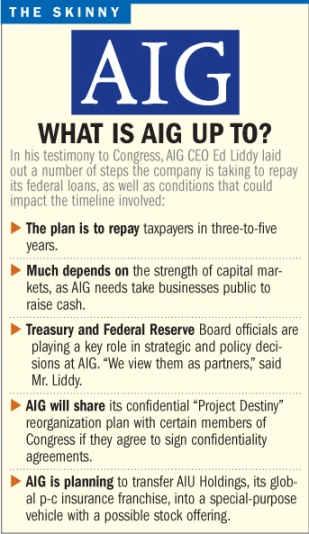
Mr. Liddy testified that "if the marketplace holds the way it is right now, we think that the American taxpayer will be fully repaid."
He said AIG is now using $40 billion of funds available under the government's Troubled Asset Relief Program, has a $43 billion loan from the Federal Reserve Bank of New York, and has access to $30 billion more from the Fed.
He did not speak of other guarantees–for example, the fact that the government is guaranteeing short-term credit needed by its international leasing subsidiary.
In addition, the government has also advanced cash to AIG in return for certain assets formerly collateralized by devalued residential mortgage-backed securities owned by its life insurance subsidiaries. Those assets are being held in "Maiden Lane" facilities created by the Federal Reserve Bank of New York.
At the same time, he said the Treasury Department is completing regulations that will govern AIG's bonus policy–a flashpoint in the recent past that has generated intense criticism not only for the company, but also for Obama administration and Fed officials involved in the bailout.
In other comments, he said that Treasury and Federal Reserve Board officials are playing a key role in strategic and policy decisions at AIG, and that the company should never have gotten itself involved in the trading of derivatives and securities.
Instead, he said, the company should have stuck to its core insurance business.
In response to a question from a member of the committee, he voiced support for state insurance regulation. However, he said, it is critical that Congress add to that a systemic regulatory process as proposed in testimony earlier this month before the Senate Banking Committee by Sheila Bair, chair of the Federal Deposit Insurance Corp.
In response to questions from Rep. Towns and Rep. Darrell Issa, R-Calif., ranking minority member of the committee, Mr. Liddy also committed himself to sharing with certain members of Congress or staff the company's confidential "Project Destiny" reorganization plan that he has described "as a multiyear road map for the restructuring of AIG."
After conferring with AIG's outside counsel, he said he would provide the document only if the particular officials who would have access sign the same kind of confidentiality agreement signed by officials at the Fed and Treasury who have had a hand in developing the strategic plan.
He said that to let the document become public knowledge would hurt AIG's competitive position by providing confidential marketing data to competitors, and would as a result impair the company's ability to fully repay the government.
"We intend to pay back the government as soon as possible," Mr. Liddy said in response to another question.
"We hope we can start that in a matter of months," he added, noting that Treasury and Fed officials "are very involved" with AIG in meeting with internal committees and its board.
According to an advance copy of his testimony prepared for delivery to the committee obtained by NU a day before his May 13 congressional appearance, Mr. Liddy said AIG's game plan going forward is to establish "separate identities" for its "best businesses" and to shut down its financial products unit. The advance copy noted, however, that the spinoffs will only occur over time and not at fire-sale prices.
"Representatives of the Fed and the Treasury, and their advisers, are engaged with various AIG offices every day," Mr. Liddy said in the advance testimony. "We view them as partners."
At the same time, the breaking apart of strong constituent insurance units is now underway, his testimony noted.
As disclosed in its March year-end 2008 earnings report, AIG is accelerating the transfer of its two major foreign insurance companies–ALICO and AIA–into special-purpose vehicles. "We expect to complete the contractual arrangements for these transfers in the near future," his testimony stated.
Stock in these units, according to the March filing, will be exchanged for a special reduction in AIG's debt to the Federal Reserve Bank of New York. But, as previously outlined, AIG will retain management of the units.
At the same time, AIG is planning to transfer AIU Holdings, its global property and casualty insurance franchise, into a special-purpose vehicle with a possible stock offering.
"This move will secure the value of that very substantial business in preparation for the potential sale of a minority stake, which ultimately may include a public offering of shares, depending on market conditions," his testimony noted.
Mr. Liddy stated that the timing of outright divestitures will depend on market conditions. "We intend for taxpayers to realize the fullest possible value from every asset disposition," he said. "And we intend that every company that emerges at the end of the restructuring will be strong, transparent and a credit to all its owners."
Under the plan, the parent company will become smaller and its major insurance companies "will emerge with diverse products, strong management and clear growth strategies worthy of investor confidence," his testimony noted.
In his prepared text, Mr. Liddy said the company is making progress in winding down the complex derivatives portfolio at AIG Financial Products–from a peak notional exposure of $2.7 trillion, the current exposure is $1.5 trillion.
He said AIG continues to explore multiple options to "break apart these trading books so that we can reduce the remaining risks, sell off portions of the business, repay or otherwise retire the AIGFP debt, and exit this segment of the financial products business."
Mr. Liddy also said AIG officials are working to simplify the complex structure of AIG, which currently has a "global footprint and an intricate capital structure characterized by over 4,000 legal entities, cross-ownership and myriad special purpose structures."
SYSTEMIC RISK
As for Ms. Bair's reform proposal, she suggested that a committee of federal regulators have the authority to preempt an institution's primary regulator if that institution engages in activities that could constitute a systemic risk.
While Ms. Bair supports a committee, the Obama administration–especially Treasury Secretary Timothy Geithner–indicated last week that they support the Federal Reserve Board for that role.
In her testimony, Ms. Bair also proposed creation of a resolution authority that would have the power to take control of a potentially systemically risky institution–regardless of size and the products it sells–and either rehabilitate it or liquidate it.
A representative for Rep. Barney Frank, D-Mass., chair of the House Financial Services Committee, said it is unclear when Congress will act on such legislation.
"As you know, we have not scheduled legislative hearings or a markup yet on the creation of a systemic risk regulator," said the representative, Steve Adamske.
"We will be prepared to move as soon as the legislation is ready," he said. "Mr. Frank has discussed July 4 as a tentative time to complete our committee's work, but that is not set in stone."
© Arc, All Rights Reserved. Request academic re-use from www.copyright.com. All other uses, submit a request to TMSalesOperations@arc-network.com. For more information visit Asset & Logo Licensing.