For the growing number of aging workers, employers should modify the workplace, engage the work force, institute wellness programs and tailor jobs for older employees to avoid costly comp claims, risk management experts suggest.
 Glenn Pransky, director of the Center for Disability Research at the Liberty Mutual Research Institute, said employers should assess their work force and pay particular attention to older employees forced to keep working by the poor economy.
The secret to limiting injuries for older employees is a modification of job activities and the workplace, according to Jon Gice, second vice president for the Travelers Claim major case unit. As examples, he cited the following:
o Eliminating heavy lifting for aged workers.
o Minimizing upper-extremity reach.
o Minimizing stationary standing.
o Reducing glare on computer screens.
o Examining walking surfaces, as slips and falls that lead to injuries are more common among older workers.
Woody Dwyer, senior ergonomics specialist at Travelers Risk Control, said employers are generally willing to make changes for older workers because they are experienced and valued employees that companies typically do not want to lose.
During a recent Liberty Mutual webinar dealing with medical management of the aging work force, Mr. Pransky explained that "older workers" are typically defined as 55 and above, although aging effects can be seen in manual laborers as early as age 40.
Mr. Pransky said the number of people over 55 is growing. More than 35 percent of all those over 55 are currently working, he noted, adding over the next seven years that number will increase by another third.
The reasons for the increase include baby boomers aging, increases in retirement age, improved medical technology and decreased retirement savings.
The aging process affects people differently, Mr. Pransky noted. Changes that are likely for most older workers include visual diminution, loss of hearing, increases in blood pressure, and a decrease in peak strength and aerobic capacity. Effects that can vary depending on the person include changes in one's ability to reason, think and remember, excessive weight gain and chronic illness, he added.
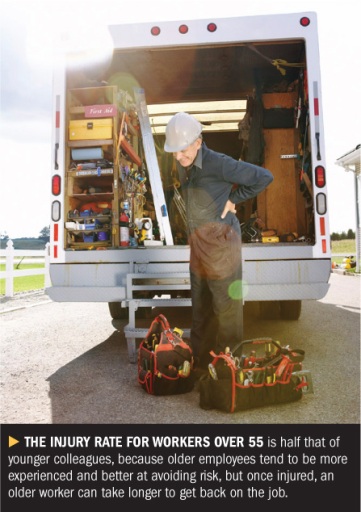
On a positive note, Mr. Pransky cited Bureau of Labor statistics showing the injury rate per year for workers over 55 is half that of younger colleagues, because older employees tend to be more experienced and better at avoiding risk.
But accidents such as falls are more common for older workers–and if these workers do have a fall, they are twice as likely to have a fracture, Mr. Pransky said, warning that fatality risk from an accident also increases with age.
Mr. Gice at Travelers cited a 2005 National Council on Compensation Insurance study also showing that older workers require more medical care, have a more difficult time returning to work, and go through a longer healing process than younger employees.
Mr. Pransky suggested employers should assess worker capabilities as a strategy for getting a handle on potential exposures before an injury occurs.
All older workers are not the same, he noted, pointing to a study in New Hampshire conducted by the Liberty Mutual Research Institute, which sampled all employees over 55 who had workers' comp claims.
Mr. Pransky said older workers generally fall into three categories:
o Healthy survivors who are still successfully working in their first career.
o Post-retirement workers who changed careers.
o Trapped workers who want to retire but are financially unable to.
Post-retirement workers, according to Mr. Pransky, risk facing a mismatch between their job and their capabilities, because they are typically moving to a different industry with different demands.
Trapped workers, he related, tend to have a lower level of education and income, and more chronic health problems that could complicate comp claims.
Employers should particularly identify workers in this last group, Mr. Pransky emphasized, as marginal job performance and difficulties on the job typically precede a workplace injury.
Mr. Pransky said employers should develop a wellness program for older workers including diet and exercise. Additionally, he said training should be modified for these workers, as some older employees may need more repetition than younger colleagues when learning tasks and responsibilities.
Employers should also tailor jobs to aging workers by decreasing the manual handling of heavy loads and ensuring a comfortable working posture, he added.
Post-injury, Mr. Pransky said employers should capture the value of the attachment older workers have to their jobs, which tends to be greater than for younger colleagues. Employers should communicate early and often with an injured older worker, and also try to find alternate duties to permit an early return to work, he advised.
Mr. Gice said Travelers assigns a nurse case manager to work with injured workers and guide them through the process of returning to the job. One area of focus for older workers, he noted, is to focus on the medications they are using.
Mr. Gice said it is not uncommon for a worker to be taking some form of medication before a mishap, and then additional prescribed medication during recovery for an injury. Sometimes, he added, the medications do not mix well–noting Travelers has independent pharmacology reviews to make sure there are no such conflicts.
As for returning to work, Mr. Gice said it is important to set definitive targets for older workers, but not to push them to return too quickly. Pressuring them to get back to work too soon, he warned, can result in the employee reinjuring themselves. It is therefore important, he explained, to customize a return-to-work strategy with the individual worker.
Rehabilitation and re-training efforts should take into account the special needs of older workers, Mr. Pransky said.
Craig Ross, regional medical director for Liberty Mutual Group, said an empathetic call from a supervisor could be invaluable to an older worker.
As pre-existing injuries can complicate a workers' comp claim, Mr. Ross also said a thorough investigation of a workplace accident should be conducted so the employer can determine what happened.
Mr. Gice said paying attention to the aging work force is more important today than it was even five years ago because of the current economic climate. He noted that within a reduced work force, many employees tend to be more experienced employees.
© Arc, All Rights Reserved. Request academic re-use from www.copyright.com. All other uses, submit a request to TMSalesOperations@arc-network.com. For more information visit Asset & Logo Licensing.