In the current economic climate, insurers who look to program business to generate additional premium volume will be conducting more thorough due diligence examinations of potential programs before agreeing to take them on.
Program administrators should therefore be prepared, when marketing an established program, to provide a potential new insurance company partner with hard data, well-reasoned growth projections and adequate time for the insurer to consider the opportunity.
Underwriters looking for program business in this economy will be seriously scrutinizing the quality of the program presentation materials to ensure the program will meet their acceptable criteria before they consider extending limited underwriting authority.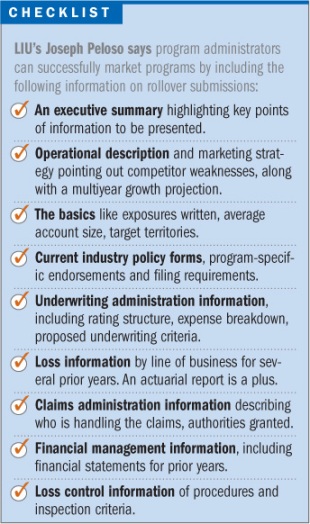
To win insurers' confidence, program administrators must demonstrate that they are capable of underwriting the business. They will not get far delivering program rollover submissions that are sketchy at best and unprofessional at worst.
Rather than unsupported promises that a program will be hugely successful, underwriters typically want a submission that covers at least nine areas of concern–in detail–for insurers. Be mindful to include only information not subject to any nondisclosure agreements.
In the balance of this article, we outline one possible ordering of nine specific sections of a program administrator's proposal to address the key concerns of potential carrier partners.
First, the presentation should contain an executive summary of the salient information in the next eight sections. This summary can be a powerful marketing tool if the program agent has crafted the submission with hard data and solidly reasoned projections.
In addition, if the business is moving from an existing carrier, the summary should explain why the program administrator expects the program to prosper with a new insurance carrier and the attributes they are looking for in the new carrier.
Following the executive summary, the program administrator should provide a description of the program's operations, including how long it has been written, the r?sum?s of key management personnel, and a description of the program's prior as well as current proposed structure. This includes lines of business, limits provided and current carriers.
In this second section, program administrators should present a marketing strategy that describes how desirable accounts will be identified, examines the strengths and weaknesses of competitors' programs, and provides a well-founded, multiyear growth projection that takes into account the program's distribution system.
Next, the program administrator should provide basic program information, including types of exposures written, the number of insureds, the average account size, the mix of states or regions where insureds are located, and the types of coverage insureds want.
Those coverages lead into the fourth section of the submission–detailed information about current industry policy forms that are in use for the program. This information should include copies of all program-specific endorsements and other special filing requirements.
The mistake that program administrators sometimes make here is not providing this information in a timely fashion. Sometimes specialty policy forms need three-to-four months to be filed and approved, but many program administrators begin marketing their programs only a few months before their scheduled renewal dates. The insurance carrier may not be able to participate in the program if it is not provided with adequate time to make the necessary form and rate filings to support the program.
Another problem with timeliness arises with the next two submission sections: underwriting administration information and summary program loss experience.
Administration includes the rating structure, a breakdown of expense components and proposed underwriting criteria.
Loss information requires currently valued loss information on a line of business basis for the previous three-to-five years. An independent actuarial report is a plus and will assist in the program evaluation.
If, after examining the program experience, a potential insurance carrier determines it would need to adjust its filed rating structure, the insurer would need adequate time to obtain regulator approval. Again, marketing the program just a few months before the renewal date could eliminate consideration by many potential insurance company markets.
A program administrator should be realistic in its request for commissions and work to align its interests with the carrier in order to achieve underwriting profits.
In the submission's last sections, the program administrator should cover claims administration, financial management, loss control, and information on who is currently handling claims and what authorities and strategies are utilized. If the administrator controls a third-party administrator, at our firm, we require that the PA must show that the claims-handling operation is at arm's length from the underwriting operation.
The program administrator must submit financial documents, including its verified financial statements for the previous years as well as any risk-sharing agreements. At our company, we require the submission of two prior years of financial statements. In addition, the submission should include information on loss control procedures and inspection criteria.
Overall, program administrators must bear in mind that the insurer executives they approach with rollover submissions might have to convince their own management that the programs represent good opportunities. That will necessitate solid business plans.
An insurer being asked to provide limited underwriting authority wants to be assured that a program administrator considers itself an underwriter that believes the business will be profitable, rather than someone whose top priority is simply placing business. A timely and thorough submission can help a program administrator demonstrate its expertise and commitment to a long-term, mutually profitable relationship.
Joseph Peloso is vice president-casualty programs for Liberty International Underwriters
© Arc, All Rights Reserved. Request academic re-use from www.copyright.com. All other uses, submit a request to TMSalesOperations@arc-network.com. For more information visit Asset & Logo Licensing.