Atypical Industry Growth Challenges Conventional Underwriting Strategies
Arguably one of the most influential perceptions of late in the commercial insurance industry is that of a shrinking business sector and the resulting decline in the number of customers for commercial lines coverages.
As sculpted by the "dot-com" recession and the ensuing "jobless recovery," this image has served to heighten concerns about the threat posed by softening insurance rates.
In fact, data recently released by the Economic Census of U.S. Business show a different picture. And, as is often the case in these "MarketStance" analyses, taking a closer look at varying industry trends in account and revenue growth can help insurance carriers avoid deteriorating underwriting results in the coming months.
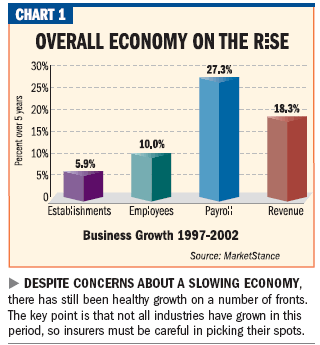
As seen in Chart 1, the new Economic Census information shows that U.S. businesses actually managed to record appreciable growth on balance over the 1997-2002 time frame.
Employment growth during the five-year period averaged 2.2 percent annually only 0.4 percent per year less than during the heady rebound from the 1998-1999 recession. In point of fact, business payrolls rose at a faster pace in the recent period than during the period of faster economic growth between 1992 and 1997.
If recent economic performance has indeed been so close to par, how could the tenor of the business sector be so bad? A large part of the gap between perception and reality is attributable to the marked disparity between economy-wide results, such as those cited above, and the recent experiences of individual industries.
As shown in Chart 2, employment growth experience over the 1997-2002 period varied greatly among major industrial sectors. During this period, very strong growth was recorded in industries such as educational services and information services. Indeed, employment in some of these "new economy" industries expanded at rates averaging from two-to-four times the 2 percent annual employment growth registered by the overall economy during this period.
In contrast, significant employment declines were registered in some traditional industries, such as mining and manufacturing no doubt accounting for much of the negative perception of business conditions. Commercial lines writers focusing on classes in these two industries almost certainly have experienced considerable contraction in market potential that will become more apparent as recent hard market conditions in commercial lines continue to unwind.

Chart 3, offering details on fast-growth industries, provides a sense of this. While each of the industries recorded 40-plus percent revenue growth during the 1997-2002 period, the composition of this growth varied considerably.
In three industries broadcasting and telecommunications, performing arts/spectator sports, and professional scientific and technical services substantial growth experienced in the number of accounts complemented the significant growth in average revenue per accounts. This type of balanced growth is consistent with most popular images of economic growth.
In contrast, several of the other industries shown in Chart 3 experienced exceptionally strong gains in revenue-per-account and only modest growth in the number of accounts. Indeed, in the health and personal care stores industry, strong revenue increases were coupled with a decline in number of accounts during the 1997-2000 tracking period.

o First, the limited number of additional accounts created does little to dissipate the competitive pressures that typically rise as hard insurance market conditions abate.
o Second, extremely rapid growth in per-account revenue is apt to boost exposures and with it, losses faster than premium audit processes are able to collect additional premiums.
o The result, of course, is deteriorating underwriting experience.
To avoid this pitfall, rather than settling for whatever combinations of growth its current book provides, carriers can adjust underwriting appetites to avoid some of the more challenging classes.
For example, heightened concern over intensifying competition for existing accounts might lead some carriers to deemphasize classes of business reporting sharp declines in account numbers. Three fairly obvious candidates for this list are apparel manufacturing, leather products and textile mills (respectively, North American Industrial Classification System industries 315, 316 and 313).
At the other extreme, carriers might approach classes reporting excessively rapid expansion in per-account exposures with more cautionstepping up audit activity and otherwise being careful about renewal exposures. From the 1997-2002 period, business classes that might fall into this category include real estate, social assistance, transportation support activities and publishing industries. Each of these recorded per-account revenue growth in excess of 35 percent.
Quite a few classes have displayed strong but balanced growth over the 1997-2002 period. Among these "sweet spot" business classes are waste management, education services, general contracting, and professional, scientific and technical services. In each case, significant growth in number of accounts offers some respite from intensifying competition, while moderately strong revenue growth does not threaten to push exposure growth and losses to the point of outstripping premium.
The composition of business growth also has specific implications for workers' compensation profitability. The payroll growth in some industries has been almost entirely composed of increases in pay-per-employee, with little or no growth in number of employees.
Apart from an impact on indemnity loss costs, this type of payroll growth has only a very modest effect on occupational accident frequency. As a result, such payroll growth tends to improve underwriting experience by increasing premiums collected significantly more than losses incurred.
In contrast, industries such as information services, education services and social assistance have registered strong, but more balanced growth in both employment and pay-per-employee during the 1997-2002 period. In this case, the impact on indemnity costs is more moderate however, the strong growth in employment is likely to have boosted accident frequency and had a deleterious impact on incurred loss experience.
The new data on business growth should provide encouragement to those girding for softer market conditions. Beyond this, however, the notion of considering the composition of that growth in adjusting appetite and underwriting criteria to changing market conditions should provide some practical bottom-line benefit.
Frederick Yohn is the developer of "MarketStance," a market analysis tool for U.S. commercial property-casualty insurers and a registered trademark of IntelliStance, LLC, in Middletown, Conn.
Reproduced from National Underwriter Edition, August 5, 2004. Copyright 2004 by The National Underwriter Company in the serial publication. All rights reserved.Copyright in this article as an independent work may be held by the author.
© Arc, All Rights Reserved. Request academic re-use from www.copyright.com. All other uses, submit a request to TMSalesOperations@arc-network.com. For more information visit Asset & Logo Licensing.