WC: The P-C Industry's Quiet Crisis? Show me a line of insurance that managed to lop 15 points off its combined ratio in a single year, realized double-digit premium growth for the second consecutive year, chopped its underwriting losses by more than half and cut its reserve deficiency by a billion or two, and Ill show you a line that, remarkably, still has a lot of problems.
 And so goes the never-ending saga of workers' compensation insurance. From balance sheet black hole in the early 1990s to profit juggernaut just a few years later, the commercial property-casualty industrys biggest single line of coverage today finds itself stuck in profit purgatory. But how can this be?
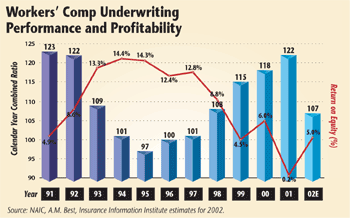
Theres no question that moving from a calendar year combined ratio of 122 to an estimated 107 is a giant leap in the right direction, and that slicing underwriting losses from $6 billion to $2 billion is impressive. Twenty-plus percent premium growth is nothing to sneeze at, eitherbut is it enough? The answer is unequivocally no.
The fact of the matter is that workers' comp suffers from seven major problems. These are: poor underwriting performance, softening pricing, weak investment returns, reserve inadequacy, rapidly rising medical costs, a slow-growth economy and massive terrorism exposure. Let's tackle them one by one:
Underwriting Performance: Lets face it. Paying out $1.07 for every dollar you take in means youre losing moneyand lots of it. With about $29 billion in premiums, workers' comp carriers spilled about $2 billion in red ink in 2002about the same amount that was lost in the Unicover fiasco a few years back.
How do you stop the bleeding? You set unconventionally ambitious underwriting targets. For workers' comp, this means forcing the combined ratio down to well below 100think close to 90.
The accompanying chart suggests that underwriters are faced with a turnaround job every bit if not more daunting than the one they engineered as decade ago.
In 1993, workers' comp insurers enjoyed a 13.3 percent return on net worth despite running a calendar year combined ratio of 108.6 (although on an accident-year basis, the figure was just 95). Between 1994 and 1997, the combined ratio ranged from 97 to 101, propelling the workers' comp RNW to a lofty 13.5 percent over the entire five-year period.
However, 1993 was on the leading edge of the Wall Street bubble and interest rates were much higher, so a combined ratio in the neighborhood of 100 was all that was needed to ensure significant profitability.
Price Softening: Pricing throughout the commercial p-c sector has softened considerably over the past year and the general consensus among industry analysts is that the pricing cycle peaked in 2002. Workers' comp is no exception.
A survey by the Washington-based Council of Insurance Agents & Brokers found that 32 percent of policies renewed with hikes of 20 percent or more in the first quarter of 2003, compared to 54 percent in the second quarter of 2002.
While no all-out price wars have erupted, the general softening in prices is disconcerting given that workers' comp insurers must trim at least 15 additional points off the combined ratio to ensure reasonable rates of return.
Weak Investment Returns: Investment income fell 2.8 percent in 2002 to $36.7 billion–its lowest level since 1994, and the fourth decline in the past five years. Interest rates at 40-year lows are the principal reason for the drop-off in investment income, but three consecutive down years in the stock markets have added insult to financial misery.
Since there is nothing whatsoever that insurers can do about the depressed earnings environment, it is painfully clear that for the indefinite future all the heavy lifting in terms of generating adequate profits will have to be done through pricing and underwriting.
Insurers would do well to view relatively low interest rates and puny stock market yields as a fixture of the economic landscape, and to price their products accordingly.
Reserve Inadequacy: As of year-end 2001, the workers' comp reserve deficiency stood at $21 billion, according to the National Council on Compensation Insurance in Boca Raton, Fla. The billions that insurers took in reserve charges last year mean this figure likely fell somewhat in 2002, but it is clear that eliminating this deficiency will create a drag on workers' comp profits for years to come.
While a quick amortization of the reserve shortfall is a bitter pill for insurers to swallow, shareholders and ratings agencies will likely react favorably because uncertainty is reduced while future earnings opportunities are enhanced. The unencumbered capital of an insurer with little reserve overhang will also find itself in a better position to seize growth opportunities in the years ahead.
Rapidly Rising Medical Costs: Private and self-insured workers' comp medical costs totaled about $30 billion in 2002, up at least 10 percent from 2001. The increase mirrors national trends, with national health care costs now exceeding $1.4 trillion, or 14 percent of gross domestic product.
Workers' comp medical costs are driven by factors that affect all medical care delivery systems, as well as some that are more specific to workers' comp. Surging pharmaceutical costs have been a major contributor to higher health care costs for all financiers of medical carewith some workers' comp carriers seeing costs for the most commonly prescribed drugs rise by 100 percent or more over the past few years.
New and costly threats are never far away. Had hundreds or thousands of health care workers been infected on the job by the SARS virus, as they were in several Asian nations and Canada, the associated workers' comp costs would have been staggering.
Utilization rates, abuse and outright fraud also remain problematic, although more so in some states than others.
Workers' comp insurers are doing what they can to tame runaway medical costs, but they are, in the end, the proverbial flea on the back of the health care elephantaccounting for only about four percent of national health care expenditures.
During the early 1990s, the national debate on health care reform contributed to the demise of fee-for-service workers' comp systems, ushering in the era of managed care. No such obvious solution is on the horizon today, leaving insurers no option other than to recoup as much of these costs as possible through price adjustments.
A Slow-Growth Economy: The exposure base for workers' comppayrollsis nearly stagnant and the U.S. labor force has shrunk by two million workers over the past two years. The unemployment rate in April 2003 was 6 percent compared to 5.8 percent for all of 2002, 4.8 percent in 2001 and 4 percent in 2000.
Looking ahead, the economy is expected to grow by 2.4 percent this year and 3.5 percent in 2004–about half as fast as in 1999 and 2000. This means the workers' comp exposure base will grow only marginally over the next two years.
The danger for workers' comp insurers is that the only way to grow in a slow-to-no-growth economy is to steal another companys customer, usually by offering a lower price. This scenario amounts to little more than rearranging deck chairs on the Titanic. The same risks get swapped around among various insurers at ever-lower prices, while everyone pretends not to notice the listing of the ship as it begins to slowly to sink beneath an ocean of red ink.
Massive Terrorism Exposure: The Taliban and Saddam Hussein have been vanquished, but the threat of terrorist strikes against the United States and its 135 million workers remains very real. The exposure has not been fully priced into policies for employers in the most at-risk areas, and insurance departments are balking at the hikes and catastrophe loadings being filed.
As a result, insurers and risk modelers find themselves in the midst of what amounts to a long-term program to educate regulators and policymakers thatif the post-Hurricane Andrew experience is any guidewill eventually be successful.
Amid the jubilation over the recent significant improvement in the p-c insurance industrys premium growth and underwriting performance, something very important seems to have been forgottenwere still not making any money. The industrys return on equity–despite the fastest premium growth in 16 years, and the best single-year improvement in underwriting performance in a decade–was an embarrassing one percent last year. Workers' comp, which accounts for about 8 percent of industry revenues and 16 percent of commercial premiums, was responsible for a not inconsequential share of that poor performance.
Investors are not happy. Lets not test their patience.
Robert Hartwig, Ph.D., CPCU is senior vice president and chief economist at the Insurance Information Institute in New York. He can be reached at bobh@iii.org.
Reproduced from National Underwriter Edition, May 12, 2003. Copyright 2003 by The National Underwriter Company in the serial publication. All rights reserved. Copyright in this article as an independent work may be held by the author.
© Arc, All Rights Reserved. Request academic re-use from www.copyright.com. All other uses, submit a request to TMSalesOperations@arc-network.com. For more information visit Asset & Logo Licensing.