Group Life Insurers Worry About The Other Shoe The group life market has looked deceptively calm.
The conflict with Iraq could change the picture by the time this article appears in print.
 But, as of press time, the benefits groups and benefits advisors that represent employers reported seeing little change in prices or contract terms as a result of the Sept. 11, 2001, terrorist attacks.
The Consumer Federation of America, Washington, put out a statement earlier this year ridiculing suggestions that the federal government should reinsure life insurers against big attacks.
"Life insurers have provided absolutely no evidence that they cant prevent overexposure to terrorism risk by using a variety of risk-spreading measures," the federation said.
But Tom Corcoran, a principal in the Hartford office of Tillinghast-Towers Perrin, said insurance company executives have been nervous.
"They really cant get catastrophic reinsurance protection the way they could in the past," Corcoran said. "Some companies are considering whether they want to be in the group life market under current conditions."
U.S. life insurers began selling employer-sponsored group life insurance in significant quantities in the 1910s.
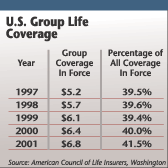
U.S. insurers provided $5.3 trillion in group life coverage in 2001, according to the ACLI 2002 life industry fact book.
Although the face amount of the typical group life certificate amounts to only about 100% to 200% of the typical employees annual income, group life accounts for about 42% of all life coverage in force in the United States, the ACLI says.
In the 20th century, life insurance of all kinds has been readily available and relatively cheap in the United States because insurers have regarded the United States as a safe, stable company. In countries where war or terrorism pose obvious threats, life insurance tends to be expensive and scarce.
To most customers, the United States has seemed to be the same old, stable group life market.
A spokesman for the American Benefits Council, Washington, said it had heard few, if any, complaints from big benefit plan sponsors about problems with group life coverage.
Bob Lindberg, a vice president at Lindberg & Ripple Inc., Windsor, Conn., who sells employee benefits to employers with more than 200 workers, said he had seen big employers asking more about insurers ratings, and insurers looking at group life clients a little more closely. But, for the most part, "weve seen a very limited impact to date," Lindberg said.
His brother, Bill Lindberg, who sells group life coverage to Lindberg & Ripples smaller commercial clients, said he had seen no noticeable changes in the price or availability of coverage for small groups.
"Rates have actually been very, very stable and extremely competitive," Bill Lindberg said.
But, on the insurer side, the effects of the 2001 attacks have been obvious, Corcoran said.
"Theres coverage available for catastrophic risk, but its much more expensive than it used to be," Corcoran said.
Insurers have stayed with group life product mainly because finding other, profitable ways to use capital has been difficult, Corcoran said.
States have based minimum life insurer capital requirements on the example set by a 1918 flu epidemic that killed 500,000 U.S. residents in a few weeks. Claims amounted to 0.5% of the 1918 U.S. gross domestic product, or the equivalent of $50 billion today.
Group life insurers believe the effects of a terrorist attack could be far more uneven than the effects of a major flu epidemic, Corcoran said.
In theory, group life insurers could hold premiums down by excluding or limiting coverage for deaths resulting from acts of terrorism.
In practice, states have not let life insurers exclude coverage for terrorist attacks, Corcoran said.
"The states dont think its good public policy, and Im not sure the insurance companies think its a good approach," Corcoran said.
If insurers exclude coverage for terrorist attacks, public pressure might force them to pay benefits on terrorism-related claims anyway, even though they have not built such coverage into their rate structures, Corcoran said.
Reproduced from National Underwriter Edition, April 7, 2003. Copyright 2003 by The National Underwriter Company in the serial publication. All rights reserved. Copyright in this article as an independent work may be held by the author.
© Arc, All Rights Reserved. Request academic re-use from www.copyright.com. All other uses, submit a request to TMSalesOperations@arc-network.com. For more information visit Asset & Logo Licensing.