Underwriters Should Rule In Hard Market The Hard Market. Where are we and how did we get here? You know what the hard market is, you know that it requires greater underwriting effort, and you know that it finally grants you–the underwriter–empowerment.
Life is good for an underwriter during a hard market because you can get proper pricing and all the information for which you have always been entitled. You no longer have to endure the price going down regardless of your instincts warning you to raise it up.
 The great thing about underwriting is just when you think you have it figured out, something changes.
However, this doesn't mean the hard market is going to be easy for underwriters. It is going to take more than getting higher premiums, dropping the less desirable risks, and making closer friendships with your reinsurers to walk away a winner from this cycle. There are complications, unlike the last hard market, that make this one unique.
The losses of Enron and World Com have caused the identifiable risks of errors and omission and directors and officers liability to be nearly uninsurable. The losses of Sept. 11 have put a risk of terrorism on the table that has never been seen before.
The hype and actual losses of mold has emerged as another potential asbestos-like exposure, and we all know that just wont go away. The threat of cyber-terrorism, medical malpractice meltdowns, tort reform battles on the state and federal level–all of these critical issues are appearing on the radar screen at once. It's up to underwriters to make sure their carriers navigate safely through this minefield in one piece.
 Adding to the pressure of this hard market are the capacity shortages and reserve shortfalls. Without excess capacity, an unexpected catastrophe erodes any profit you may have expected.
There is nothing gratifying about this hard market. However, a for-profit organization cannot grow and be profitable with fear in the souls of its workers. An underwriter is paid to measure and take a risk.
A hard market calls for better underwriting discipline. The flawed philosophy of "experience underwriting" has been exposed as inappropriate and should have never been used. But this begs the question: Then what do we do?
Underwriting must be about the measurement of risk, no matter what has actually happened in the past. You can argue that the hazards of a long-haul truck are lessened by the good experience of a driver, but you cannot state that since this truck has had no losses, it will not. What if someone else is driving that same truck?
Let me give some practical advice to those underwriters who are seeing a hard market for the first time and have been underwriting between two and 10 years:
First of all, you are not responsible for what you have never been taught. However, since you are now aware of what you need to know, you are responsible to learn your lessons well and quickly.
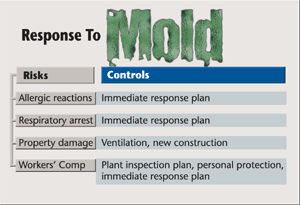
First, use your underwriting guides to help you qualify a good versus bad risk. Using a template similar to the one accompanying this column, list all of the known and common hazards on one side of the paper. For each of the risks listed, identify an appropriate control. If you have an area for which you cannot figure out a control, then get up and go to a loss control representative and ask for their recommendation based on their experience. (Note the accompanying graphic on mold as an example.)
Now, you must determine if an applicant is likely to do the things that you have determined will help you eliminate or control potential losses. Order an inspection of the building to verify its condition. Look at the recently dated loss runs and make sure there have been no water losses. (They may not have been repaired and remediated properly.) Such an inspection should include information on whether the applicant has an immediate response plan, personal protection program or plant inspection plan in place.
Finally, quantify the remaining risk that has not been addressed by the applicants controls. If you find out that they do not have an immediate response plan in place, you must determine the potential cost of the loss that might occur as a result. How? Get up and go over to your claims department and ask them. Ask how much the loss would be for 10 people to go to the hospital with allergic reactions? Ask if it is necessary to tear down a building if there is a little mold found in its walls?
These are factors that the claims people know, and that you must learn to underwrite in a hard market. You must understand the measurement of risk–a skill that develops over time and with the help of repeated exercises such as this.
Do you think this will be tedious and time-consuming at a time when your desk is loaded with paper and your agents are screaming for results?
You will never be given a more appropriate time. Writing profitable business is only achieved if these lessons are already ingrained. Now is your chance. You are aware of what you need to know. Enjoy the flight of a satisfying career!
Barbara Reardon is an insurance trainer, educator and freelance writer, based in Batavia, Ill. She can be reached at Breard@megapathdsl.net.
Reproduced from National Underwriter Edition, March 3, 2003. Copyright 2003 by The National Underwriter Company in the serial publication. All rights reserved.Copyright in this article as an independent work may be held by the author.
© Arc, All Rights Reserved. Request academic re-use from www.copyright.com. All other uses, submit a request to TMSalesOperations@arc-network.com. For more information visit Asset & Logo Licensing.