ESOP Helps Higginbotham 'Share The Vision' Of Success
Downtown Ft. Worth, Texas, is undergoing a renaissance. A city built upon the sweat and hard work of the people who drove cattle into the town along the Chisholm Trail, it continues to evolve into a world-class center of commerce and culture.
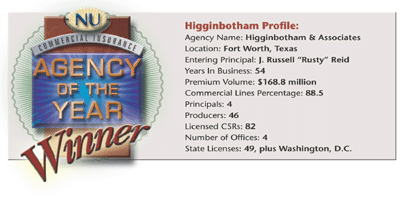
Construction equipment moves acres of earth in the reconstruction of a freeway extension that is part of a long-range plan to redevelop the citys downtown area. In a sense, this evolution is symbolic of the emergence of National Underwriters first "Commercial Insurance Agency of the Year"–Higginbotham & Associates in Ft. Worth–as a growing local and national power.
Begun as a one-man personal lines agency around World War II, today the office sits on a corner near the edge of the freeway project. In a sense, Higginbotham is working to make sure the agencys success continues to mirror the downtown areas development–after modest beginnings, imagination and investment created a boomtown with influence beyond the borders of Texas.
The Higginbotham story is a tale of hard work, dedication, and a unique attitude that gives every employee a share in the agencys future, summed up in a catchphrase hung throughout its offices: "Share The Vision."
That vision involves every employee making sure that clients are provided with all the insurance and risk management services they need in one place.
And while going that extra mile in ensuring those services, employees get to enjoy a share of the agencys success through its Employee Stock Ownership Plan. The benefits are two-way, as having "skin in the game"–as the agencys head put it during one interview–motivates all shareholders to go above and beyond to grow new business, keep clients happy, and improve the bottom line.
From that one-man agency begun seven decades ago, Higginbotham has grown into a multifaceted insurance, risk management, and financial services firm with branch offices in Dallas, Denton and Weatherford, Texas. The agency has 135 employees and managers on board, a premium volume of more than $168 million, and the honor of being named "Employer of the Year" for 2002 in the Ft. Worth area, beating out such notable competition as Pier 1 Imports.
Much of the credit for the agencys success is awarded to its leader. Without hesitation, when speaking to executives at Higginbotham, J. Russell "Rusty" Reid, president and chief executive officer, is cited as the key, go-to player.
"Before Rusty was hired, I tried to look down the road and was concerned if we would even be around in 10 years. I began to see the handwriting on the wall as far as the future of small agencies," reflected Robert Morgan Woodruff, executive vice president, secretary and treasurer, who joined the agency in 1970.

"What Rusty has done, under his leadership, is amazing," Mr. Woodruff said. "It is highly unusual to find in one individual so many talents in one package–salesmanship, management, vision. If there is one specific factor I can point to when talking about where we are today, it is J.R. Reid."
According to a historical perspective prepared by Mr. Woodruff, Higginbothams story began in 1940, when Paul C. Higginbotham opened his storefront agency in the Riverside area of Ft. Worth. By 1943, with war waging, Mr. Higginbotham was called to service and had to sell the agency under the terms of a five-year non-compete clause.
It was not until 1948 that he was able to start anew, contracting with General Insurance Company of America, a subsidiary of Seattle-based SAFECO, and Trinity Universal Insurance Company in Dallas. (Both companies, Mr. Woodruff notes, are still represented by the agency.)
In 1961, William A. Stroud, a nephew of Mr. Higginbotham, joined the agency. The following year, Mr. Higginbotham died, leaving his widow, Edith Day Higginbotham, and Mr. Stroud to run the agency.
Mr. Stroud took over the agency in 1969, purchasing Mrs. Higginbothams 90 percent interest for $100,000, of which two-thirds represented good will. At the time of the purchase, Mr. Woodruff points out, the agency approached $100,000 in gross commissions annually.
In 1972, Mr. Stroud and Mr. Woodruff, with the help of "three ladies" working at the agency, rented a U-Haul and made its first move within the city. Mr. Stroud had purchased a building once owned by the Boy Scouts of America. It would be the first of a number of moves on the road to expansion.
Concerned with perpetuation of the agency, Mr. Woodruff observed, in 1986 Mr. Stroud hired "a young, 24-year-old marketing representative with American General Insurance Company by the name of James R. "Rusty" Reid. He proved to be the person Mr. Stroud had been looking for."
 The agency was sold to its employees under the ESOP agreement in 1989 for $1.67 million, and Mr. Reid was named president. The employees became the owners of an agency that Mr. Woodruff said had $7.66 million in gross premium and $1.3 million in income in 1988.
The agency made several strategic acquisitions that expanded its depth of business and developed several departments. This included the growth of its life and health division (later to become employee benefits) that at the time of the ESOP deal garnered only $25,000 in commission income.
The agency would also develop several programs that are credited not only with helping its expansion, but also promoting client loyalty that in a hard market helps explain an account retention rate of 93 percent over the past three years. The success also allowed the firm to retire its ESOP debt by 1996.
There are a number of reasons for Higginbothams success, its executives say. In large part, credit is given to the ESOP for motivating employees.
"Because of the ESOP, it is about more than just a job. You are a shareholder and you have as much to gain being the receptionist as I do being the president of Higginbotham," observed Mr. Reid. "Driving the company and contributing what you can is just vital to our success. It's not as if you do that, and all your profits go to an absentee owner or disconnected operator."
The ESOP has "helped us get to where we are today," agreed Mr. Woodruff, referring to employee ownership as "sweat equity" in the firm.
"People either rent jobs or own them," pointed out Michael Parks, vice president for employee benefits. "The ESOP helps people have ownership."
Mr. Parks explained that employees become shareholders within the ESOP after one year of employment and become vested after five years. In the office, this has led to a culture where competitive producers willingly share information and successes with one another because in the end everyone benefits from the agencys profitability.
The ESOP also works as a recruitment and retention tool for quality employees, Mr. Parks noted. Those who are new to Higginbotham and the concept of an ESOP do not truly understand how significant ownership is until they get their share-value statement after their first year, he explained.
But the desire for success goes deeper than just the ESOP.
The business needed a plan to bring new clients to the agency for it to grow. Confesses Mr. Reid, doing this by expanding services was not the result of some clever brainstorm, but simply listening to the desires of the agencys customers and employees.
"We did not subscribe to the theory that we could be a jack-of-all-trades, master of none," he continued, which led to the hiring of those with expertise outside of the property-casualty field as early as 1989. Coming on board then were Jim Hubbard, who today is executive vice president, and Michael Parks, vice president, both of whom oversee the growing employee benefits area.
By 1995, the agency adopted the concept of developing "the complete relationship" with the customer, said Mr. Reid, with Higginbotham striving to become "the single source for a secure future." This meant having on staff individual experts on every service under one umbrella, ranging from insurance to risk management, to human resources.
By contrast, the competition, Mr. Reid noted, while perhaps offering value-added services to clients, would charge extra for those services or just concentrate on insurance product pricing. Part of the growth strategy was offering clients the same insurance services as the competition, but to include a complete package of human resource and risk control services as well.
 "We sell solutions instead of just products," Mr. Reid pointed out.
Getting clients to move their business to the agency was another challenge, and to do that meant first identifying their needs. "A client will never move to you unless you identify what their pain is," Mr. Reid said, crediting Randy Schwantz, a sales consultant and author of the book, "The Wedge: How to Stop Selling and Start Winning," published by The National Underwriter Company, with bringing this strategy to the agencys attention.
"The way you identify with their pain is to draw a comparison between what they have and what they could have," Mr. Reid continued. "In certain cases you are able to make the change, and in other cases youre not, but he has a really defined strategy."
Identifying that pain has led to some innovative solutions and, as Mr. Parks points out, "getting ahead of the curve" of other agencies in providing benefits for clients.
For a property-casualty firm, recognizing the need to provide clients with other lines of products and services outside of the traditional p-c markets put the broker out in front of the competition back in the 1980s, noted Mr. Parks.
At the time, clients went separately to a life and health agency for employee benefits. Making available one source where all insurance coverage solutions could be found–both in p-c and life and health–suddenly made life easier for businesses trying to figure out what combination of plans were best for them.
Another strategy was that while other producers would introduce only one type of managed healthcare plan to a client, Mr. Parks explained, Higginbotham went the extra mile to give the client a choice of plans. "If I only come in and show you exactly what you have, then I really havent done anything for you," Mr. Parks observed, adding that in a hard market this practice solidifies Higginbothams position as a trusted consultant.
Clients want "silos of expertise" and simplicity in dealing with benefits, according to Mr. Parks. This led the agency to be one of the first in North Texas to create a department devoted to 401k plans, along with the launch of an in-house Section 125 administration plan, while offering other human resource services that make life easier for commercial clients.
One unique value-added employee benefit service is the Higginbotham health insurance credit card. When a client switches health benefit providers, complications usually arise and not all employee information gets transferred immediately, which could result in delays in coverage. However, a mother trying to get a prescription filled for her child in an emergency, for instance, cannot afford to wait a week for the new coverage provider to get up to speed while such billing problems get resolved.
Under Higginbotham's credit card program, a human resource manager can page one of the brokerages service representatives 24-hours-a-day. If a coverage complication arises during an employee's transition to the company's new health plan, the brokerage pays for the healthcare under the terms of the policy, getting reimbursed later by the carrier.
Yes, there are risks in such an initiative, Mr. Parks noted, but the credit program underscores the commitment Higginbotham makes to its clients, and that pays dividends in retention and referrals.
"Its a huge value-added service and cuts down on the workload and stress level as we go through this transitional time," Mr. Parks explained. "The first impression that the employee is going to have of that carrier is going to be the first time they use that card. If that doesnt work, they may never like that carrier. Perception is reality, and we want to make that perception more valuable."
Tying services together for Higginbothams commercial and personal lines clients means "wrapping" services together, Mr. Reid said. It also means providing those services based on commission, and not looking to charge additional fees to clients.
Higginbotham is always looking to provide multiple products and services to all accounts. "We have a close relationship with our clients, and we communicate with them all the time," noted C. Douglas Dickerson, executive vice president for property-casualty. "The more products and services you have a customer in, the closer they are tied to you."
"Our producers monitor their clients closely because there could be more involved than just home and auto," explained Mary Russell, vice president for personal lines. "Ours could be a piece of another account."
Higginbotham created a VIP department to coordinate a key client's personal and business policies to ensure comprehensive coverage. The service includes an annual home audit and a personal insurance portfolio laying out the clients entire coverage plan.
As Chris Rooker, vice president for commercial lines, observed, the point of all this service is to have as many "touch points" as possible with clients. This also includes asking if there are any insurance needs or concerns they may have during every customer contact.
To help customer service representatives cross-sell products, Mr. Rooker said, each has a booklet containing information on different products the firm offers. There are also financial incentives for those who help successfully promote cross-selling, which all comes back to the concept of "Share the Vision."
Expanding on that vision of success is a venture into captives, as well as an online managing general agent vehicle called "InsureZone."
Higginbotham is not using captives as an insurer of last resort, said Mr. Rooker. Instead, the firm is setting up largely Bermuda-based entities for its better customers who have their risk management house in order and are looking to provide a stable coverage source for long-term risks.
InsureZone, which came to the firm through an acquisition, offers access to commercial insurance carriers for more than 1,650 rural agents in 32 states. These agents, Mr. Rooker explained, are virtually locked out of obtaining appointments with carriers that write large commercial accounts, who would never give such agents appointments because they lack the minimum volume required. Through their Web portal, Higginbotham can extend the firms clout with carriers throughout the country.
However, it is not the intention of those at Higginbotham to rest on their laurels. Instead, they are looking to progress and grow, and become an even bigger player among Americas brokers.
The agency remains one of the largest to represent SAFECO in the companys central region, and is joined by other notable standard carriers such as AIG, Chubb, CNA, Crum & Forster, Firemans Fund, Hartford, Kemper, Royal & Sun Alliance, St. Paul, Travelers, Wausau, Zenith, Zurich and others, along with access to numerous specialty and E&S carriers.
"We really subscribe to the theory that change is good, and as we all know, some people have a difficult time with change" observed Mr. Reid on the growth of Higginbotham. "It is one thing to implement a change and another thing to manage through that change, but at the end of the day you should come out of that valley of despair higher than when you went in."
Mr. Reid said he applauds his management team and staff "for doing an exceptional job of thinking outside of the box, implementing new ideas and strategies, listening to the client, listening to the marketplace, and leveraging all those things to run a successful operation."
Reproduced from National Underwriter Property & Casualty/Risk & Benefits Management Edition, September 23, 2002. Copyright 2002 by The National Underwriter Company in the serial publication. All rights reserved.Copyright in this article as an independent work may be held by the author.
© Arc, All Rights Reserved. Request academic re-use from www.copyright.com. All other uses, submit a request to TMSalesOperations@arc-network.com. For more information visit Asset & Logo Licensing.