Nat'l Accounts Expanding, But Alt. Market Threat Looms
 Within commercial lines, the national accounts market segment is viewed a bit like the U.S. government. Everyone knows its big, but its tough to pin down quite how big it really is. Everyone suspects that its growing, but no one seems to know by how much.
And, as with the federal government, most everyone has an opinion about just how much of a contribution it really makes to insurance industry results–or, in the case of the federal government, to our collective well-being.
Data recently compiled by "MarketStance" reveal that the large-account segment has grown markedly over the past 15 years. Large U.S. businesses now account for almost 64 percent of all U.S. business receipts.
Remarkably, this 15-year increase in revenue share–amounting to a staggering 12 percentage points–has been little noticed, perhaps in part due to the publicity lavished upon the "new economy" and its high-tech industries, and the presumed rapid growth implications for smaller "gazelle" accounts.
 Through the ups and downs of hard and soft insurance markets–not to mention the pronounced 1990 recession–this commercial lines market segment has quietly expanded, and major national accounts players such as Zurich, Chubb and Kemper quietly have done a lot of business here.
In fact, "MarketStance" estimates that this segments total premium potential amounted to $72 billion last year. This represents about 40 percent of the entire commercial lines premium potential.
(For purposes of this analysis, "premium potential" measures the total insurable potential of these accounts irrespective of whether they are carrier-written or currently covered through any of the various alternative risk transfer mechanisms.)
No matter how you look at it, $72 billion represents a lot of loss dollars to be insured, administered or serviced. In addition to major insurers, there are a whole host of claims administrators and risk service providers in the national accounts arena.
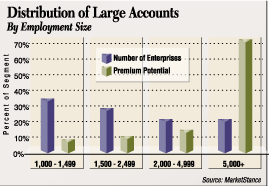
 As with the government sector, the commercial lines national account segment covers a multitude of entities. While "smaller" firms–those with 1,000-to-4,999 employees–comprise more than 80 percent of the accounts in this segment, they represent less than one-third of its premium potential.
In contrast, the 1,900 or so firms with 5,000-plus employees accounted for more than two-thirds of this segments total premium potential. Indeed, these firms are estimated to have had a per-account premium potential of more than $7.5 million. (Just in case youre wondering, the broker fees generated on this typical account are estimated to average a "mere" $250,000.)
The upper tier of the national accounts segment still is primarily the domain of several industry groups–manufacturing, transportation, communications and utilities. In fact, "MarketStance" data indicate that these industries together account for more than 50 percent of the premium potential among firms with 5,000 or more employees.
Closely following these industries is the fast-growing services industry, which at present accounts for only about 18 percent of these largest firms premium potential. In contrast, wholesale trade and the finance, insurance and real estate industries account for very modest shares of the largest firms premium potential.
 In coming years, the service industrys share of the national account segment is expected to widen markedly as the U.S. economy continues transitioning away from its former goods-producing emphasis. Over the next few years, moreover, this growth differential in favor of the services industry will be exacerbated by the emerging recessions transitory impact on the manufacturing and transportation industries.
The economys shift toward service-based businesses quietly has been dampening use of alternative risk-transfer markets for quite some time. This is because very large, service-based firms traditionally have been less intensive users of ART mechanisms to meet their risk management needs.
For example, "MarketStance" estimates that only about 19 percent of very large service firms property exposures are covered through ART mechanisms. This low proportion of alternative markets utilization–only about half the corresponding proportion for equivalently-sized manufacturing concerns–in part reflects the much lower importance of property exposures among most types of services-based firms.
 In contrast, services firms reliance on alternative markets for both workers' compensation and general liability exposures is much higher than for property exposures. However, the alternative markets share of total premium potential for each of these lines of coverage still is 8-to-12 percentage below the corresponding share for manufacturing firms.
The one exception to this pattern is for commercial auto exposures, where "MarketStance" estimates that services firms make slightly greater use of ART mechanisms than do their manufacturing counterparts. Just the opposite of property, services firms heavy reliance on alternative market instruments for commercial auto exposures in part reflects the fact that commercial auto is a more important component of risk for them than it is for manufacturing firms.
Indeed, "MarketStance" data indicate that commercial auto comprises almost 27 percent of large services firms premium potential within core commercial lines.
Recent hardening of commercial insurance markets has increased concern about carriers' written premium potential in the national accounts segment. Specifically, many observers are concerned that carriers premium writings will erode as risk managers react to higher rates by increasing their reliance on self-insurance and other alternative risk-transfer mechanisms.
 Many large accounts undoubtedly will increase loss retentions and lower the limits they carry in an effort to control the rapid upward pressure on their total cost of risk. The recent and prospective trends in these key parameters of large-account coverages is a complex story in its own right and will be featured in a subsequent "MarketStance" article.
For the time being, suffice it to observe that the national accounts segments ongoing demographics evolution has had, and will continue to have a very large, positive impact on carriers written premium potential. And unlike the federal governments budget surplus, this impact wont be here today and gone tomorrow.
Frederick Yohn is the president of IntelliStance LLC in Middletown, Conn., and the developer of "MarketStance," a precision market analysis tool for the U.S. commercial property-casualty insurance market and a registered trademark of IntelliStance.
Reproduced from National Underwriter Property & Casualty/Risk & Benefits Management Edition, December 17, 2001. Copyright 2001 by The National Underwriter Company in the serial publication. All rights reserved.Copyright in this article as an independent work may be held by the author.
© Arc, All Rights Reserved. Request academic re-use from www.copyright.com. All other uses, submit a request to TMSalesOperations@arc-network.com. For more information visit Asset & Logo Licensing.