Adjusting WTC Claims Involves Grief And Grit
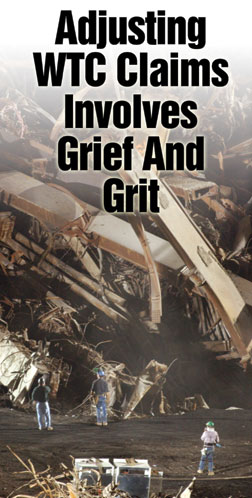 No matter how experienced at handling catastrophes they are, claims adjusters working in the dusty streets surrounding New York's World Trade Center "Ground Zero" disaster area cant breathe easily.
But struggling to inhale through a respirator is just one of the unique circumstances that adjusters said they are coping with in the wake of the Sept. 11 terrorist attacks.
As they labor to unravel the effects of the costliest man-made disaster to ever hit America, claims experts described facing challenges that have been emotional as well as physical. In addition, there have been extreme problems with site access and assessment.
Stephen Cella, an executive general adjuster with the global claims operation at Parsippany, N.J.-based GAB Robins North America, sat in his Williams Street office in Downtown Manhattan six blocks from the ruins and described how trauma from the event has added more than a few gray hairs.
Many among the thousands gone missing when the towers collapsed were from the insurance community, he noted. While previous catastrophes he has witnessed have involved loss of life, "you never had one situation with thousands lostTheres a personal mark in this on the claims industry," he added.
At GAB in Manhattan, he said, "weve all gone through and continue to go through a grieving period because of all the memorial services we had to attend. For a three-week period, it was nearly every day that there was another [victims] spouse to talk to, children to talk with–it wrenched your heart out of your body."
For Nick Bozovich, senior general adjuster working out of the York, Pa., office of Chicago-based CNA Insurance, there is a different component because of the malevolence in the terrorist attack that led to the destruction. With a hurricane or an earthquake, "it's just nature," he said. However, the evil involved in the World Trade Center destruction "added a particular emotional dimension," he added.
Mr. Cella also described the frustration in dealing with a situation where, unlike previous catastrophes he has handled, the process of restoration is so delayed.
"The rebuilding process cant be accomplished as it could in the past," he noted. "The demolition could be anywhere between nine months to a year. You cant get any feeling of accomplishment."
Watching the recovery activity at Ground Zero, he said, "its inspiring to see the people work, but from an insurance standpoint its pretty disheartening." The focus on the site where the Twin Towers once stood is so heavy "that its hard to recover surrounding buildings," Mr. Cella said.
Usually when he works a catastrophe, the rebuilding is evident, with new plate glass going up. However, a month after the World Trade Center calamity he still views buildings with vacant windows.
Fumes and dust are still a problem in the area. Mr. Bozovich said it was difficult walking the site and adjusting to having breathing restricted by a respirator mask.
For the companies that work the scene, "one of the biggest challenges we face is accessibility. The area is still restricted, and to a great extent our people are not able to get in unless they are escorted," remarked Grover Davis, the president and chief executive officer of Atlanta-based Crawford & Company.
Paul Tracey, a catastrophe team process mastery manager in the Roseville, Calif., office for Northbrook, Ill.-based Allstate Insurance Company, said normally his operation is accustomed to gaining quick access to a catastrophe site, "but we had to balance our needs against the fact that this is a crime scene."
Lack of access became a particular problem when residential policyholders, who were forced to evacuate their apartments, neared the end of a 14-day temporary living expense period.
Allstate needed to be able to tell residents whether they qualified for 12 months of additional living expense, but making a judgment was problematic.
Mr. Tracey said that working with the New York Disaster Coalition of state agencies and industry, the team was able to get close enough to the "hot zone" to do a high-level overview and see which areas sustained major damage and which escaped with only smoke and debris.
That view permitted a general assessment allowing the company to estimate that if a customer lived within a certain radius they would require 12 months of additional living expense.
Allstate, which had about 3,500 residential policyholders living below Canal Street in the heavily affected section, did a quick computer run to identify them all and "if they didnt contact us, we contacted them.People were astounded," Mr. Tracey said. Area insurance agents were also contacted, he noted.
Some policyholders who had not made a claim had "lost a spouse or a loved one and they just werent in a place where they could deal with it," explained Mr. Tracey.
John Eager, senior director of claims service for the National Association of Independent Insurers in Des Plaines, Ill., said processing of life and workers' compensation insurance claims had been aided by the states announcement that a family members affidavit could serve as evidence of a loss.
With so many people having disappeared in the Twin Towers debris, "its just horrendous. There may never be evidence of the person," he said.
In a "normal catastrophe," adjusters go in, do triage and work with what remains, but with the World Trade Center "there is nothing left, so how do you handle that?" he said.
To find the scope of business loss and business interruption, claims handlers are having forensic accounting done–recreating lost data by contacting banks, as well as hunting down information from policyholders vendors and accountants who did their taxes, Mr. Eager noted.
Mr. Cella said that areas where loss assessment has been difficult have included personal property left behind by employees fleeing the disaster scene, as well as rental costs.
In addition, he said it was very difficult to assess the issue of comparable replacement office space that policies cover. He noted that it was hard to recover copies of leases for World Trade Center space where many tenants were paying cut-rate rents after the building was bombed by terrorists in 1993.
In some cases, he said, the only space available to former World Trade Center businesses was expensive uptown real estate. "So you just doubled rent and you extrapolate that on a 20-year lease," he explained.
Telephone service in the World Trade Center area, which was a problem immediately after the attack, remained spotty more than a month later. In the immediate aftermath, Mr. Bozovich said that using e-mail was a better way to communicate than by phoning.
Mr. Tracey noted that a month after the Sept. 11 attack, there were still fears and questions about whether dust and debris floating about the area were harmful. City officials said their testing has found nothing worrisome.
The New York State Insurance Department in early October set up a special reporting system for fraud, but adjusters who spoke with National Underwriter said they had not encountered any evidence of criminal behavior. "In this situation its unbearable to think anyone would take advantage," said Mr. Tracey.
Reproduced from National Underwriter Property & Casualty/Risk & Benefits Management Edition, November 5, 2001. Copyright 2001 by The National Underwriter Company in the serial publication. All rights reserved.Copyright in this article as an independent work may be held by the author.
© Arc, All Rights Reserved. Request academic re-use from www.copyright.com. All other uses, submit a request to TMSalesOperations@arc-network.com. For more information visit Asset & Logo Licensing.