Small Agencies Face Struggle;Women, Minorities See Opportunities
With 30 years of experience in the business as an independent agent in Rochester, Ind., Ron Smith, president of Smith, Sawyer and Smith, feels that the future of the independent agent still lies in his or her ability to provide a value-added service. This is especially true in the competition between small- and large agencies.
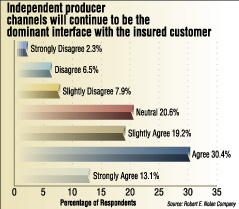 Mr. Smith, a past-president of the Alexandria, Va.-based Independent Insurance Agents of America, sees the challenge for smaller agents in achieving an economy of scale and being able to attract business in rural places.
"The small agents always have a challenge and it is revenue," observed Mr. Smith. "They need a certain amount in order to function. I marvel when I go past a Walmart and it is being replaced by a Super-Walmart. We are forced to do some of thatWill there be agents who will be dislocated and go out in the process? Yes, but I submit that that is not much different from any other business."
Providing services via the Internet and customer loyalty are factors that will help agents survive, said Mr. Smith, but he added that producers will eventually realize that economy of scale is just as important. They will need to consider mergers, consolidation, or clustering with other agencies to create leverage with companies, he predicted.
"The agent must be able to adapt," said Mr. Smith. "The philosophy should be, Lets settle a claim before it happens, not discover you have a problem when you have a claim.'"
However, for women, the future will only get better as far as the independent agency system is concerned, observed Louise Canter, senior vice president and principal of Patterson/Smith Associates in Falls Church, Va.
Ms. Canter, who is also a vice president of IIAA, observed that in the past 25 years the role of women within agencies has grown to where more and more are becoming principals. The number of female agency principals and managers will continue to increase over the next five years, she predicted.
"There is the realization that women bring skills to the table," according to Ms. Canter. "As more women become managers and principals and make greater advancements, our field will become more attractive to them if it is perceived to have more opportunity."
For minorities, the independent agency system must continue to open its doors, observed Jerald L. Tillman, principal of Jerald L. Tillman Insurance Agency in Cincinnati.
Mr. Tillman, who is also a board member and founder of the National African-American Insurance Association, headquartered in Washington, could not predict how far the doors will be opened for minority agents in the future.
However, he did say that if agencies and insurers want to attract more minorities, they will have to do a better job recognizing cultural differences, recruiting for all aspects of the insurance business, and realizing the challenges faced by most minority-owned independent agencies–many of which are new startups with less than three years business experience.
"Not knowing about the many opportunities is not a fault, but the effect of a historically closed society," Mr. Tillman said in an e-mail interview.
Reproduced from National Underwriter Property & Casualty/Risk & Benefits Management Edition, July 6, 2001. Copyright 2001 by The National Underwriter Company in the serial publication. All rights reserved.Copyright in this article as an independent work may be held by the author.
© Arc, All Rights Reserved. Request academic re-use from www.copyright.com. All other uses, submit a request to TMSalesOperations@arc-network.com. For more information visit Asset & Logo Licensing.