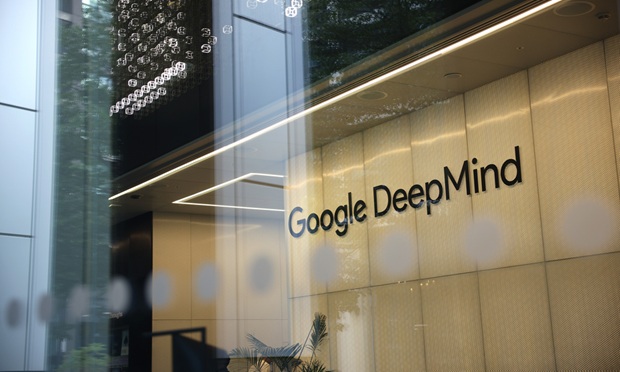
 Google DeepMind offices in London. (Credit: Dan Kitwood/Getty Images)
(Bloomberg) — Google DeepMind has released a new artificial intelligence weather model that it says is faster and more accurate than anything it’s built before, while providing additional tools for energy traders.
WeatherNext 2 builds on DeepMind’s previous AI models, which have demonstrated how machine learning can outperform traditional prediction methods.
The new model not only provides more accurate two-week forecasts of temperature, pressure and wind, but can also better predict tropical storm tracks, according to DeepMind researchers. That means its predictions of a hurricane’s path are as accurate three days ahead as the previous method was at two days out, testing shows.
The new weather model has other improvements sought by energy traders, including hourly forecasts instead of 12-hour outlooks. It can also generate predictions roughly eight times faster than DeepMind’s previous AI weather model.
“It gives you a more granular forecast,” said DeepMind AI researcher Akib Uddin. “Many other industries are quite interested in these one-hour steps. It helps them make more precise decisions. Their goal is, how can they make their business more resilient to weather?”
Advances from Alphabet Inc.’s London-based research wing, a tech heavyweight behind some of the most pioneering forecasting programs, are closely watched by the energy and agriculture industry, shipping firms, insurers and other weather-dependent businesses seeking a profitable edge in predicting temperatures, wind speeds, cloud cover and storm tracks.
The improvements stem from a new approach to the algorithms underpinning its weather models, which were detailed in a research paper published in June. Previous methods were based on machine learning models built for image and video generation that require repeated processing. DeepMind’s new model only needs to be processed once to create accurate weather predictions, which means faster forecasts that are less dependent on costly AI computing systems.
AI has fueled a boom in new weather prediction tools, which are starting to replace forecasts that for decades have been generated by supercomputers. New AI models — which look for patterns in enormous tranches of weather data instead of recreating the atmosphere’s complex physics — are shown to be more accurate than traditional forecast methods at predicting most conditions.
The increasingly competitive field of AI weather models includes forecasting tools from major institutions like the European Centre for Medium-Range Weather Forecasts, commercial players like AccuWeather Inc., Vaisala Inc., Weather Co LLC, and ones developed by tech firms like Nvidia Corp., Microsoft Corp. and Huawei Technologies Co.
Weather-dependent businesses will be scrutinizing whether DeepMind’s latest model is better at forecasting extreme events. That’s an area where traditional, physics-based counterparts still have an edge, especially as climate change pushes the planet into uncharted territory.
The new model appears to be better at accurately predicting some extremes, including temperatures, wind speeds and precipitation, DeepMind researchers said. However, they acknowledged that the AI model struggled with outlier rain and snow events, largely due to spotty observations in the training data.
“It’s one limitation of our forecast, but one that we are working on improving,” said DeepMind research scientist Ferran Alet.
See also:
- AI and location intelligence drive more equitable home insurance
- 4 Things consumers should know about risk-based rates
- 7 Arguments against climate change
Copyright 2025 Bloomberg. All rights reserved. This material may not be published, broadcast, rewritten, or redistributed.
© Arc, All Rights Reserved. Request academic re-use from www.copyright.com. All other uses, submit a request to TMSalesOperations@arc-network.com. For more information visit Asset & Logo Licensing.