 The Federal Insurance Office (FIO) is being told the government should support the private reinsurance market and think long and hard before creating any government backstop that would alter the current system.
The feedback comes in response to FIO's request for input on a forthcoming study of the global reinsurance market and the critical role reinsurers play in supporting U.S. carriers.
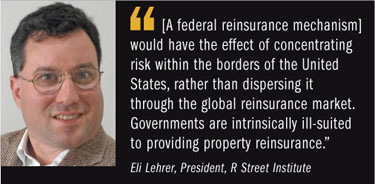
Eli Lehrer, president of industry think-tank R Street Institute, says any federal reinsurance mechanism that would replace private reinsurance "would have the effect of concentrating risk within the borders of the United States, rather than dispersing it through the global reinsurance market.
"Governments are intrinsically ill-suited to providing property reinsurance," Lehrer further argues in his letter.
In other feedback to FIO, the Coalition for Competitive Insurance Rates (CCIR) voices strong opposition to a provision of the Obama administration's proposed 2013 budget that would deny a tax deduction for certain reinsurance premiums paid to foreign-based affiliates by domestic insurers. The group calls the provision "a harmful and discriminatory proposal."
Lehrer also notes the solvency concerns currently plaguing the largest government-run reinsurer in the United States, the Florida Hurricane Catastrophe Fund (FHCF), whose financial advisors estimate it would still face a shortfall of more than $1.7 billion—even after tapping out its capacity to borrow money in the bond markets—following a major storm to make good on its obligations to Florida property insurers.
The Florida Chamber of Commerce tells FIO that FHCF and Florida Citizens Property Insurance Corp. are prime examples of why the federal government should stay out of the reinsurance business.
The American Insurance Association (AIA) also weighed in, emphasizing the importance of reinsurance to the primary insurance market and noting its interest in making certain the U.S. regulatory system would not lead to increased international trade barriers for reinsurance.
"As regulated insurance companies, AIA's members have a substantial stake in maintaining an effective and efficient insurance-regulatory system," Steven Bennett, the group's associate general counsel, says in the group's letter. "We continue to emphasize that the domestic and international regulatory systems ought to foster the growth of vibrant private, competitive insurance markets."
The AIA cites a recent report on reinsurance and financial stability by the International Association of Insurance Supervisors (IAIS) stating that reinsurance can serve as a source of stability during times of crisis for primary insurers. Further, the AIA states that traditional reinsurance and the bulk of alternative risk-transfer mechanisms utilized by reinsurers are not sources of systemic risk and do not have the potential to be threats.
The AIA also points out a number of international trade barriers for reinsurance that already affect its members, including restrictions in Argentina and Brazil. "Overtly protectionist reinsurance regulations adopted by Argentina and Brazil unfairly restrict trade," Bennett writes. "Requiring foreign insurers to cede high percentages of risk with local insurers leads to a concentration of too much risk within one nation's economy."
RIMS President Deborah M. Luthi says in her group's letter: "The role of reinsurance and the global nature of reinsurance are indispensable to the health and general well-being of our membership. It is also an invaluable component to the overall stability of the U.S. economy as the global reinsurance market functions to provide a ready source of capital to be deployed to rebuild and for recovery following catastrophic events, particularly in the case of a natural disaster or terrorist event."
Luthi points out that according to the Insurance Information Institute, reinsurers paid 60 percent of losses related to the Sept. 11 terror attacks—and the majority of those losses were paid by non-U.S. reinsurers.
"Globalization of the reinsurance market permits the pooling and spreading of risks globally, which in turn permits pooling risks from the entire spectrum of catastrophic losses and from varying jurisdictions," she adds. "This allows for reinsurance to be provided on capital bases that allow reinsurance to be priced on a basis lower than it would otherwise be priced if capital had to be held to support a specific risk in a specific geographic area."
RIMS also reiterates its opposition to legislation introduced by Rep. Richard Neal, D-Mass., and Sen. Robert Menendez, D-N.J., that would place significant restrictions on domestic insurers that cede reinsurance to their foreign affiliates.
Such statues, Luthi says, "would have a chilling effect on these insurers and reinsurers [that] provide an important safety valve in many areas of the country that are subject to a multitude of risks."
© Arc, All Rights Reserved. Request academic re-use from www.copyright.com. All other uses, submit a request to TMSalesOperations@arc-network.com. For more information visit Asset & Logo Licensing.