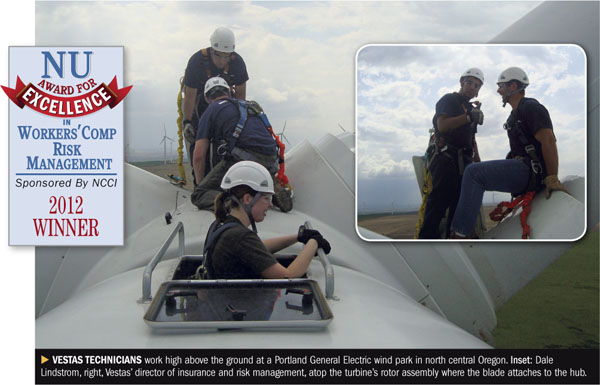
 When your employees are climbing up 250 feet above the ground to work in confined spaces, around high-voltage equipment located in remote areas subject to extreme weather and wild animals, the Workers' Compensation exposures inherent to the job are enormous.
Mitigating these daunting, dangerous and potentially deadly risks is the challenge faced by the risk-management team at Vestas-American Wind Technology, the Portland, Ore.-based division of its Danish parent company, Vestas, which has been manufacturing, installing and servicing wind turbines since the 1970s.
In 2008, Vestas-American logged 11.9 injury incidents per million hours worked—a record high. At that time, the company's primary goal was increasing business. Today, the company's passion for growth continues—but is now rivaled by its commitment to worker safety.
This focus on avoiding the injuries associated with such hazardous conditions has yielded remarkable results—and has led to the company winning NU's annual Excellence in Workers' Comp Risk Management award.
Since November 2010, Vestas-American has had zero lost-time injury accidents—no small feat considering it boasts 1,250 employees installing an average of one turbine every three hours in the U.S.
For the year beginning March 1, 2009, Vestas-American saw 104 claims and total incurred costs of $756,000 (with a head count of 1,085). For the year ending March 1, 2012, the number of claims plummeted to 41, with total incurred costs of just under $200,000.
 And its recordable-injury rate has declined from 38 in 2009 to just seven so far this year.
Vestas-American's safety focus is a strategic business advantage that helps not only with Workers' Comp costs but also in securing new business. For many of its customers, safety is a top priority—and a key element in their evaluation of which operations and maintenance contractor they will partner with during a multi-year service and maintenance contract.
PATH TO SAFETY SUCCESS
How has the company brought about this Workers' Comp success story?
The process began in 2009, following the arrival of new president Martha Wyrsch and the appointment of Rick Kroon as director of safety and health. Prior to their arrival, "safety was not integrated into operational performance—and the poor results [of 2008] reflected this lack of attention," Vestas notes in its submission.
One key early initiative was updating the company's health & safety manual and improving the company's proprietary Basic Safety Training Course, explains Dale Lindstrom, director of insurance and risk management.
The training now covers proper safety techniques for fire and fall prevention, mechanical and hydraulic hazards, working at heights, proper use of protective gear and specialized construction equipment—and even high-angle rescue training. All students become certified in first aid and adult CPR.
Ongoing training and progress tracking is then required through an online system administered through a partnership with outside vendor PureSafety.
Another key safety program adopted in 2010: task-based certification that provides training in specific technical skills—and requires from students the practical demonstration of what they have learned.
Also put into practice in 2010 was the Site Safety Scorecard, which helps keep tabs on overall key performance indicators and compliance with the Vestas safety manual. The scorecard ensures that each location holds regular safety meetings and emergency drills; practices overall safety training and hazard submittals; and conducts self-administered compliance audits.
In 2011, the Denmark-based parent company implemented a "Vestas Safety Ambassador Award" that recognizes employees who are making a difference in improving the organization's safety culture. The year it was introduced, more than 100 nominations were submitted for this honor, and the award recipient was a U.S. employee.
This year, Vestas-American's "Incident and Injury Free—Everyone, Everywhere, Every Day" campaign aims to establish its practices as best-in-class for the entire energy industry.
 ALL THE RIGHT MOVES
To counter the physical challenges many of its employees face every day, one of Vestas-American's key focus areas is soft-tissue injuries: strains and sprains.
To that end, in 2011 the company invested in a program licensed by MoveSMART, which teaches employees how to leverage their bodies when performing certain tasks such as lifting, pushing and pulling objects.
It's an approach that addresses both the physical skills of the job (the "Move" portion) as well as mental skills (the "SMART" aspect): attention to the task at hand, good judgment and personal responsibility with regard to safety.
The system has proven to help lower workplace injuries and costs while considerably raising personal control and responsibility, motivation and morale, and work effectiveness. As a result of the program's implementation, injuries from awkward positioning fell by 62.5 percent from 2011 to 2012. Injuries from lifting fell by 53.3 percent, and push/pull injuries declined by 78.5 percent.
"It's a step toward a more behavioral approach to managing risk," says Lindstrom. "There is only so much you can do to educate employees, but this gives them responsibility over their safety. In order to get them to change ingrained movements, we continue to educate and re-engage with individuals whenever an accident or near-miss happens."
MOVE TO CAPTIVE YIELDS COST SAVINGS
In previous years, Vestas-American insured its Workers' Comp under a large deductible program in which claims under $250,000 were self-insured (excluding the Monopolistic States).
Insurance premiums for the excess insurance (claims exceeding $250,000) were allocated to each department based on employee head count. Costs and expenses associated with a claim were deducted from the cost center of an injured employee's department. Third-party claims-administration services were paid by the legal department.
But on March 4, 2010, Vestas-American joined Columbus Captive Insurance, driven by a desire to spread and share Workers' Comp risk-transfer costs across all departments of the company.
 Through the captive, all of the company's program costs consisting of reinsurance, loss-control services, third-party administrator (TPA) services, broker services and pre-loss funding are paid as a premium.
That premium is allocated based on employee head count by department, allowing pre-loss funding to be distributed evenly throughout the company. (A reinsurance mechanism is built into this program to address catastrophic events or abnormally high frequency of claims that would otherwise exhaust available pre-loss funds.)
"We now have a much more stable cash flow surrounding our claims. Prior to entering into this captive, we were in a large-deductible, high-retention program, and each site was hitting its profit/loss maximum," says Lindstrom. "Claims created a large financial impact on each location as they were responsible for their own deductibles. The nature of our captive is set up as an up-front premium, smoothing the cost across the company."
A secondary motivation for joining Columbus, a heterogeneous group-captive insurance program consisting of 70-plus members: Due diligence prior to joining revealed that over the years the captive has returned significant dividends for unused pre-loss funding. This is attributed to the captive's focus on safety: Attention to safety must be demonstrated prior to being accepted, and members must show an ongoing commitment. Vestas recognized that although there was an upfront cash-flow requirement to fund future losses, with good loss experience, the unused portion of the pre-loss fund would be returned, including investment income.
Another consideration: Vestas deter-mined that administrative costs would be 27 percent lower using Columbus.
Prior to joining the captive, claims management and medical-cost containment were performed by TPA services provided by Gallagher Bassett Services. Coincidentally, Gallagher Bassett is also the TPA for Columbus Captive Insurance, and its bill-review efforts have consistently produced net cost reductions of 48-52 percent (after expenses) over the past several years.
© Arc, All Rights Reserved. Request academic re-use from www.copyright.com. All other uses, submit a request to TMSalesOperations@arc-network.com. For more information visit Asset & Logo Licensing.