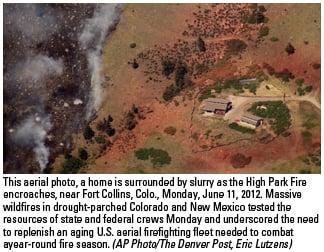
 Aggressive wildfires continue to burn through drought-parched terrain in Colorado and New Mexico, and federal officials expect that it will be months—or longer—before the fires are controlled.
On June 9, lightning ignited what has become the most destructive blaze in Colorado's history. Surpassing the 2010 fire above Boulder that destroyed 169 dwellings, the “High Park Fire” has already claimed one life and 248 properties (as of June 25), with property damage expected to grow.
The more than 600 firefighters tackling the High Park blaze have encountered their share of hurdles so far, including strong winds and searing heat. On June 10, they contended with yet another obstacle: meteors. Amid four separate reports of meteors, aerial firefighting resources were temporarily halted as a precautionary measure.
Meteorologist Scott Entrekin of the National Weather Service in Boulder told AP that these sightings “corresponded with reports of a possible meteor filed by the crews of two commercial aircrafts over Liberal, Kan.” Entrekin added that other sky sightings were reported in Raton, N.M.
As hundreds of displaced residents near Fort Collins anxiously await the fate of their homes, another fire broke out near Colorado Springs on June 23. Growing to more than three square miles by the next day, this newest blaze has prompted evacuation orders for 11,000 residents and an unknown number of tourists.
At last count, there were more than half a dozen wildfires burning in the state, and a total of 18 large wildfires burning in nine U.S. states. The U.S. Forest Service reports that more than 4,000 firefighters have been deployed, along with tankers and helicopters. The latter have been siphoning water from a reservoir and then deposited it on nearby homes.
 Wyoming diverted resources from two fires there to help with one wildfire in northern Colorado. Additionally, Canada reportedly lent two aerial bombers to fight the Colorado blaze following the recent crash of a U.S. tanker in Utah.
Meanwhile, firefighters in New Mexico obtained ground support to battle a fast-moving wildfire that charred tens of thousands of acres and forced hundreds of residents from their homes in the southern part of the state.
Progress against the largest wildfire in New Mexico's history has been slow. The blaze, which has charred 435 square miles of forest since it was sparked by lightning in mid-May, was 37-percent contained as of June 11, 2012.
Authorities express deep concern as both states brace themselves more scorching temperatures and high winds.
© Arc, All Rights Reserved. Request academic re-use from www.copyright.com. All other uses, submit a request to TMSalesOperations@arc-network.com. For more information visit Asset & Logo Licensing.